Which of the following international conventions have not been ratified by India ? 1. Employment Policy Convention 2. Abolition of Forced Labour Convention 3. International Convention on the Protection of the Rights of All Migrant Workers and Members of Their Families 4. Geneva Convention Relative to the Protection of Civilian Persons in Time of War 5. Convention on Reduction of Statelessness Select the answer using the code given below :

- A2 and 4
- B1 and 2
- C3 and 4 only
- D3, 4 and 5Correct
Explanation
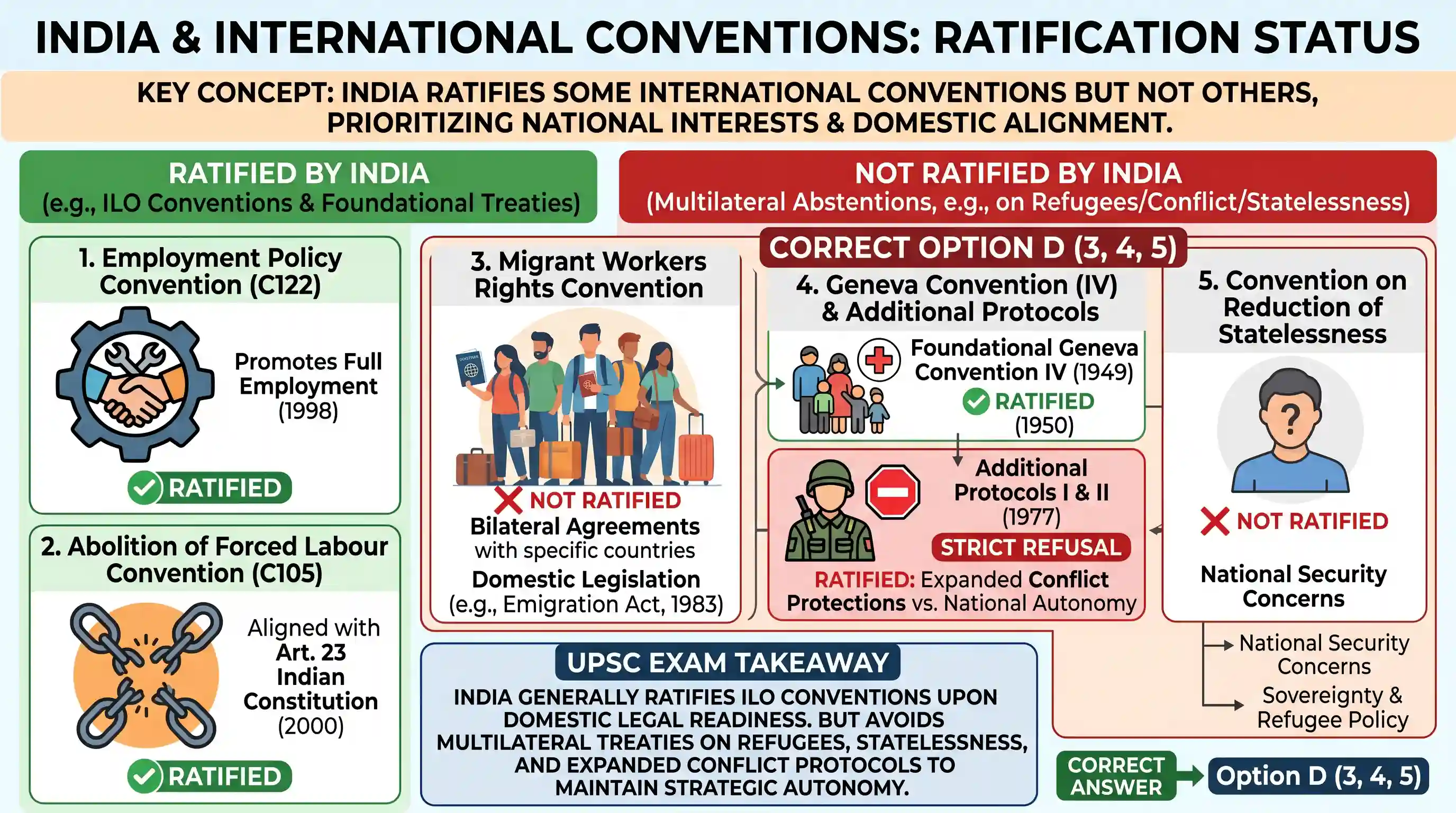
The question requires identifying the international conventions that India has not ratified. The official intended answer is Option D (3, 4, and 5).
Why Option D is correct:
- Statement 3 (Not Ratified): India is not a party to the UN International Convention on the Protection of the Rights of All Migrant Workers and Members of Their Families (1990). India manages migration via bilateral agreements and domestic legislation like the Emigration Act of 1983.
- Statement 4 (Not Ratified - Contextual Nuance): While India ratified the foundational 1949 Fourth Geneva Convention Relative to the Protection of Civilian Persons in Time of War on November 9, 1950, it firmly refuses to sign its 1977 Additional Protocols (Protocols I and II). These protocols expand the legal framework for civilian protection in armed conflicts. Standard exam questions routinely use this to test India's non-ratification of the expanded protocols, making Statement 4 the intended correct choice in this grouping.
- Statement 5 (Not Ratified): Citing national security and sovereignty, India has never ratified the 1961 Convention on the Reduction of Statelessness (nor the related 1954 Statelessness Convention and 1951 Refugee Convention).
Why the other options are incorrect: Options A, B, and C incorrectly include International Labour Organization (ILO) conventions that India has already ratified.
- Statement 1 (Ratified): India ratified the ILO Employment Policy Convention (Convention No. 122) on November 17, 1998, committing to active policies promoting full and productive employment.
- Statement 2 (Ratified): India ratified the core ILO Abolition of Forced Labour Convention (Convention No. 105) on May 18, 2000, bringing it in alignment with Article 23 of the Indian Constitution.
Takeaway: India willingly ratifies ILO conventions once domestic laws are aligned (currently ratifying 6 of 8 core ILO conventions). However, India consistently abstains from multilateral treaties on refugees, statelessness, and expanded armed conflict protocols to protect its strategic autonomy.
Related questions
More UPSC Prelims practice from the same subject and topic.
- Prelims 2026GS1polity
Mr. X, a senior officer, was overseeing a critical vaccination programme during a pandemic. He found that a private service provider responsible for vaccine distribution was compromising on quality to…
- Prelims 2026GS1polity
In a multi-ethnic district where both economic competition and historical grievances frequently led to community tensions, a flashpoint has arisen with a Government decision to allocate land for a was…
- Prelims 2026GS1polity
'X' was addressing a seminar on the meaning of the term 'law' as provided under Article 13, Part III of the Constitution of India. 'X' explained that the meaning of the term 'law' in the Constitution …
- Prelims 2026GS1polity
Consider the following statements with reference to the Constitution of India : 1. There is no Article in the Constitution of India that specifies that the Constitution of India will be officially cal…
- Prelims 2026GS1polity
Which of the following statements with regard to the persons with disabilities in India is/are correct ? 1. The Rights of Persons with Disabilities Act, an Act passed by the Parliament of India in 201…
- Prelims 2026GS1polity
Consider the following statements about the provisions pertaining to the Scheduled Castes and the Scheduled Tribes in India : 1. Provisions regarding the administration of the Tribal Areas in the Stat…