Which of the following statements with respect to the Revamped Rashtriya Gram Swaraj Abhiyan (RGSA) is/are correct? 1. The period of its implementation is 1st April, 2021 to 31st March, 2026. 2. The key objective of the Revamped RGSA is to develop the governance capabilities of the Panchayati Raj Institutions to deliver on the Sustainable Development Goals. 3. The share of the Central funding for the Revamped RGSA is 100% for all States and Union Territories. Select the answer using the code given below:

- A1 and 2
- B2 onlyCorrect
- C1 and 3
- D2 and 3
Explanation
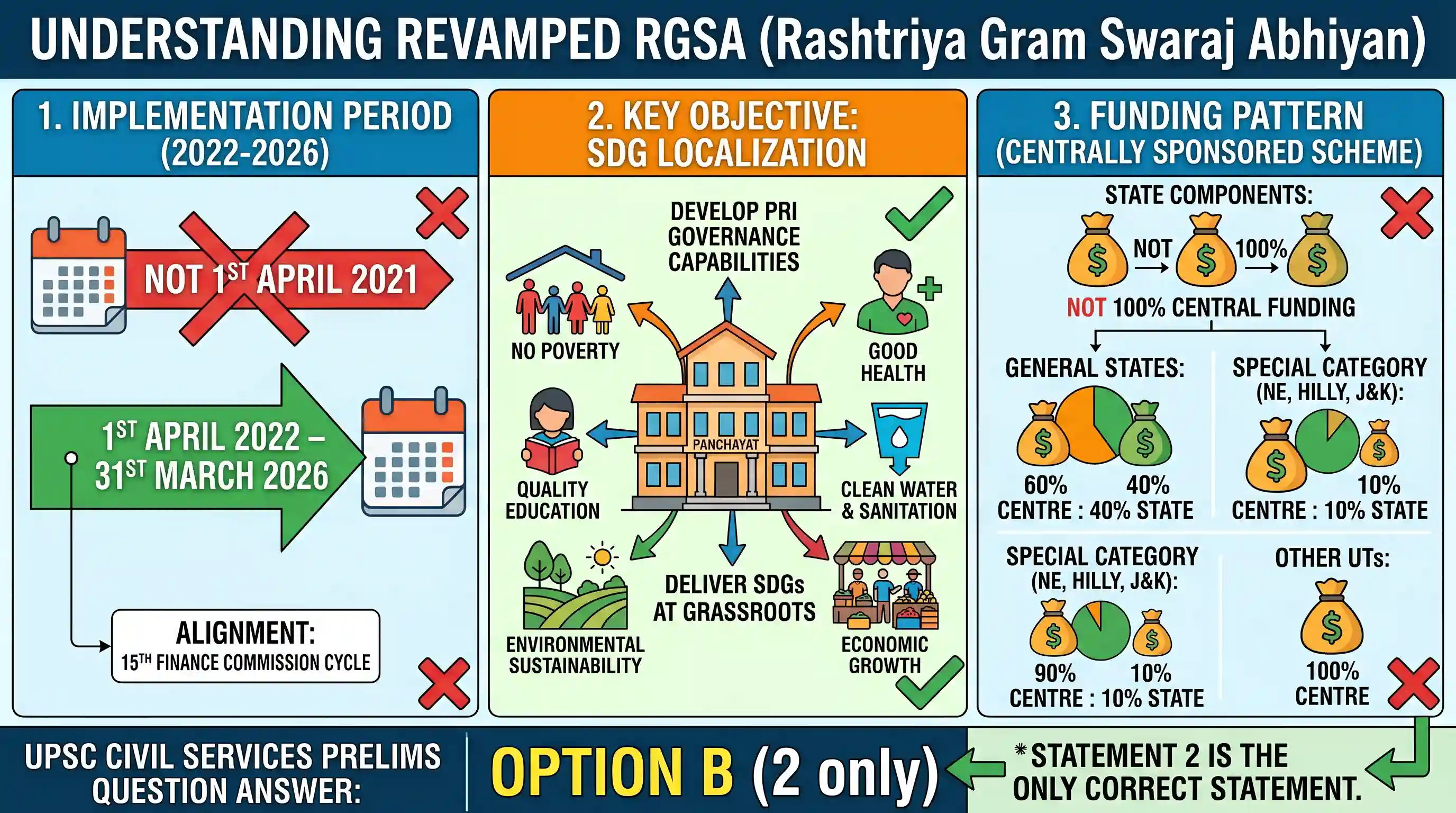
The correct answer is Option B (2 only).
Statement 1 is incorrect: The Revamped Rashtriya Gram Swaraj Abhiyan (RGSA) was approved by the Cabinet Committee on Economic Affairs for implementation from 1st April 2022 to 31st March 2026. This period is co-terminus with the 15th Finance Commission cycle; it did not commence in April 2021.
Statement 2 is correct: The primary objective of the Revamped RGSA is to reimagine Panchayati Raj Institutions (PRIs) as vibrant centers of local self-governance and economic growth. Its key goal is to develop their governance capabilities to deliver on the Sustainable Development Goals (SDGs). It emphasizes the "Localization of SDGs" at the grassroots level across nine thematic areas (e.g., poverty-free, healthy, and child-friendly villages).
Statement 3 is incorrect: The Revamped RGSA is a Centrally Sponsored Scheme comprising both Central and State components. While the Central component is fully funded by the Government of India, the State components follow a shared funding pattern. The ratio is 60:40 between the Centre and States for general category states. For North Eastern States, Hilly States, and the Union Territory of Jammu and Kashmir, it is 90:10. Only for other Union Territories is the Central share 100%.
Takeaway: Remember the Revamped RGSA by its alignment with the 15th Finance Commission (2022-2026) and its focus on SDG localization in Panchayats. Funding for Centrally Sponsored Schemes is rarely 100% for general states, usually defaulting to a 60:40 split.
Related questions
More UPSC Prelims practice from the same subject and topic.
- Prelims 2026GS1polity
Mr. X, a senior officer, was overseeing a critical vaccination programme during a pandemic. He found that a private service provider responsible for vaccine distribution was compromising on quality to…
- Prelims 2026GS1polity
In a multi-ethnic district where both economic competition and historical grievances frequently led to community tensions, a flashpoint has arisen with a Government decision to allocate land for a was…
- Prelims 2026GS1polity
'X' was addressing a seminar on the meaning of the term 'law' as provided under Article 13, Part III of the Constitution of India. 'X' explained that the meaning of the term 'law' in the Constitution …
- Prelims 2026GS1polity
Consider the following statements with reference to the Constitution of India : 1. There is no Article in the Constitution of India that specifies that the Constitution of India will be officially cal…
- Prelims 2026GS1polity
Which of the following statements with regard to the persons with disabilities in India is/are correct ? 1. The Rights of Persons with Disabilities Act, an Act passed by the Parliament of India in 201…
- Prelims 2026GS1polity
Consider the following statements about the provisions pertaining to the Scheduled Castes and the Scheduled Tribes in India : 1. Provisions regarding the administration of the Tribal Areas in the Stat…