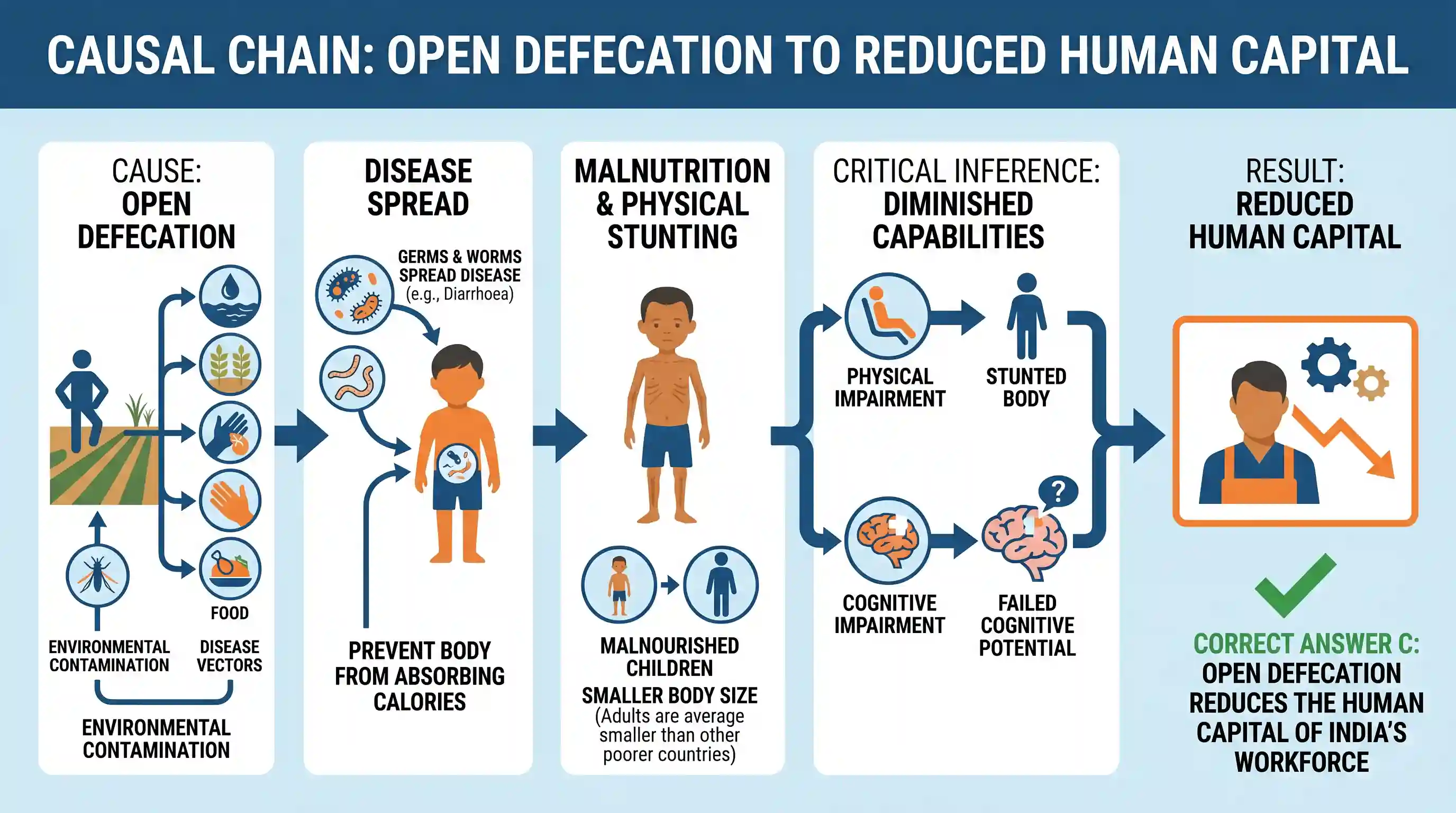
Open defecation is disastrous when practised in very densely populated areas, where it is impossible to keep away human faeces from crops, wells, food and children's hands. Groundwater is also contaminated by open defecation. Many ingested germs and worms spread diseases. They prevent the body from absorbing calories and nutrients. Nearly one-half of India's children remain malnourished. Lakhs of them die from preventable conditions. Diarrhoea leaves Indians' bodies smaller on average than those of people in some poorer countries where people eat fewer calories. Underweight mothers produce stunted babies prone to sickness who may fail to develop their full cognitive potential. The germs released into environment harm rich and poor alike, even those who use latrines. Which among the following is the most critical inference that can be made from the above passage?

- AThe Central and State governments in India do not have enough resources to afford a latrine for each household
- BOpen defecation is the most important public health problem of India
- COpen defecation reduces the human capital of India's workforceCorrect
- DOpen defecation is a public health problem in all developing countries.
Explanation
The passage details the severe consequences of open defecation, including malnutrition, preventable deaths, smaller body size, and most critically, stunted babies who "may fail to develop their full cognitive potential."
Let's analyze each option:
A) The Central and State governments in India do not have enough resources to afford a latrine for each household. This option discusses government resources, which are not mentioned or implied anywhere in the passage. The passage focuses on the impacts of open defecation, not the causes of its prevalence from a policy or resource perspective.
B) Open defecation is the most important public health problem of India. While the passage strongly emphasizes open defecation as a major public health problem with disastrous consequences in India, it does not compare it to all other public health problems to declare it "the most important." It highlights its severity, but not its comparative rank.
C) Open defecation reduces the human capital of India's workforce. The passage states that "Underweight mothers produce stunted babies prone to sickness who may fail to develop their full cognitive potential." Stunted physical growth and impaired cognitive development directly lead to a less healthy, less educated, and less productive future workforce. This reduction in the physical and mental capabilities of the population, particularly the future workforce, is precisely what "reduces human capital." This is a critical, long-term societal and economic inference drawn directly from the detailed consequences described.
D) Open defecation is a public health problem in all developing countries. The passage focuses specifically on India ("Nearly one-half of India's children remain malnourished," "Diarrhoea leaves Indians' bodies smaller"). While open defecation is indeed a problem in many developing countries, the passage provides no information to make a universal claim about "all" developing countries.
Conclusion: Option C is the most critical inference because it synthesizes the various health and developmental impacts (malnutrition, stunting, cognitive impairment) into a profound, long-term societal and economic consequence – the reduction of human capital, which is crucial for a nation's development. The passage explicitly links open defecation to factors that diminish the capabilities of the future workforce.
The final answer is C
Related questions
More UPSC Prelims practice from the same subject and topic.
- Prelims 2015CSATReading Comprehension
Human history abounds in claims and theories confining the right of governing to a few select citizens. Exclusion of the many is justified on the ground that human beings may be rightfully segregated …
- Prelims 2015CSATReading Comprehension
By 2050, the Earth's population will likely have swelled from seven to nine billion people. To fill all those stomachs while accounting for shifting consumption patterns, climate change, and a finite …
- Prelims 2015CSATReading Comprehension
Many people in India feel that if we cut our defence expenditure on weapon- building, we can create a climate of peace with our neighbours, subsequently reducing the conflict or creating a no- war sit…
- Prelims 2015CSATReading Comprehension
India accounts for nearly a fifth of the world's child deaths. In terms of numbers, it is the highest in the world - nearly 16 lakhs every year. Of these, more than half die in the first month of life…
- Prelims 2015CSATReading Comprehension
Foods travel more than the people who eat them. Grocery stores and supermarkets are loaded with preserved and processed foods. This, however, often leads to environmental threats, such as pollution ge…
- Prelims 2015CSATReading Comprehension
I must say that, beyond occasionally exposing me to laughter, my constitutional shyness has been of no disadvantage whatever. In fact I can see that, on the contrary, it has been all to my advantage. …