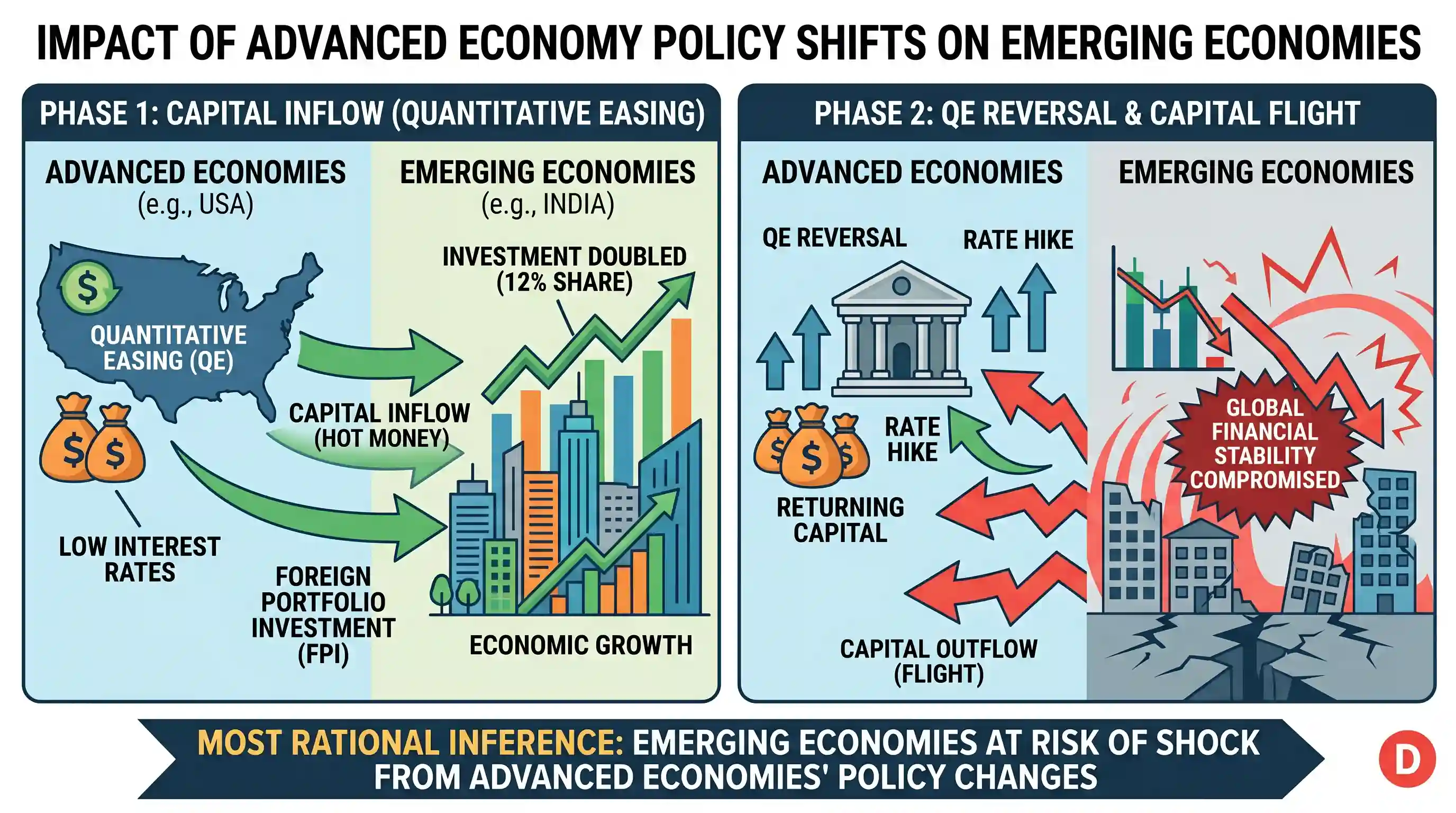
The Global Financial Stability Report finds that the share of portfolio investments from advanced economies in the total debt and equity investments in emerging economies has doubled in the past decade to 12 percent. The phenomenon has implications for Indian policy makers as foreign portfolio investments in the debt and equity markets have been on the rise. The phenomenon is also flagged as a threat that could compromise global financial stability in a chain reaction, in the event of United States Federal Reserve's imminent reversal of its "Quantitative Easing" policy. Which among the following is the most rational and critical inference that can be made from the above passage?

- AForeign portfolio investments are not good for emerging economies
- BAdvanced economies undermine the global financial stability
- CIndia should desist from accepting foreign portfolio investments in the future
- DEmerging economies are at a risk of shock from advanced economies.Correct
Explanation
The passage highlights that the increased foreign portfolio investments (FPI) from advanced economies into emerging economies, including India, are flagged as a threat to global financial stability. This threat is particularly acute in the event of the US Federal Reserve reversing its "Quantitative Easing" policy. A reversal of QE would likely lead to capital outflow from emerging economies back to advanced economies, causing market instability and economic shocks in the former.
Let's analyze the options:
A) Foreign portfolio investments are not good for emerging economies This statement is too absolute. The passage flags a risk associated with FPI under specific conditions (QE reversal), not that FPI is inherently bad or never beneficial. FPI can bring much-needed capital.
B) Advanced economies undermine the global financial stability The passage attributes the potential threat to the "phenomenon" of increased FPI and the policy action of the US Federal Reserve (an entity within an advanced economy), not to advanced economies as a whole inherently undermining stability. It's about specific capital flows and policy changes.
C) India should desist from accepting foreign portfolio investments in the future This is a prescriptive policy recommendation, which cannot be directly inferred from the passage. The passage states there are "implications for Indian policy makers," meaning they need to manage the situation, not necessarily stop all FPI.
D) Emerging economies are at a risk of shock from advanced economies. This is the most rational and critical inference. The passage explicitly states that the phenomenon (FPI from advanced economies to emerging economies) is a "threat that could compromise global financial stability in a chain reaction, in the event of United States Federal Reserve's imminent reversal of its 'Quantitative Easing' policy." This directly implies that policy changes in an advanced economy (like the US Fed's actions) can cause a significant shock to emerging economies that have received these investments.
The final answer is D
Related questions
More UPSC Prelims practice from the same subject and topic.
- Prelims 2015CSATReading Comprehension
Human history abounds in claims and theories confining the right of governing to a few select citizens. Exclusion of the many is justified on the ground that human beings may be rightfully segregated …
- Prelims 2015CSATReading Comprehension
By 2050, the Earth's population will likely have swelled from seven to nine billion people. To fill all those stomachs while accounting for shifting consumption patterns, climate change, and a finite …
- Prelims 2015CSATReading Comprehension
Many people in India feel that if we cut our defence expenditure on weapon- building, we can create a climate of peace with our neighbours, subsequently reducing the conflict or creating a no- war sit…
- Prelims 2015CSATReading Comprehension
India accounts for nearly a fifth of the world's child deaths. In terms of numbers, it is the highest in the world - nearly 16 lakhs every year. Of these, more than half die in the first month of life…
- Prelims 2015CSATReading Comprehension
Foods travel more than the people who eat them. Grocery stores and supermarkets are loaded with preserved and processed foods. This, however, often leads to environmental threats, such as pollution ge…
- Prelims 2015CSATReading Comprehension
I must say that, beyond occasionally exposing me to laughter, my constitutional shyness has been of no disadvantage whatever. In fact I can see that, on the contrary, it has been all to my advantage. …