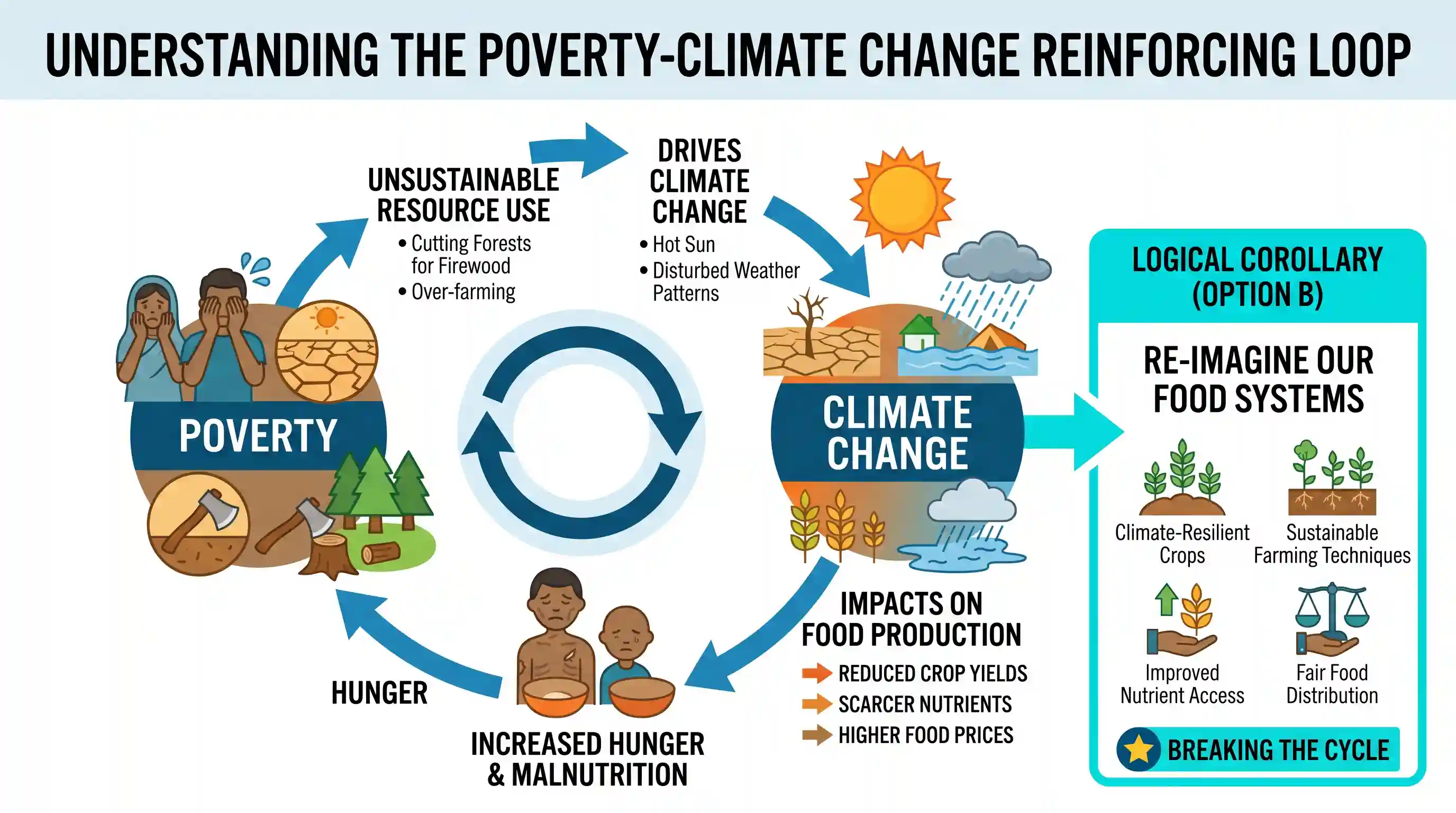
Climate change is already making many people hungry all over the world, by disrupting crop yields and pushing up prices. And it is not just food but nutrients that are becoming scarcer as the climate changes. It is the poorest communities that will suffer the worst effects of climate change, including increased hunger and malnutrition as crop production and livelihoods are threatened. On the other hand, poverty is a driver of climate change, as desperate communities resort to unsustainable use of resources to meet current needs. Which among the following is the most logical corollary to the above passage?

- AGovernment should allocate more funds to poverty alleviation programmes and increase food subsidies to the poor communities
- BPoverty and climate impacts reinforce each other and therefore we have to re-imagine our food systemsCorrect
- CAll the countries of the world must unite in fighting poverty and malnutrition and treat poverty as a global problem
- DWe must stop unsustainable agricultural practices immediately and control food prices.
Explanation
The passage clearly establishes a two-way relationship: climate change causes hunger and malnutrition, disproportionately affecting the poor, and conversely, poverty drives unsustainable resource use, exacerbating climate change. This highlights a reinforcing cycle.
Let's analyze the options:
A) Government should allocate more funds to poverty alleviation programmes and increase food subsidies to the poor communities. This is a valid intervention for some of the problems mentioned (poverty, hunger) but it doesn't capture the interconnectedness or the cyclical nature of the relationship between poverty and climate change as described in the passage. It's a partial solution, not the most logical corollary encompassing the full scope.
B) Poverty and climate impacts reinforce each other and therefore we have to re-imagine our food systems. This option perfectly captures the core message of the passage: "Poverty and climate impacts reinforce each other" directly reflects the mutual causation described. The passage extensively discusses disruptions to "crop yields," "food but nutrients that are becoming scarcer," and "hunger and malnutrition as crop production and livelihoods are threatened." Therefore, "re-imagine our food systems" is a direct and logical systemic response to address these interconnected challenges at their root.
C) All the countries of the world must unite in fighting poverty and malnutrition and treat poverty as a global problem. While true that poverty is a global problem, this option focuses only on poverty and malnutrition, largely omitting the crucial climate change aspect and the mutual reinforcement emphasized in the passage. It doesn't capture the full interplay.
D) We must stop unsustainable agricultural practices immediately and control food prices. The passage mentions "unsustainable use of resources" by desperate communities as a driver of climate change, but it primarily focuses on climate change disrupting crop yields and pushing up prices. While stopping unsustainable practices is important, this option doesn't fully capture the reinforcing cycle between poverty and climate change, nor does it encompass the broader implications for food and nutrient scarcity as comprehensively as option B. Controlling food prices is a symptom management, not addressing the systemic issue.
Therefore, option B is the most logical corollary as it accurately summarizes the reinforcing relationship between poverty and climate change and proposes a systemic solution that addresses the core mechanism of impact discussed in the passage.
Related questions
More UPSC Prelims practice from the same subject and topic.
- Prelims 2015CSATReading Comprehension
Human history abounds in claims and theories confining the right of governing to a few select citizens. Exclusion of the many is justified on the ground that human beings may be rightfully segregated …
- Prelims 2015CSATReading Comprehension
By 2050, the Earth's population will likely have swelled from seven to nine billion people. To fill all those stomachs while accounting for shifting consumption patterns, climate change, and a finite …
- Prelims 2015CSATReading Comprehension
Many people in India feel that if we cut our defence expenditure on weapon- building, we can create a climate of peace with our neighbours, subsequently reducing the conflict or creating a no- war sit…
- Prelims 2015CSATReading Comprehension
India accounts for nearly a fifth of the world's child deaths. In terms of numbers, it is the highest in the world - nearly 16 lakhs every year. Of these, more than half die in the first month of life…
- Prelims 2015CSATReading Comprehension
Foods travel more than the people who eat them. Grocery stores and supermarkets are loaded with preserved and processed foods. This, however, often leads to environmental threats, such as pollution ge…
- Prelims 2015CSATReading Comprehension
I must say that, beyond occasionally exposing me to laughter, my constitutional shyness has been of no disadvantage whatever. In fact I can see that, on the contrary, it has been all to my advantage. …