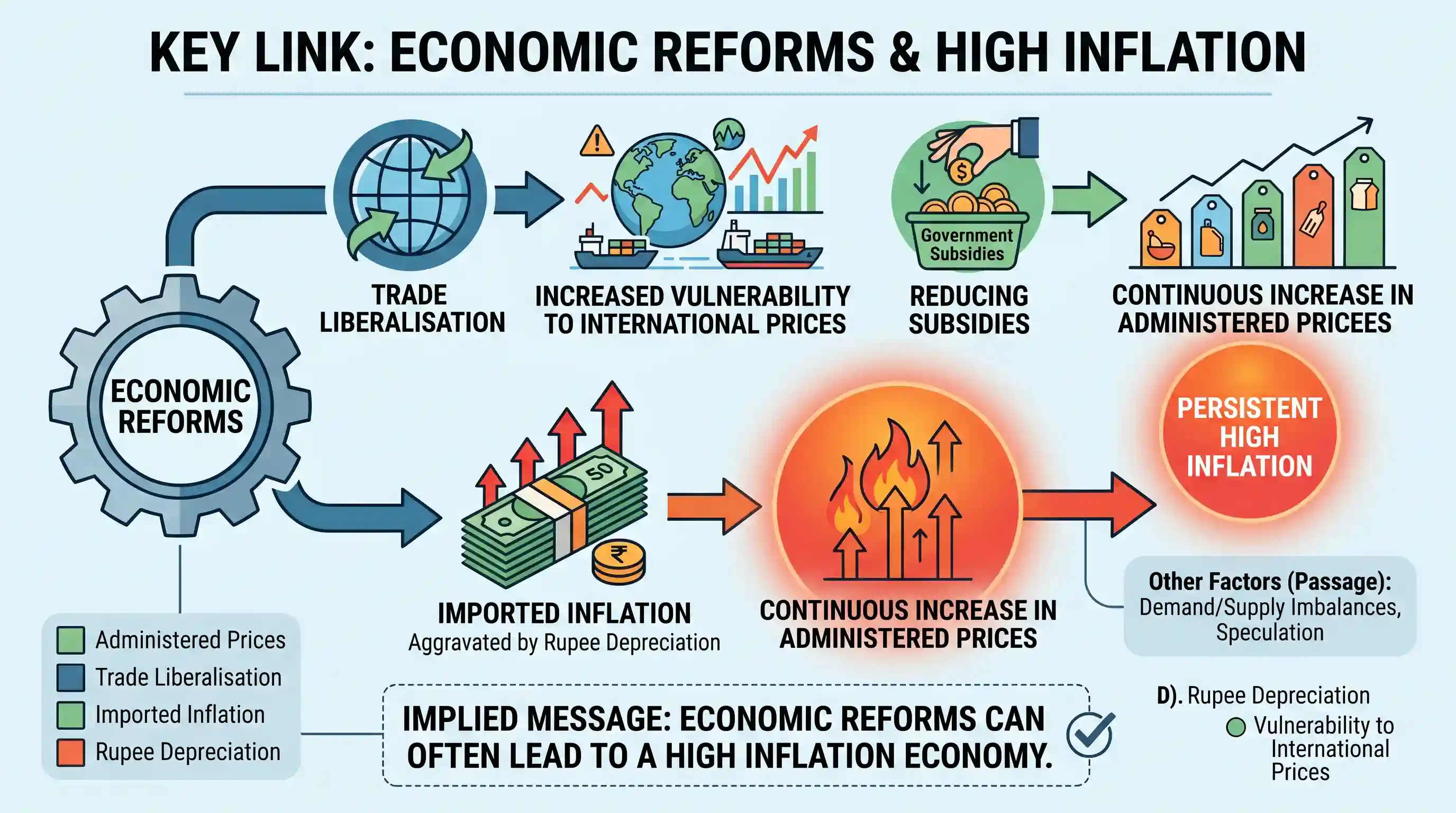
India has suffered from persistent high inflation. Increase in administered prices, demand and supply imbalances, imported inflation aggravated by rupee depreciation, and speculation - have combined to keep high inflation going. If there is an element common to all of them, it is that many of them are the outcomes of economic reforms. India's vulnerability to the effects of changes in international prices has increased with trade liberalisation. The effort to reduce subsidies has resulted in a continuous increase in the prices of commodities that are administered. What is the most logical, rational and crucial message that is implied in the above passage?

- AUnder the present circumstances, India should completely avoid all trade liberalisation policies and all subsidies
- BDue to its peculiar socio-economic situation, India is not yet ready for trade liberalisation process
- CThere is no solution in sight for the problems of continuing poverty and inflation in India in the near future
- DEconomic reforms can often high inflation economy.Correct
Explanation
The passage explicitly states that many of the factors contributing to persistent high inflation in India "are the outcomes of economic reforms." It provides examples like increased vulnerability due to trade liberalisation and price increases from efforts to reduce subsidies, both of which are economic reforms. Therefore, the most logical and crucial message is that economic reforms can often lead to or contribute to a high inflation economy.
A) This is an extreme and prescriptive solution not implied by the passage, which only points out a consequence of reforms, not that they should be completely avoided. B) The passage discusses the effects of trade liberalisation but does not make a judgment on India's readiness for the process due to its socio-economic situation. C) The passage focuses on inflation and its link to reforms, not on poverty or the lack of solutions for future problems. This is an overly broad and pessimistic conclusion not supported by the text. D) This option directly captures the central argument of the passage, which repeatedly links the causes of high inflation to the outcomes of economic reforms.
Related questions
More UPSC Prelims practice from the same subject and topic.
- Prelims 2015CSATReading Comprehension
Human history abounds in claims and theories confining the right of governing to a few select citizens. Exclusion of the many is justified on the ground that human beings may be rightfully segregated …
- Prelims 2015CSATReading Comprehension
By 2050, the Earth's population will likely have swelled from seven to nine billion people. To fill all those stomachs while accounting for shifting consumption patterns, climate change, and a finite …
- Prelims 2015CSATReading Comprehension
Many people in India feel that if we cut our defence expenditure on weapon- building, we can create a climate of peace with our neighbours, subsequently reducing the conflict or creating a no- war sit…
- Prelims 2015CSATReading Comprehension
India accounts for nearly a fifth of the world's child deaths. In terms of numbers, it is the highest in the world - nearly 16 lakhs every year. Of these, more than half die in the first month of life…
- Prelims 2015CSATReading Comprehension
Foods travel more than the people who eat them. Grocery stores and supermarkets are loaded with preserved and processed foods. This, however, often leads to environmental threats, such as pollution ge…
- Prelims 2015CSATReading Comprehension
I must say that, beyond occasionally exposing me to laughter, my constitutional shyness has been of no disadvantage whatever. In fact I can see that, on the contrary, it has been all to my advantage. …