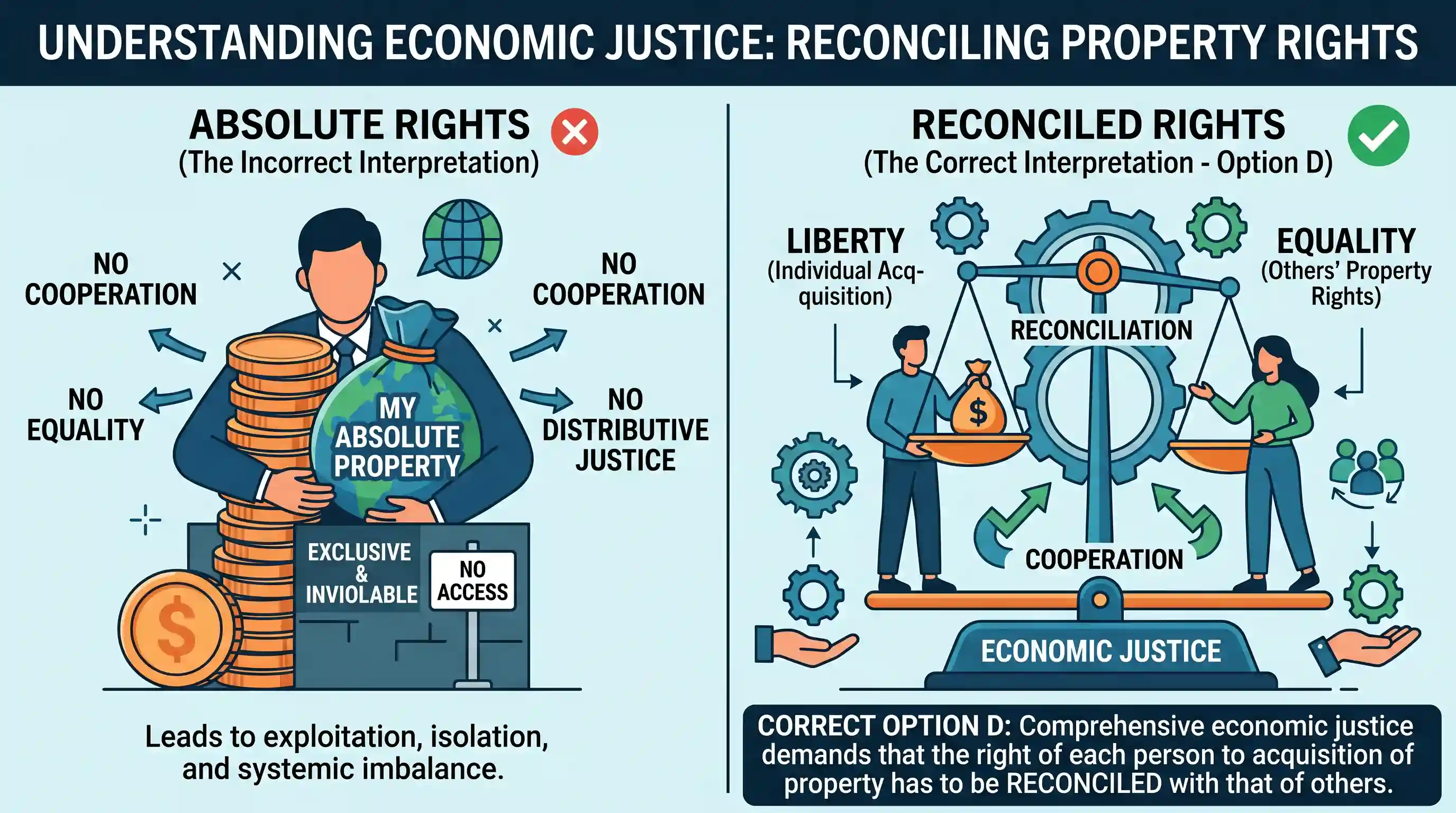
No Right is absolute, exclusive or inviolable. The Right of personal property, similarly, has to be perceived in the larger context of its assumed legitimacy. The Right of personal property should unite the principle of liberty with that of equality, and both with the principle of cooperation. In the light of the argument in the above passage, which one of the following statements is the most convincing explanation?

- AThe Right of personal property is a Natural Right duly supported by statutes and scriptures
- BPersonal property is a theft and an instrument of exploitation. The Right of personal property is therefore violative of economic justice
- CThe Right of personal property is violative of distributive justice and negates the principle of cooperation
- DThe comprehensive idea of economic justice demands that the Right of each person to acquisition of property has to be reconciled with that of others.Correct
Explanation
Explanation:
The passage argues that no right, including personal property, is absolute. It must be viewed in a larger context and should integrate liberty, equality, and cooperation. This implies a need for balance and mutual consideration rather than an absolute individual claim.
Analyzing the options:
A) The Right of personal property is a Natural Right duly supported by statutes and scriptures. This contradicts the passage's opening statement that "No Right is absolute, exclusive or inviolable." The passage questions the absolute nature of rights, including property, rather than affirming it as an unqualified natural right. It also does not mention statutes or scriptures.
B) Personal property is a theft and an instrument of exploitation. The Right of personal property is therefore violative of economic justice. This is an extreme interpretation not supported by the passage. The passage does not condemn personal property as theft or exploitation. Instead, it seeks to perceive and frame the right in a way that unites liberty, equality, and cooperation, implying a reform or contextualization of the right, not its abolition or condemnation.
C) The Right of personal property is violative of distributive justice and negates the principle of cooperation. Similar to B, this is too strong and negative. The passage states that the right "should unite" with equality and cooperation, not that it inherently violates justice or negates cooperation. It calls for a reconciliation, not an inherent conflict.
D) The comprehensive idea of economic justice demands that the Right of each person to acquisition of property has to be reconciled with that of others. This statement perfectly encapsulates the essence of the passage.
- "No Right is absolute, exclusive or inviolable" implies limits and the need for reconciliation.
- "perceived in the larger context of its assumed legitimacy" suggests that individual property rights must be considered within a broader societal framework.
- "should unite the principle of liberty with that of equality, and both with the principle of cooperation" directly supports the idea of reconciling individual acquisition (liberty) with the rights and needs of others (equality and cooperation). This reconciliation is fundamental to a comprehensive idea of economic justice.
The final answer is D.
Related questions
More UPSC Prelims practice from the same subject and topic.
- Prelims 2015CSATReading Comprehension
Human history abounds in claims and theories confining the right of governing to a few select citizens. Exclusion of the many is justified on the ground that human beings may be rightfully segregated …
- Prelims 2015CSATReading Comprehension
By 2050, the Earth's population will likely have swelled from seven to nine billion people. To fill all those stomachs while accounting for shifting consumption patterns, climate change, and a finite …
- Prelims 2015CSATReading Comprehension
Many people in India feel that if we cut our defence expenditure on weapon- building, we can create a climate of peace with our neighbours, subsequently reducing the conflict or creating a no- war sit…
- Prelims 2015CSATReading Comprehension
India accounts for nearly a fifth of the world's child deaths. In terms of numbers, it is the highest in the world - nearly 16 lakhs every year. Of these, more than half die in the first month of life…
- Prelims 2015CSATReading Comprehension
Foods travel more than the people who eat them. Grocery stores and supermarkets are loaded with preserved and processed foods. This, however, often leads to environmental threats, such as pollution ge…
- Prelims 2015CSATReading Comprehension
I must say that, beyond occasionally exposing me to laughter, my constitutional shyness has been of no disadvantage whatever. In fact I can see that, on the contrary, it has been all to my advantage. …