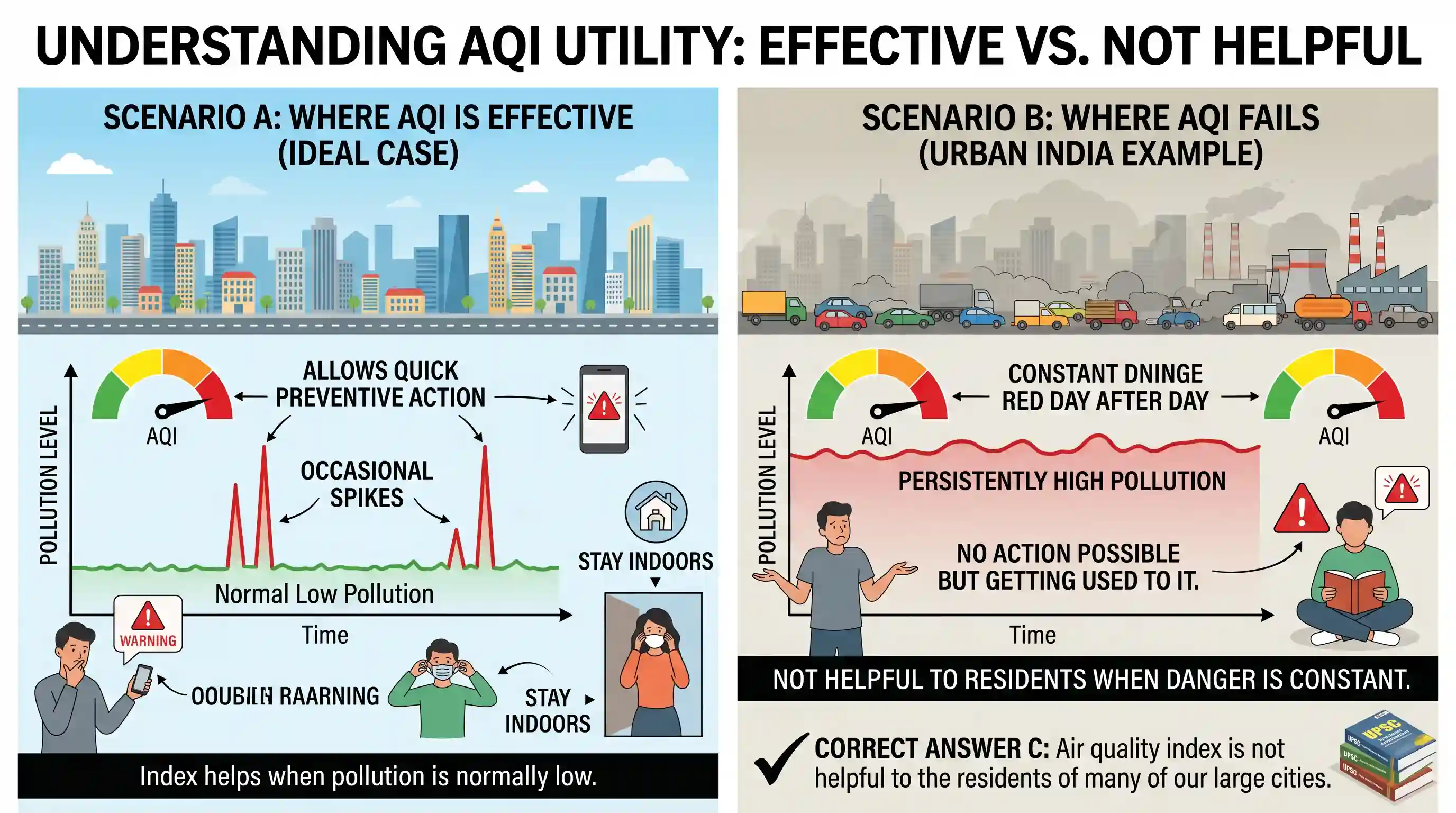
An air quality index (AQI) is a way to combine measurements of multiple air pollutants into a single number or rating. This index is ideally kept constantly updated and available in different places. The AQI is most useful when lots of pollution data are being gathered and when pollution levels are normally, but not always, low. In such cases, if pollution levels spike for a few days, the public can quickly take preventive action (like staying indoors) in response to an air quality warning. Unfortunately, that is not urban India. Pollution levels in many large Indian cities are so high that they remain well above any health or regulatory standard for large part of the year. If our index stays in the Red/Dangerous' region day after day, there is not much any one can do, other than getting used to ignoring it. Which among the following is the most logical and rational inference that can be made from the above passage?

- AOur governments are not responsible enough to keep our cities pollution free
- BThere is absolutely no need for air quality indices in our country
- CAir quality index is not helpful to the residents of many of our large citiesCorrect
- DIn every city, public awareness about pollution problems should increase.
Explanation
The passage explains that an Air Quality Index (AQI) is most useful when pollution levels are normally low but occasionally spike, allowing the public to take quick preventive action. However, it states that in many large Indian cities, pollution levels are constantly high, remaining in the "Red/Dangerous" region day after day. In such a scenario, the passage concludes, "there is not much any one can do, other than getting used to ignoring it."
Let's analyze each option:
A) Our governments are not responsible enough to keep our cities pollution free: The passage describes the state of pollution and the utility of AQI, but it does not directly make an inference about government responsibility or lack thereof. While government action is related to pollution, this statement goes beyond the direct scope of the passage's argument about AQI's usefulness.
B) There is absolutely no need for air quality indices in our country: This is too strong a generalization. The passage specifically talks about "many large Indian cities" where the AQI's utility is diminished. It doesn't imply that AQI is useless everywhere in the country, for instance, in areas where pollution levels might fluctuate more or be lower.
C) Air quality index is not helpful to the residents of many of our large cities: This directly aligns with the passage's main point about urban India. The passage states that when the index is constantly in the "Red/Dangerous" region, people cannot take specific preventive action and get used to ignoring it. This implies that the AQI, in its intended role of prompting action based on warnings, loses its helpfulness in such persistent high-pollution environments. This is the most logical inference from the provided text.
D) In every city, public awareness about pollution problems should increase: The passage implies that residents in these cities are already aware of the high pollution (it's "Red/Dangerous" day after day). The problem isn't a lack of awareness, but a lack of actionable information or effective response options when pollution is perpetually high. Therefore, increasing awareness isn't the primary inference about the AQI's utility.
The final answer is C.
Related questions
More UPSC Prelims practice from the same subject and topic.
- Prelims 2017CSATReading Comprehension
Disruption of traditional institutions, identifications and loyalties is likely to lead to ambivalent situations. It is possible that some people may renew their identification with traditional groups…
- Prelims 2017CSATReading Comprehension
Disruption of traditional institutions, identifications and loyalties is likely to lead to ambivalent situations. It is possible that some people may renew their identification with traditional groups…
- Prelims 2017CSATReading Comprehension
We live in digital times. The digital is not just something we use strategically and specifically to do a few tasks. Our very perception of who we are, how we connect to the world around us, and the w…
- Prelims 2017CSATReading Comprehension
The IMF has pointed out that the fast growing economies of Asia face the risk of falling into 'middle-income trap'. It means that average incomes in these countries, which till now have been growing r…
- Prelims 2017CSATReading Comprehension
An innovative India will be inclusive as well as technologically advanced, improving the lives of all Indians. Innovation and R&D can mitigate increases in social inequality and relieve the pressures …
- Prelims 2017CSATReading Comprehension
Climate change is likely to expose a large number of people to increasing environmental risks forcing them to migrate. The international community is yet to recognize this new category of migrants. Th…