Productive jobs are vital for growth and a good lob is the best form of inclusion. More than half of our population depends on agriculture, but the experience of other countries suggests that the number of people dependent on agriculture will have to shrink if per capita incomes in agriculture are to go up substantially. While industry is creating jobs, too many such jobs are low-productivity non-contractual jobs in the unorganized sector, offering low incomes, little protection, and no benefits. Service jobs are relatively of high productivity, but employment growth in services has been slow in recent years. Which among the following is the most logical and rational inference that can be made from the above passage?

- AWe must create conditions for the faster growth of highly productive service jobs to ensure employment growth and inclusionCorrect
- BWe must shift the farm workers to the highly productive manufacturing and service sectors to ensure the economic growth and inclusion
- CWe must create conditions for the faster growth of productive jobs outside of agriculture even while improving the productivity of agriculture
- DWe must emphasize the cultivation of high-yielding hybrid varieties and genetically modified crops to increase the per capita income in agriculture.
Explanation
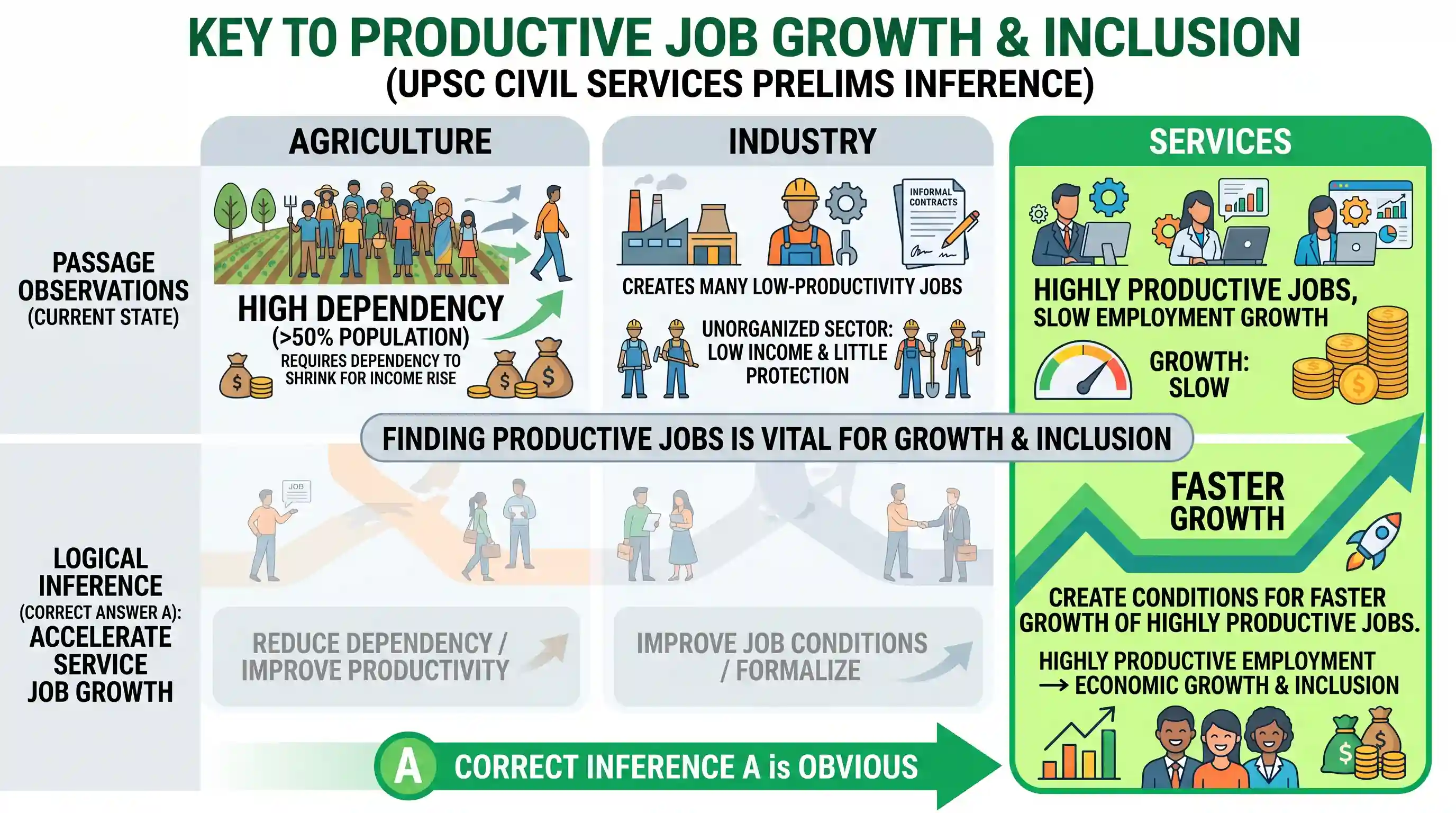
The passage highlights the importance of "productive jobs" for growth and inclusion. It then analyzes three sectors:
- Agriculture: Too many people depend on it; per capita income will only rise if dependency shrinks.
- Industry: Creates jobs, but many are "low-productivity," offering poor conditions.
- Services: Jobs are "relatively of high productivity," but "employment growth... has been slow."
Let's analyze each option:
A) We must create conditions for the faster growth of highly productive service jobs to ensure employment growth and inclusion. * The passage explicitly states that "Service jobs are relatively of high productivity." * It also notes that "employment growth in services has been slow in recent years." * Given that "Productive jobs are vital for growth and a good job is the best form of inclusion," and services are the only sector explicitly identified as having "high productivity" jobs, the most direct and logical inference is to address the bottleneck in this sector, which is slow growth. This option directly leverages an existing strength (high productivity) and addresses its weakness (slow growth).
B) We must shift the farm workers to the highly productive manufacturing and service sectors to ensure the economic growth and inclusion. * While shifting workers from agriculture is implied, the passage explicitly states that many industrial jobs are "low-productivity." Therefore, assuming "highly productive manufacturing" as a general destination for farm workers contradicts the passage's description of industry.
C) We must create conditions for the faster growth of productive jobs outside of agriculture even while improving the productivity of agriculture. * This is a comprehensive and generally sound policy statement. It covers the need for productive non-agricultural jobs (which includes services and improved industrial jobs) and also addresses the need to improve agriculture itself. * However, compared to option A, it is more general. The passage specifically identifies services as already having "high productivity" jobs, but suffering from "slow growth." Option A is a more direct and specific inference from this particular observation, focusing on leveraging an existing strength. The passage highlights a specific opportunity in services that is not being fully realized.
D) We must emphasize the cultivation of high-yielding hybrid varieties and genetically modified crops to increase the per capita income in agriculture. * This option is too specific. While increasing agricultural productivity is implied as necessary for per capita income to rise, the passage does not specify how to achieve this (e.g., through HYV or GM crops). It goes beyond the scope of the passage's explicit statements.
Conclusion: Option A is the most logical and rational inference because the passage explicitly identifies service jobs as "high productivity" (meeting the core requirement for "productive jobs") but notes their "slow growth." Therefore, fostering faster growth in this specific sector is a direct and highly logical solution derived from the passage's own characterization of the problem and opportunity.
The final answer is A.
Related questions
More UPSC Prelims practice from the same subject and topic.
- Prelims 2017CSATReading Comprehension
Disruption of traditional institutions, identifications and loyalties is likely to lead to ambivalent situations. It is possible that some people may renew their identification with traditional groups…
- Prelims 2017CSATReading Comprehension
Disruption of traditional institutions, identifications and loyalties is likely to lead to ambivalent situations. It is possible that some people may renew their identification with traditional groups…
- Prelims 2017CSATReading Comprehension
We live in digital times. The digital is not just something we use strategically and specifically to do a few tasks. Our very perception of who we are, how we connect to the world around us, and the w…
- Prelims 2017CSATReading Comprehension
The IMF has pointed out that the fast growing economies of Asia face the risk of falling into 'middle-income trap'. It means that average incomes in these countries, which till now have been growing r…
- Prelims 2017CSATReading Comprehension
An innovative India will be inclusive as well as technologically advanced, improving the lives of all Indians. Innovation and R&D can mitigate increases in social inequality and relieve the pressures …
- Prelims 2017CSATReading Comprehension
Climate change is likely to expose a large number of people to increasing environmental risks forcing them to migrate. The international community is yet to recognize this new category of migrants. Th…