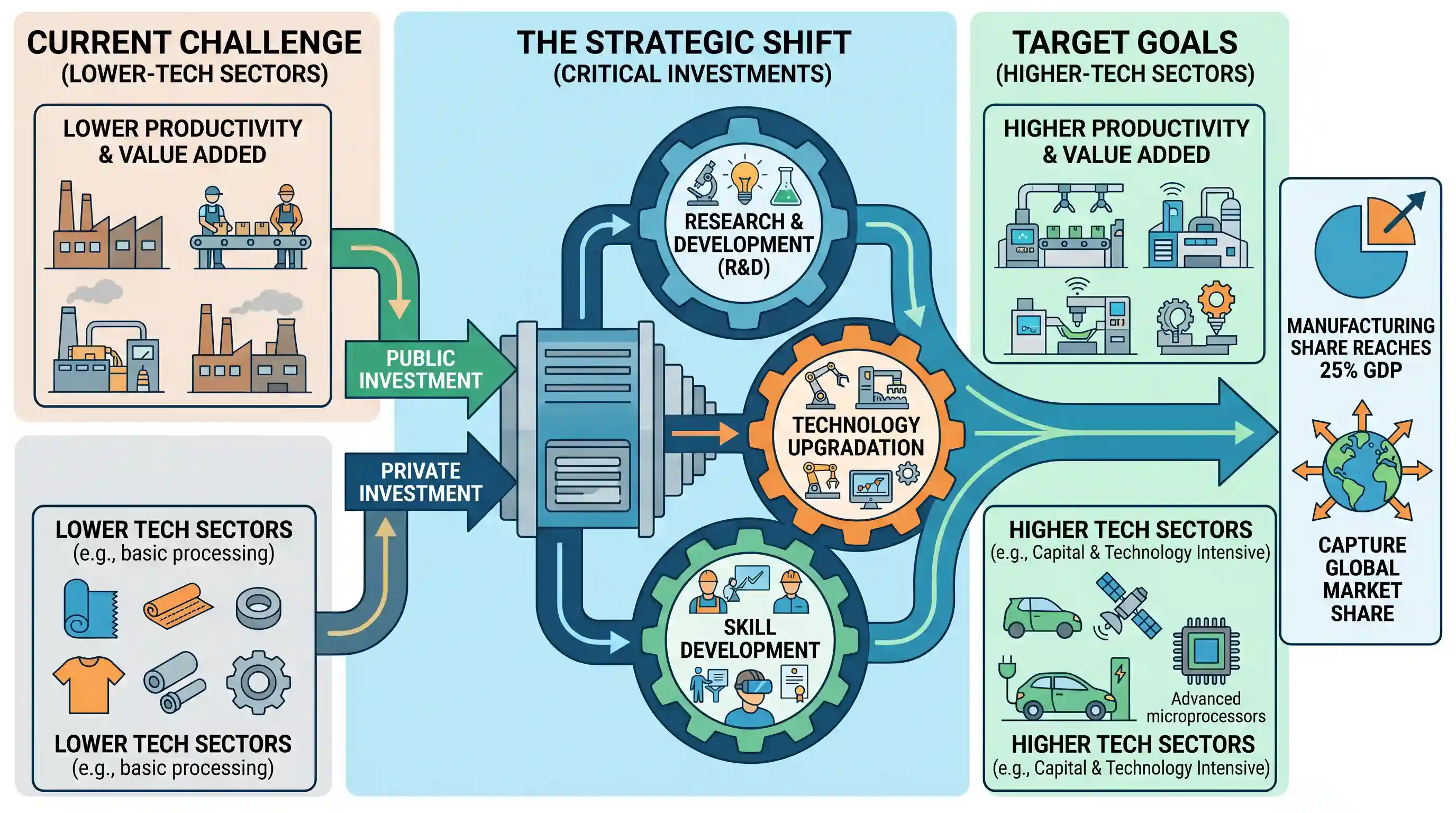
The medium term challenge for Indian manufacturing is to move from lower to higher tech sectors, from lower to higher value-added sectors, and from lower to higher productivity sectors. Medium tech industries are primarily capital intensive and resource processing; and high tech industries are mainly capital and technology intensive. In order to push the share of manufacturing in overall GDP to the projected 25 per cent, Indian manufacturing needs to capture the global market in sectors showing a rising trend in demand. These sectors are largely high technology and capital intensive. Which among the following is the most logical and rational inference that can be made from the above passage?

- AIndia's GDP displays high value-added and high productivity levels in medium tech and resource processing industries
- BPromotion of capital and technology intensive manufacturing is not possible in India
- CIndia should push up the public investments and encourage the private investments in research and development, technology upgradation and skill developmentCorrect
- DIndia has already gained a great share in global markets in sectors showing a rising trend in demand.
Explanation
The passage outlines a medium-term challenge for Indian manufacturing: to transition from lower to higher tech, value-added, and productivity sectors, specifically targeting high technology and capital intensive sectors to capture global market share.
Let's analyze each option:
A) India's GDP displays high value-added and high productivity levels in medium tech and resource processing industries. This is incorrect. The passage states that India needs to move from lower to higher tech, value-added, and productivity sectors. This implies that the current state, especially in medium tech and resource processing, is not characterized by high value-added and high productivity.
B) Promotion of capital and technology intensive manufacturing is not possible in India. This is incorrect. The passage explicitly states that the goal is for Indian manufacturing to capture the global market in sectors that are "largely high technology and capital intensive." This indicates that promoting such manufacturing is not only possible but also a strategic imperative.
C) India should push up the public investments and encourage the private investments in research and development, technology upgradation and skill development. This is the most logical inference. To move to "higher tech sectors," "higher value-added sectors," "higher productivity sectors," and to capture global markets in "high technology and capital intensive" sectors, significant investments are required. Research and development (R&D) is crucial for developing high technology, technology upgradation is essential for moving up the value chain, and skill development is necessary for a workforce capable of operating in high-tech, high-productivity environments. Both public and private investments are typically needed for such large-scale strategic shifts. This option provides the concrete steps necessary to achieve the goals outlined in the passage.
D) India has already gained a great share in global markets in sectors showing a rising trend in demand. This is incorrect. The passage states that "Indian manufacturing needs to capture the global market in sectors showing a rising trend in demand." The phrase "needs to capture" implies that this is a future goal, not an already achieved status.
Therefore, option C provides the most logical and rational actions required to address the challenges and achieve the goals presented in the passage.
Related questions
More UPSC Prelims practice from the same subject and topic.
- Prelims 2017CSATReading Comprehension
Disruption of traditional institutions, identifications and loyalties is likely to lead to ambivalent situations. It is possible that some people may renew their identification with traditional groups…
- Prelims 2017CSATReading Comprehension
Disruption of traditional institutions, identifications and loyalties is likely to lead to ambivalent situations. It is possible that some people may renew their identification with traditional groups…
- Prelims 2017CSATReading Comprehension
We live in digital times. The digital is not just something we use strategically and specifically to do a few tasks. Our very perception of who we are, how we connect to the world around us, and the w…
- Prelims 2017CSATReading Comprehension
The IMF has pointed out that the fast growing economies of Asia face the risk of falling into 'middle-income trap'. It means that average incomes in these countries, which till now have been growing r…
- Prelims 2017CSATReading Comprehension
An innovative India will be inclusive as well as technologically advanced, improving the lives of all Indians. Innovation and R&D can mitigate increases in social inequality and relieve the pressures …
- Prelims 2017CSATReading Comprehension
Climate change is likely to expose a large number of people to increasing environmental risks forcing them to migrate. The international community is yet to recognize this new category of migrants. Th…