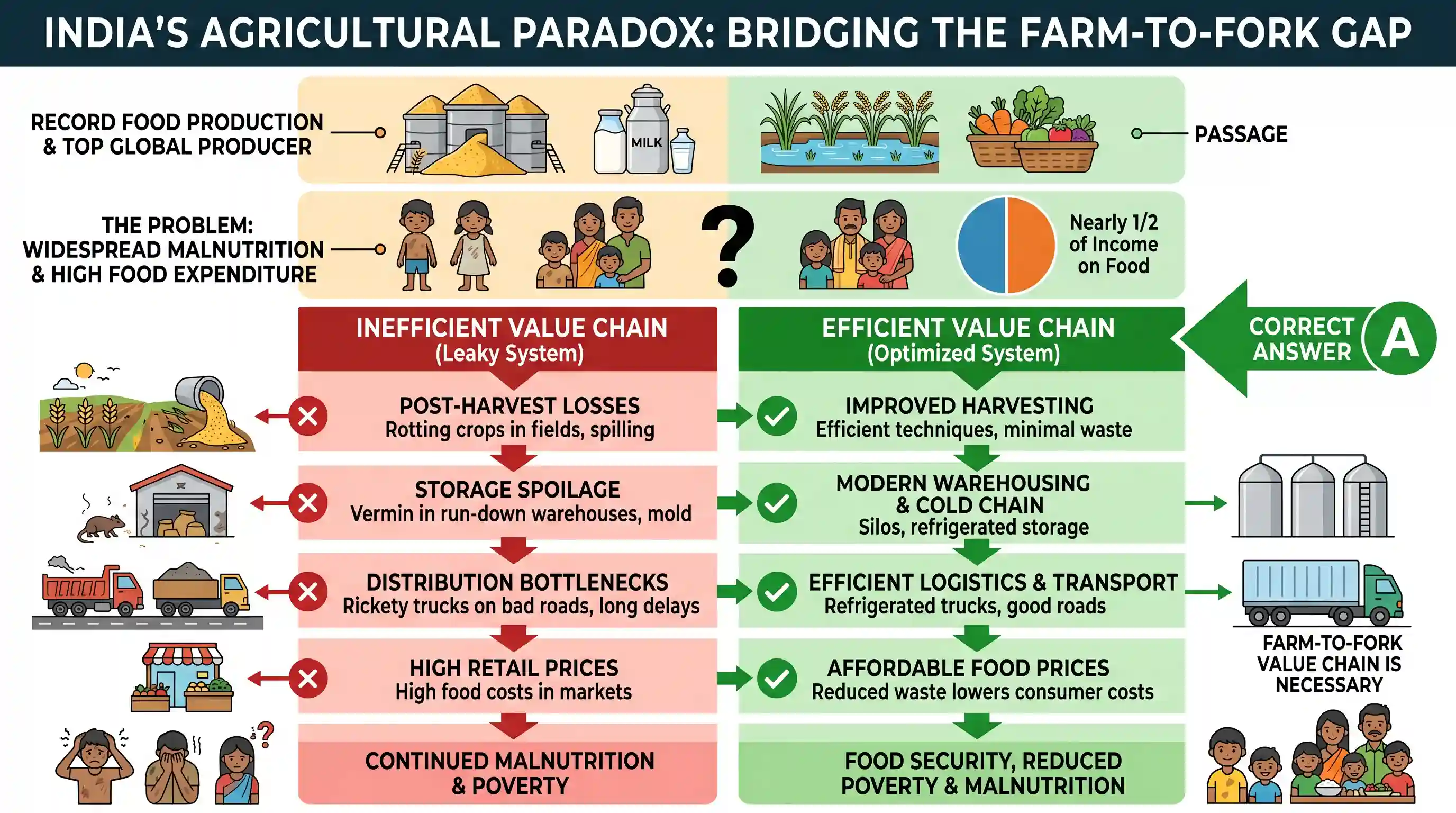
Over the last decade, Indian agriculture has become more robust with record production of food grains and oilseeds. Increased procurement, consequently, has added huge of food grains in the granaries. India is one of the world's top producers of rice, wheat, milk, fruits and vegetables. India is still home of undernourished people in the world. On an average, almost half of the total expenditure of nearly half of the households is on food. Which among the following is the most logical corollary to the above passage?

- AIncreasing the efficiency of farm to-fork value chain is necessary to reduce the poverty and malnutritionCorrect
- BIncreasing the agricultural productivity will automatically eliminate the poverty and malnutrition in India
- CIndia's agricultural productivity is already great and it is not necessary to increase it further
- DAllocation of more funds for social welfare and poverty alleviation programmes will ultimately eliminate the poverty and malnutrition in India.
Explanation
The passage highlights a paradox: India has record food production and huge granary stocks, ranking among the top producers globally, yet it still houses many undernourished people, and nearly half of households spend almost half their income on food.
Let's analyze the options:
A) Increasing the efficiency of farm-to-fork value chain is necessary to reduce the poverty and malnutrition. This option directly addresses the paradox. If food is abundant but people are undernourished and spend a lot on food, it implies inefficiencies in getting the food from where it's produced to the consumers. An efficient farm-to-fork value chain reduces post-harvest losses, improves storage, transportation, processing, and distribution, making food more accessible, affordable, and reducing waste. This would directly combat malnutrition and free up household income, thus reducing poverty. This is a logical corollary to the problem presented.
B) Increasing the agricultural productivity will automatically eliminate the poverty and malnutrition in India. The passage states India already has "record production" and is a "top producer." The problem isn't necessarily a lack of production, but rather access and affordability despite high production. Therefore, simply increasing productivity further won't "automatically" solve the problem if the distribution and access issues persist.
C) India's agricultural productivity is already great and it is not necessary to increase it further. While the passage mentions high production, it doesn't conclude that productivity is "great" or that further increases are "not necessary." The core issue highlighted is the disparity between production and nutrition, not the absolute level of productivity. This option doesn't offer a solution to the problem presented.
D) Allocation of more funds for social welfare and poverty alleviation programmes will ultimately eliminate the poverty and malnutrition in India. While social welfare programs are important, the passage specifically points to a situation where food is available in abundance. The issue seems to be systemic inefficiencies in the food system itself, rather than just a general lack of funds for welfare. An efficient value chain (Option A) addresses the root cause of food access and affordability more directly given the context of abundant production.
Conclusion: Option A is the most logical corollary because it offers a solution that directly addresses the central contradiction presented in the passage: abundant food supply coexisting with widespread malnutrition and high food expenditure. Improving the efficiency of the food supply chain would bridge this gap.
Related questions
More UPSC Prelims practice from the same subject and topic.
- Prelims 2017CSATReading Comprehension
Disruption of traditional institutions, identifications and loyalties is likely to lead to ambivalent situations. It is possible that some people may renew their identification with traditional groups…
- Prelims 2017CSATReading Comprehension
Disruption of traditional institutions, identifications and loyalties is likely to lead to ambivalent situations. It is possible that some people may renew their identification with traditional groups…
- Prelims 2017CSATReading Comprehension
We live in digital times. The digital is not just something we use strategically and specifically to do a few tasks. Our very perception of who we are, how we connect to the world around us, and the w…
- Prelims 2017CSATReading Comprehension
The IMF has pointed out that the fast growing economies of Asia face the risk of falling into 'middle-income trap'. It means that average incomes in these countries, which till now have been growing r…
- Prelims 2017CSATReading Comprehension
An innovative India will be inclusive as well as technologically advanced, improving the lives of all Indians. Innovation and R&D can mitigate increases in social inequality and relieve the pressures …
- Prelims 2017CSATReading Comprehension
Climate change is likely to expose a large number of people to increasing environmental risks forcing them to migrate. The international community is yet to recognize this new category of migrants. Th…