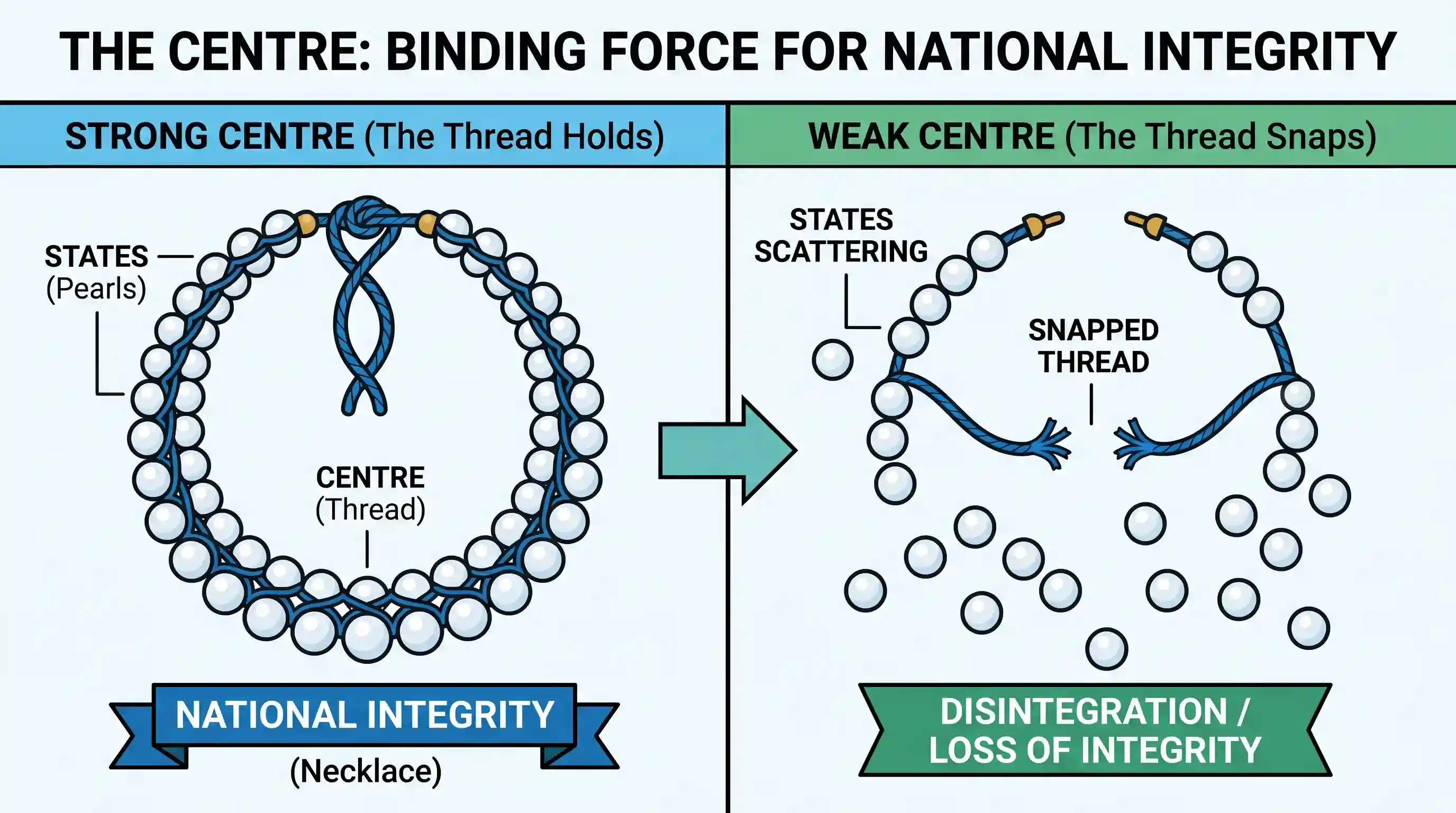
The States are like pearls and the Centre is the thread which turns them into a necklace; if the read snaps, the pearls are scattered. Which one of the following views corroborates the above statement?

- AA strong Centre and strong States make the federation strong
- BA strong Centre is a binding force for national integrityCorrect
- CA strong Centre is a hindrance to State autonomy
- DState autonomy is a prerequisite for a federation.
Explanation
The statement emphasizes the critical role of the Centre (the "thread") in holding together the States (the "pearls") to form a unified whole (the "necklace"). If the Centre's binding force is lost ("thread snaps"), the States would scatter, implying a loss of national unity and integrity.
Let's analyze the options:
A) A strong Centre and strong States make the federation strong This option describes an ideal balance in a federation. While generally true, the original statement focuses specifically on the Centre's role in preventing disintegration (scattering of pearls), not just general strength through balanced power.
B) A strong Centre is a binding force for national integrity This option perfectly corroborates the statement. The "thread" represents the "binding force," and the "necklace" represents the "nation." If the thread snaps and pearls scatter, it signifies a loss of "national integrity." Therefore, a strong Centre is crucial for maintaining national integrity by binding the states together.
C) A strong Centre is a hindrance to State autonomy This option presents a negative perspective on a strong Centre, suggesting it curtails state powers. The original statement, however, highlights the Centre's positive and essential role in maintaining unity, not its potential negative impact on autonomy. The concern is about scattering, not about central overreach.
D) State autonomy is a prerequisite for a federation. This option defines a characteristic of a federation. While federations do involve autonomous states, the statement's concern is about what happens if the Centre fails to hold the units together, leading to disunity. It's about maintaining the existing structure's integrity, not about the initial conditions for forming a federation.
The final answer is B because the statement's core message is about the Centre's indispensable role in preventing the disintegration of the nation by binding its constituent units, which directly translates to being a binding force for national integrity.
Related questions
More UPSC Prelims practice from the same subject and topic.
- Prelims 2017CSATReading Comprehension
Disruption of traditional institutions, identifications and loyalties is likely to lead to ambivalent situations. It is possible that some people may renew their identification with traditional groups…
- Prelims 2017CSATReading Comprehension
Disruption of traditional institutions, identifications and loyalties is likely to lead to ambivalent situations. It is possible that some people may renew their identification with traditional groups…
- Prelims 2017CSATReading Comprehension
We live in digital times. The digital is not just something we use strategically and specifically to do a few tasks. Our very perception of who we are, how we connect to the world around us, and the w…
- Prelims 2017CSATReading Comprehension
The IMF has pointed out that the fast growing economies of Asia face the risk of falling into 'middle-income trap'. It means that average incomes in these countries, which till now have been growing r…
- Prelims 2017CSATReading Comprehension
An innovative India will be inclusive as well as technologically advanced, improving the lives of all Indians. Innovation and R&D can mitigate increases in social inequality and relieve the pressures …
- Prelims 2017CSATReading Comprehension
Climate change is likely to expose a large number of people to increasing environmental risks forcing them to migrate. The international community is yet to recognize this new category of migrants. Th…