Really I think that the poorest he that is in England has a life to live, as the greatest he, and therefore truly, I think it is clear that every man that is to live under a government ought first by his own consent to put himself under the government, and I do think that the poorest man in England is not at all bound in a strict sense to that government that he has not had a voice to put himself under. The above statement argues for

- Adistribution of wealth equally to all
- Brule according to the consent of the governedCorrect
- Crule of the poor
- Dexpropriation of the rich
Explanation
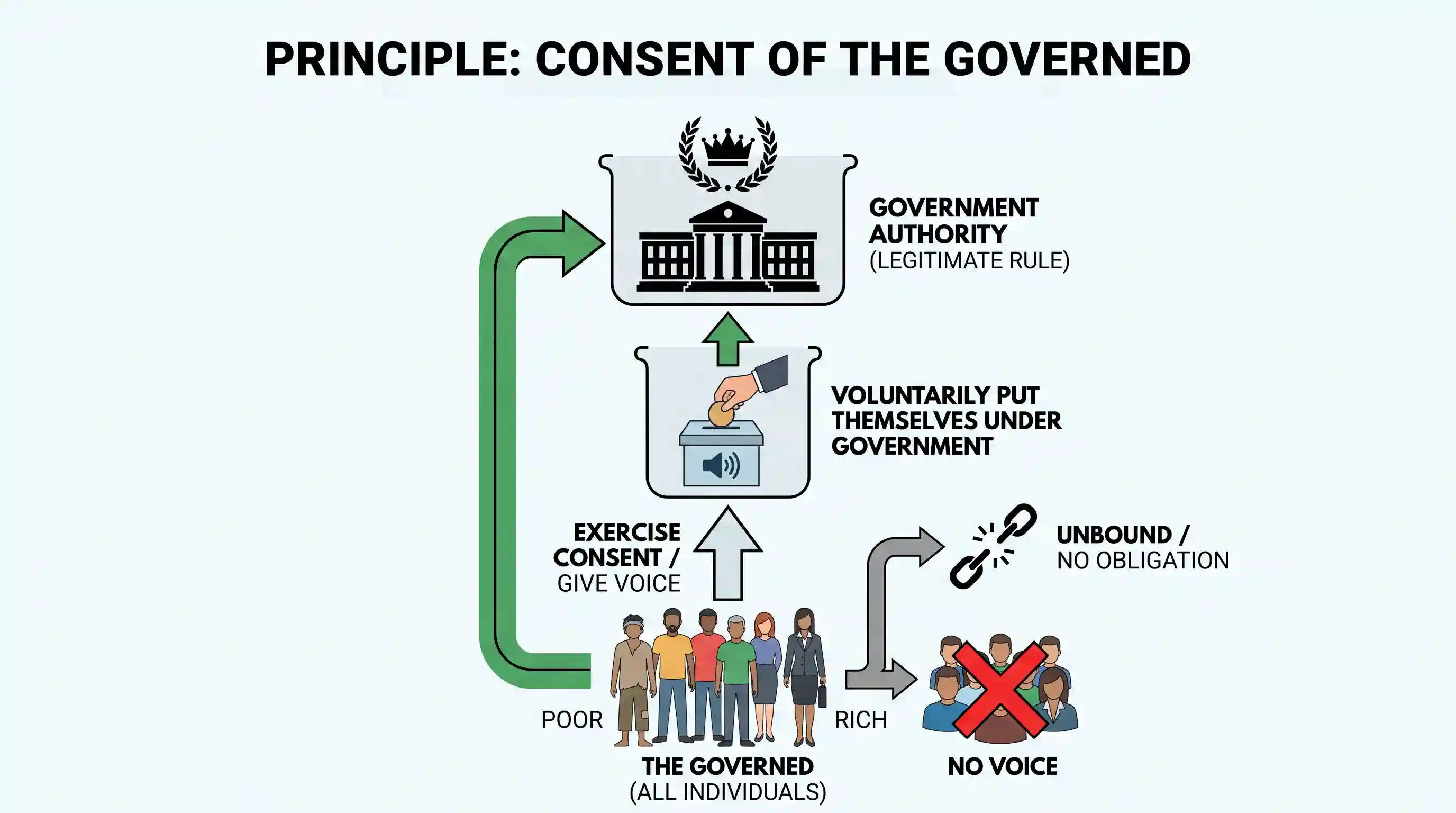
The statement argues that every individual, regardless of their social standing (poorest or greatest), must give their consent to be governed. It explicitly states that a person not having a voice to put themselves under a government is not bound by it. This directly supports the principle of "rule according to the consent of the governed."
A) distribution of wealth equally to all: The text mentions the poor and rich to establish equality in the right to consent, not to advocate for economic redistribution. B) rule according to the consent of the governed: This is the central theme. The phrases "every man... ought first by his own consent to put himself under the government" and "not at all bound... that he has not had a voice to put himself under" directly support this. C) rule of the poor: The text argues for the right of the poor to consent, not for the poor to exclusively rule. It's about universal consent, not class rule. D) expropriation of the rich: The text does not suggest taking wealth from the rich; it uses the rich/poor distinction to emphasize that the principle of consent applies to everyone.
Related questions
More UPSC Prelims practice from the same subject and topic.
- Prelims 2017CSATReading Comprehension
Disruption of traditional institutions, identifications and loyalties is likely to lead to ambivalent situations. It is possible that some people may renew their identification with traditional groups…
- Prelims 2017CSATReading Comprehension
Disruption of traditional institutions, identifications and loyalties is likely to lead to ambivalent situations. It is possible that some people may renew their identification with traditional groups…
- Prelims 2017CSATReading Comprehension
We live in digital times. The digital is not just something we use strategically and specifically to do a few tasks. Our very perception of who we are, how we connect to the world around us, and the w…
- Prelims 2017CSATReading Comprehension
The IMF has pointed out that the fast growing economies of Asia face the risk of falling into 'middle-income trap'. It means that average incomes in these countries, which till now have been growing r…
- Prelims 2017CSATReading Comprehension
An innovative India will be inclusive as well as technologically advanced, improving the lives of all Indians. Innovation and R&D can mitigate increases in social inequality and relieve the pressures …
- Prelims 2017CSATReading Comprehension
Climate change is likely to expose a large number of people to increasing environmental risks forcing them to migrate. The international community is yet to recognize this new category of migrants. Th…