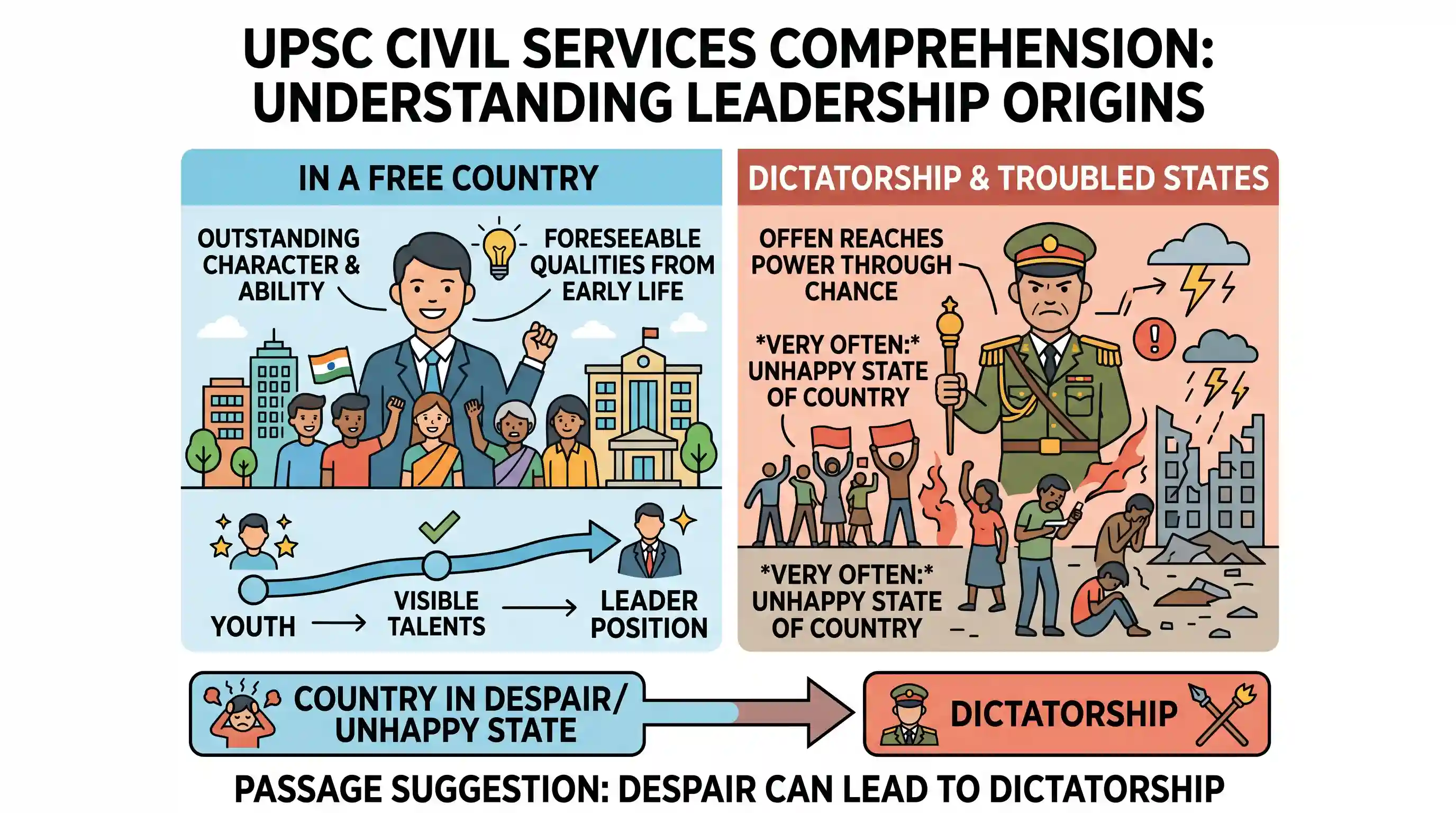
In a free country, the man who reaches the position of leader is usually one of outstanding, character and ability. Moreover, it is usually possible to foresee that he will reach such a position, since early in life one can see his qualities of character. But this is not always true in the case of a dictator; often he reaches his position of power through chance, very often through the unhappy state of his country. The passage seems to suggest that

- Aa leader foresees his future position
- Ba leader is chosen only by a free country
- Ca leader must see that his country is free from despair
- Ddespair in a country sometimes leads to dictatorshipCorrect
Explanation
The passage states that a dictator "often he reaches his position of power... very often through the unhappy state of his country." The phrase "unhappy state of his country" directly implies despair or a similar negative condition. Therefore, the passage suggests that despair in a country can sometimes lead to dictatorship.
A) a leader foresees his future position: The passage says "it is usually possible to foresee that he will reach such a position" (referring to observers foreseeing it), not that the leader himself foresees it. B) a leader is chosen only by a free country: The passage discusses leaders in free countries and dictators, but does not make an exclusive claim that leaders are only chosen by free countries. C) a leader must see that his country is free from despair: While a good leader would aim for this, the passage highlights "unhappy state of his country" as a cause for dictatorship, not as a direct duty suggested for a leader in a free country. D) despair in a country sometimes leads to dictatorship: This is directly supported by the line "often he reaches his position of power... very often through the unhappy state of his country."
Related questions
More UPSC Prelims practice from the same subject and topic.
- Prelims 2017CSATReading Comprehension
Disruption of traditional institutions, identifications and loyalties is likely to lead to ambivalent situations. It is possible that some people may renew their identification with traditional groups…
- Prelims 2017CSATReading Comprehension
Disruption of traditional institutions, identifications and loyalties is likely to lead to ambivalent situations. It is possible that some people may renew their identification with traditional groups…
- Prelims 2017CSATReading Comprehension
We live in digital times. The digital is not just something we use strategically and specifically to do a few tasks. Our very perception of who we are, how we connect to the world around us, and the w…
- Prelims 2017CSATReading Comprehension
The IMF has pointed out that the fast growing economies of Asia face the risk of falling into 'middle-income trap'. It means that average incomes in these countries, which till now have been growing r…
- Prelims 2017CSATReading Comprehension
An innovative India will be inclusive as well as technologically advanced, improving the lives of all Indians. Innovation and R&D can mitigate increases in social inequality and relieve the pressures …
- Prelims 2017CSATReading Comprehension
Climate change is likely to expose a large number of people to increasing environmental risks forcing them to migrate. The international community is yet to recognize this new category of migrants. Th…