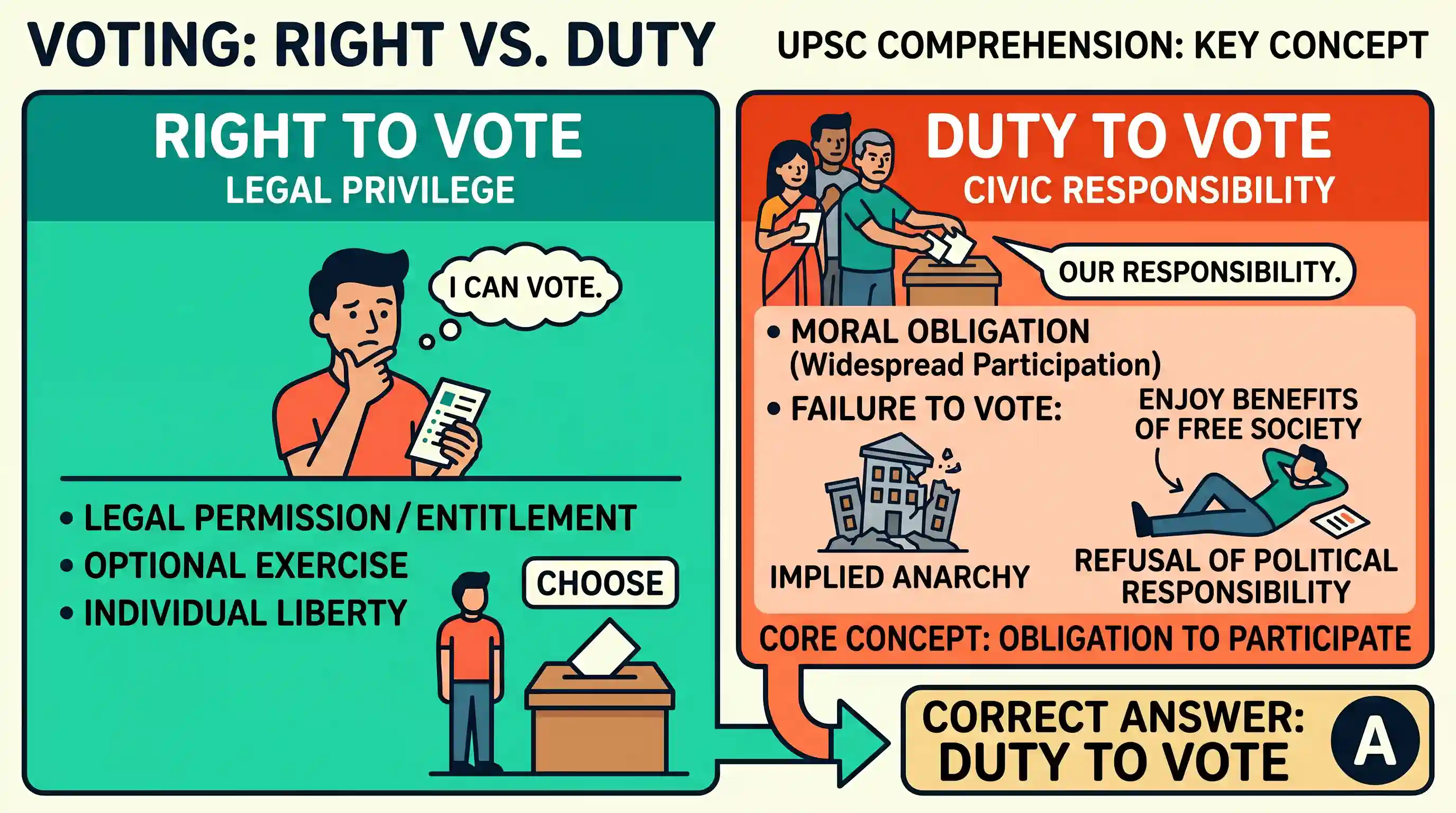
A successful democracy depends upon widespread interest and participation in politics, in which voting is an essential part. To deliberately refrain from taking such an interest, and from voting, is a kind of implied anarchy, it is to refuse one's political responsibility while enjoying the benefits of a free political society. This passage relates to

- Aduty to voteCorrect
- Bright to vote
- Cfreedom to vote
- Dright to participate in politics
Explanation
The passage argues that refraining from voting is a refusal of "political responsibility" and a form of "implied anarchy." This language strongly suggests that voting is not just a privilege or a choice, but an obligation or a moral imperative for citizens in a free society.
A) duty to vote: This aligns perfectly with the passage's emphasis on "political responsibility" and the negative framing of deliberately refraining from voting. The passage is essentially arguing for a civic duty to participate through voting.
B) right to vote: While voting is a right, the passage takes this right for granted and instead focuses on the exercise of that right as a responsibility, not merely its existence.
C) freedom to vote: This refers to the ability to choose whether or not to vote without coercion. The passage acknowledges this freedom by discussing "deliberately refrain[ing]," but then argues that despite this freedom, there is a responsibility to vote.
D) right to participate in politics: While voting is a form of political participation, the passage specifically highlights voting as an "essential part" and frames the responsibility directly around the act of voting, not just general participation.
The core message is about the obligation or responsibility to vote, making "duty to vote" the most accurate interpretation.
Related questions
More UPSC Prelims practice from the same subject and topic.
- Prelims 2017CSATReading Comprehension
Disruption of traditional institutions, identifications and loyalties is likely to lead to ambivalent situations. It is possible that some people may renew their identification with traditional groups…
- Prelims 2017CSATReading Comprehension
Disruption of traditional institutions, identifications and loyalties is likely to lead to ambivalent situations. It is possible that some people may renew their identification with traditional groups…
- Prelims 2017CSATReading Comprehension
We live in digital times. The digital is not just something we use strategically and specifically to do a few tasks. Our very perception of who we are, how we connect to the world around us, and the w…
- Prelims 2017CSATReading Comprehension
The IMF has pointed out that the fast growing economies of Asia face the risk of falling into 'middle-income trap'. It means that average incomes in these countries, which till now have been growing r…
- Prelims 2017CSATReading Comprehension
An innovative India will be inclusive as well as technologically advanced, improving the lives of all Indians. Innovation and R&D can mitigate increases in social inequality and relieve the pressures …
- Prelims 2017CSATReading Comprehension
Climate change is likely to expose a large number of people to increasing environmental risks forcing them to migrate. The international community is yet to recognize this new category of migrants. Th…