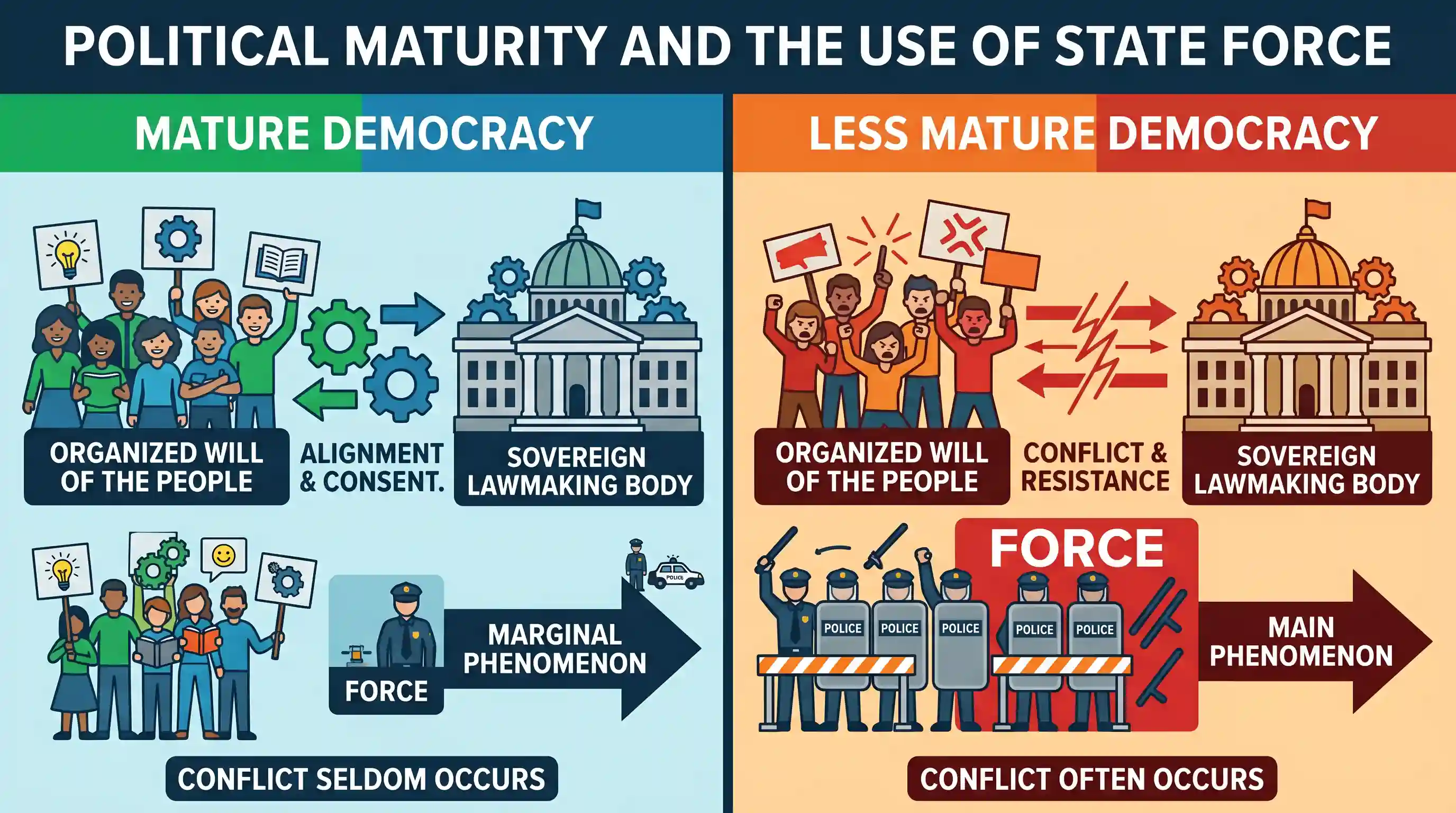
In a democratic State, where a high degree of Political maturity of the people obtains, the conflict between the will of the sovereign lawmaking body and the organized will of the people seldom occurs. What does the above passage imply?

- AIn a democracy, force is the main phenomenon in the actual exercise of sovereignty
- BIn a mature democracy, force to a great extent is the main phenomenon in the actual exercise of sovereignty
- CIn a mature democracy, use of force is irrelevant in the actual exercise of sovereignty
- DIn a mature democracy, force is narrowed down to a marginal phenomenon in the actual exercise of sovereignty.Correct
Explanation
The passage states that in a democratic state with politically mature people, conflict between the lawmaking body and the people "seldom occurs." This implies a high degree of acceptance and alignment between the government's actions and the citizens' will.
Let's analyze the options:
A) In a democracy, force is the main phenomenon in the actual exercise of sovereignty This is incorrect. Democracies are founded on consent, representation, and rule of law, not primarily on force.
B) In a mature democracy, force to a great extent is the main phenomenon in the actual exercise of sovereignty This is also incorrect. A mature democracy would rely even less on overt force as its legitimacy is widely accepted.
C) In a mature democracy, use of force is irrelevant in the actual exercise of sovereignty This is an extreme statement and incorrect. Even in a mature democracy, the state retains the monopoly on legitimate force (e.g., police, military) to enforce laws, maintain order, and protect its citizens. It is not irrelevant, but ideally used as a last resort.
D) In a mature democracy, force is narrowed down to a marginal phenomenon in the actual exercise of sovereignty. This is the correct implication. If conflict "seldom occurs" due to political maturity, it means the need for the state to impose its will through overt force is significantly reduced. People generally accept laws and resolve differences through democratic processes. Therefore, force becomes a "marginal phenomenon"—it exists but is rarely needed and not central to the daily exercise of sovereignty. It's used only in exceptional circumstances, rather than being a primary tool.
The final answer is D.
Related questions
More UPSC Prelims practice from the same subject and topic.
- Prelims 2017CSATReading Comprehension
Disruption of traditional institutions, identifications and loyalties is likely to lead to ambivalent situations. It is possible that some people may renew their identification with traditional groups…
- Prelims 2017CSATReading Comprehension
Disruption of traditional institutions, identifications and loyalties is likely to lead to ambivalent situations. It is possible that some people may renew their identification with traditional groups…
- Prelims 2017CSATReading Comprehension
We live in digital times. The digital is not just something we use strategically and specifically to do a few tasks. Our very perception of who we are, how we connect to the world around us, and the w…
- Prelims 2017CSATReading Comprehension
The IMF has pointed out that the fast growing economies of Asia face the risk of falling into 'middle-income trap'. It means that average incomes in these countries, which till now have been growing r…
- Prelims 2017CSATReading Comprehension
An innovative India will be inclusive as well as technologically advanced, improving the lives of all Indians. Innovation and R&D can mitigate increases in social inequality and relieve the pressures …
- Prelims 2017CSATReading Comprehension
Climate change is likely to expose a large number of people to increasing environmental risks forcing them to migrate. The international community is yet to recognize this new category of migrants. Th…