"The individual, according to Rousseau, puts his person and all his power in common under the supreme direction of the General Will and in our corporate capacity we receive each member as an indivisible part of the whole." In the light of the above passage, the nature of General Will is best described as

- Athe sum total of the private wills of the individualsCorrect
- Bwhat is articulated by the elected representatives of the individuals
- Cthe collective good as distinct from private wills of the individuals
- Dthe material interests of the community
Explanation
The question asks to describe the nature of the General Will based on the provided passage from Rousseau. The passage emphasizes individuals putting their power "in common" and becoming an "indivisible part of the whole," suggesting a collective formation.
Let's analyze each option:
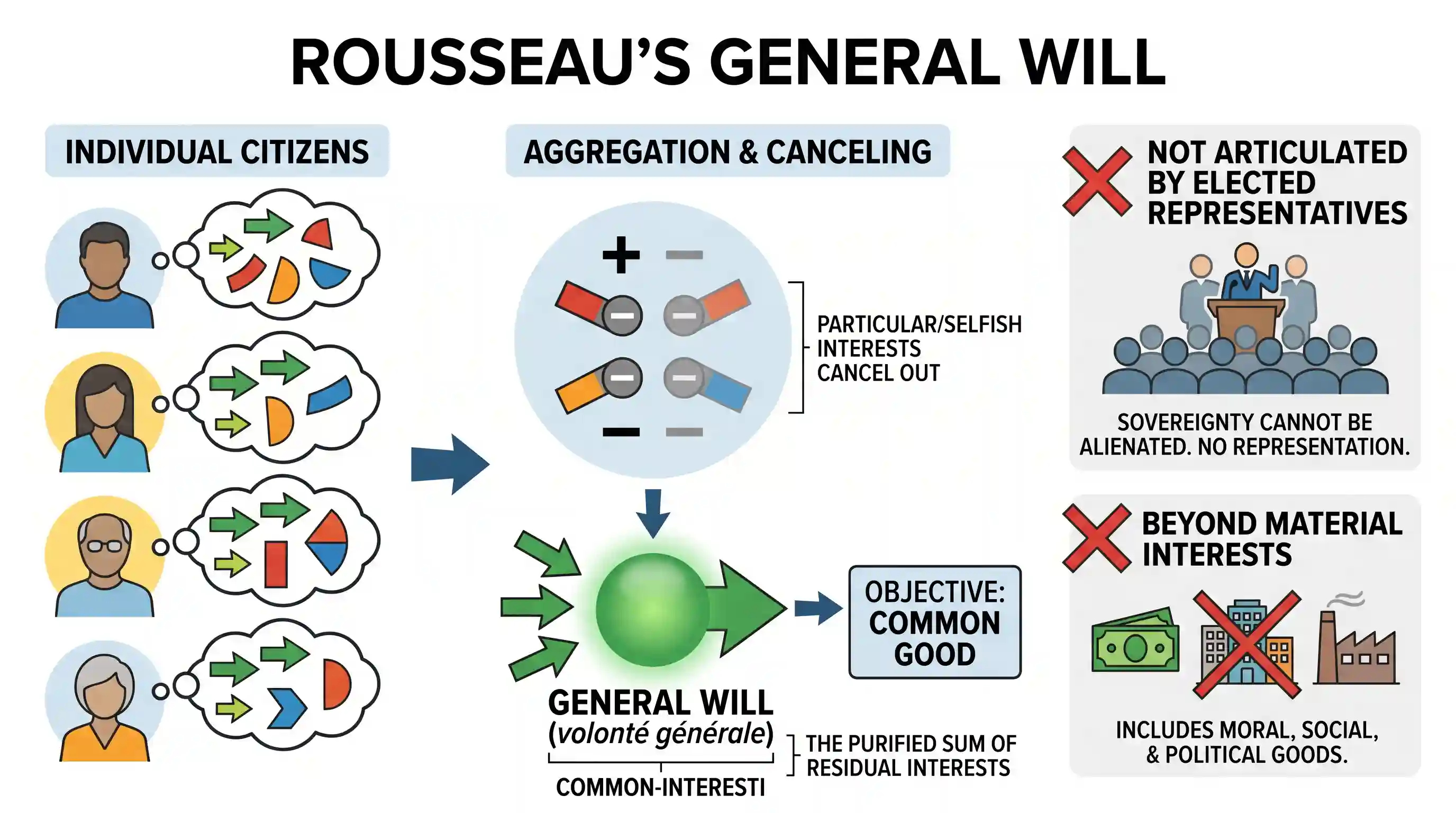
A) the sum total of the private wills of the individuals Rousseau famously distinguished the "General Will" (volonté générale) from the "Will of All" (volonté de tous). The Will of All is indeed the simple sum of private, often self-interested, wills. The General Will, however, aims at the common good. However, Rousseau also explained that if citizens are well-informed and deliberate without factions, their individual judgments about the common good, when aggregated, would lead to the General Will. He stated that if you "take away from these same wills the pluses and minuses that cancel one another, and the general will remains as the sum of the differences." In this specific sense, the General Will emerges from the private wills, not as a simple aggregation of selfish desires, but as the common element that remains after particular interests cancel out. Given the options, and the need to choose the "best" description, A can be interpreted as this purified collective will that arises from individuals contributing their wills to the common good.
B) what is articulated by the elected representatives of the individuals This is incorrect. Rousseau was a strong critic of representative government, believing that sovereignty (and thus the General Will) could not be alienated or represented. He argued that the moment a people elects representatives, it ceases to be free.
C) the collective good as distinct from private wills of the individuals This option describes the aim or object of the General Will (the collective good), rather than its nature as a will. The General Will wills the collective good, but it is a will, not the good itself. While it is distinct from private wills in its object and moral quality, it still originates from the individuals' collective deliberation.
D) the material interests of the community This is too narrow. While the General Will certainly encompasses the material well-being of the community, Rousseau's concept of the common good is broader, including moral, political, and social aspects, not just material interests.
Conclusion: While option A can be misleading if "sum total" is interpreted as a mere aggregation of selfish wills, it is the most plausible answer when understood in Rousseau's nuanced sense: the General Will is what results when individuals, acting as citizens, contribute their wills to the collective, and the particular (self-interested) aspects cancel out, leaving the common interest. This makes it a collective will derived from the individuals. Compared to other options that are clearly incorrect or describe the object rather than the nature of the will, A is considered the best fit in a multiple-choice context, assuming a specific interpretation of "sum total."
The final answer is A.
Related questions
More UPSC Prelims practice from the same subject and topic.
- Prelims 2017CSATReading Comprehension
Disruption of traditional institutions, identifications and loyalties is likely to lead to ambivalent situations. It is possible that some people may renew their identification with traditional groups…
- Prelims 2017CSATReading Comprehension
Disruption of traditional institutions, identifications and loyalties is likely to lead to ambivalent situations. It is possible that some people may renew their identification with traditional groups…
- Prelims 2017CSATReading Comprehension
We live in digital times. The digital is not just something we use strategically and specifically to do a few tasks. Our very perception of who we are, how we connect to the world around us, and the w…
- Prelims 2017CSATReading Comprehension
The IMF has pointed out that the fast growing economies of Asia face the risk of falling into 'middle-income trap'. It means that average incomes in these countries, which till now have been growing r…
- Prelims 2017CSATReading Comprehension
An innovative India will be inclusive as well as technologically advanced, improving the lives of all Indians. Innovation and R&D can mitigate increases in social inequality and relieve the pressures …
- Prelims 2017CSATReading Comprehension
Climate change is likely to expose a large number of people to increasing environmental risks forcing them to migrate. The international community is yet to recognize this new category of migrants. Th…