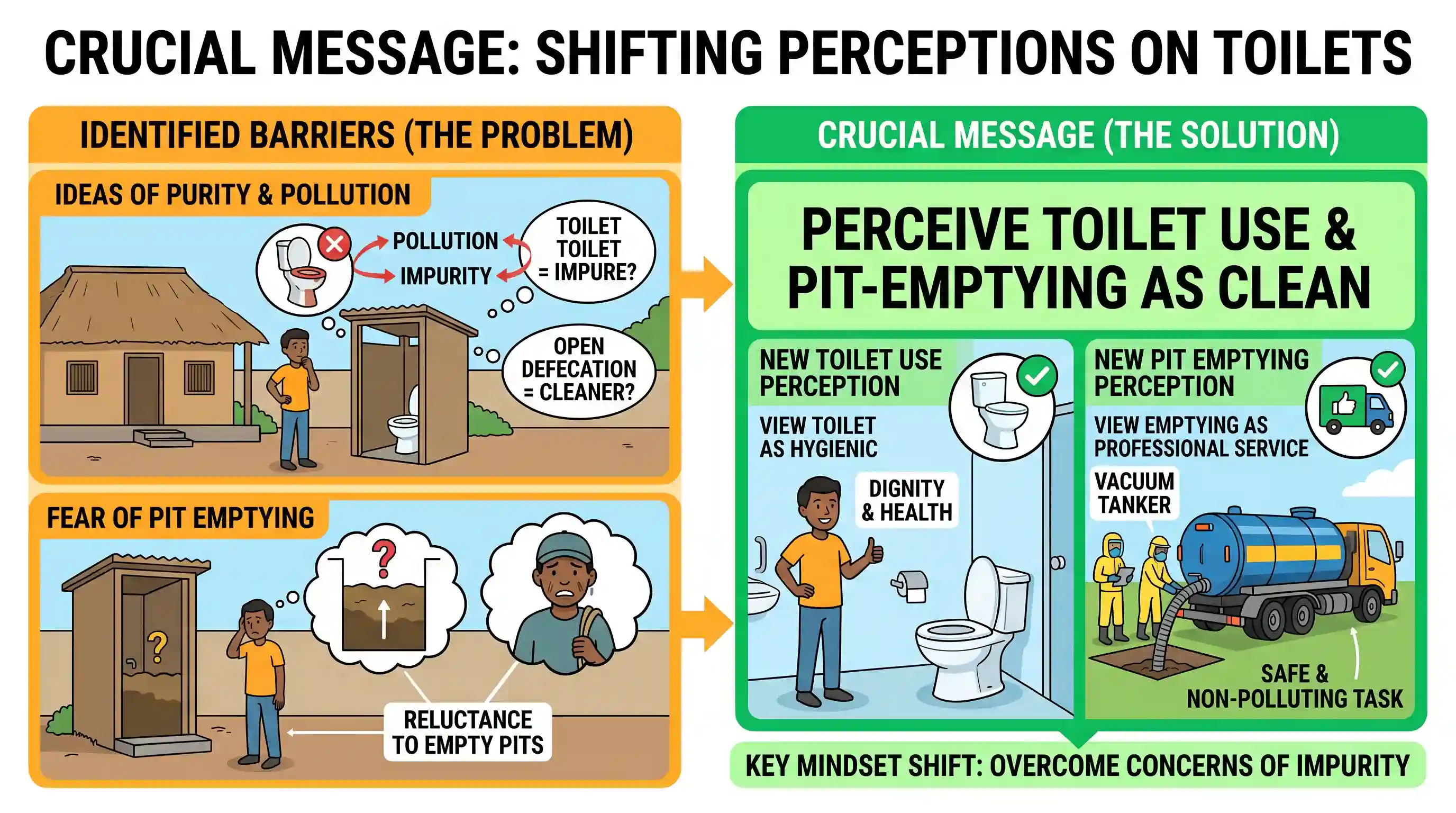
Why do people prefer open defecation and not want toilets or, if they have them, only use them sometimes? Recent research has shown two critical elements: ideas of purity and pollutions, and not wanting pits or septic tanks to fill they have to be emptied. These are the issue that nobody wants to talk about, but if we want to eradicate the practice of open defection, they have to be confronted and dealt properly. Which among the following is the most crucial message conveyed by the above passage?

- AThe ideas of purity and pollutions are so deep-rooted that they cannot be removed from the minds of the people
- BPeople have to perceive toilet use and pit-emptying as clean and not pollutingCorrect
- CPeople cannot change their old habits
- DPeople have neither civic sense nor sense of privacy.
Explanation
The passage highlights two critical reasons for open defecation: ideas of purity and pollution, and reluctance to empty pits/septic tanks. It concludes by stating these issues "have to be confronted and dealt properly" to eradicate the practice.
Analyzing the options:
A) The ideas of purity and pollutions are so deep-rooted that they cannot be removed from the minds of the people. This contradicts the passage's call to "confront and deal properly," which implies that change is possible.
B) People have to perceive toilet use and pit-emptying as clean and not polluting. This directly addresses both critical elements mentioned in the passage: the "ideas of purity and pollutions" and the reluctance concerning "pits or septic tanks to fill they have to be emptied." Changing this perception is precisely how these issues would be "dealt properly" to encourage toilet use. This is the most crucial message as it proposes the necessary shift in mindset to overcome the identified barriers.
C) People cannot change their old habits. The passage identifies specific underlying reasons, not just generic "old habits." The call to "confront and deal properly" implies that change is possible if these root causes are addressed.
D) People have neither civic sense nor sense of privacy. The passage explicitly states the reasons are "ideas of purity and pollutions" and reluctance to empty pits. It does not mention lack of civic sense or privacy as the critical elements.
Therefore, option B is the most crucial message as it directly addresses the core issues identified and suggests the fundamental change in perception required to solve the problem.
Related questions
More UPSC Prelims practice from the same subject and topic.
- Prelims 2017CSATReading Comprehension
Disruption of traditional institutions, identifications and loyalties is likely to lead to ambivalent situations. It is possible that some people may renew their identification with traditional groups…
- Prelims 2017CSATReading Comprehension
Disruption of traditional institutions, identifications and loyalties is likely to lead to ambivalent situations. It is possible that some people may renew their identification with traditional groups…
- Prelims 2017CSATReading Comprehension
We live in digital times. The digital is not just something we use strategically and specifically to do a few tasks. Our very perception of who we are, how we connect to the world around us, and the w…
- Prelims 2017CSATReading Comprehension
The IMF has pointed out that the fast growing economies of Asia face the risk of falling into 'middle-income trap'. It means that average incomes in these countries, which till now have been growing r…
- Prelims 2017CSATReading Comprehension
An innovative India will be inclusive as well as technologically advanced, improving the lives of all Indians. Innovation and R&D can mitigate increases in social inequality and relieve the pressures …
- Prelims 2017CSATReading Comprehension
Climate change is likely to expose a large number of people to increasing environmental risks forcing them to migrate. The international community is yet to recognize this new category of migrants. Th…