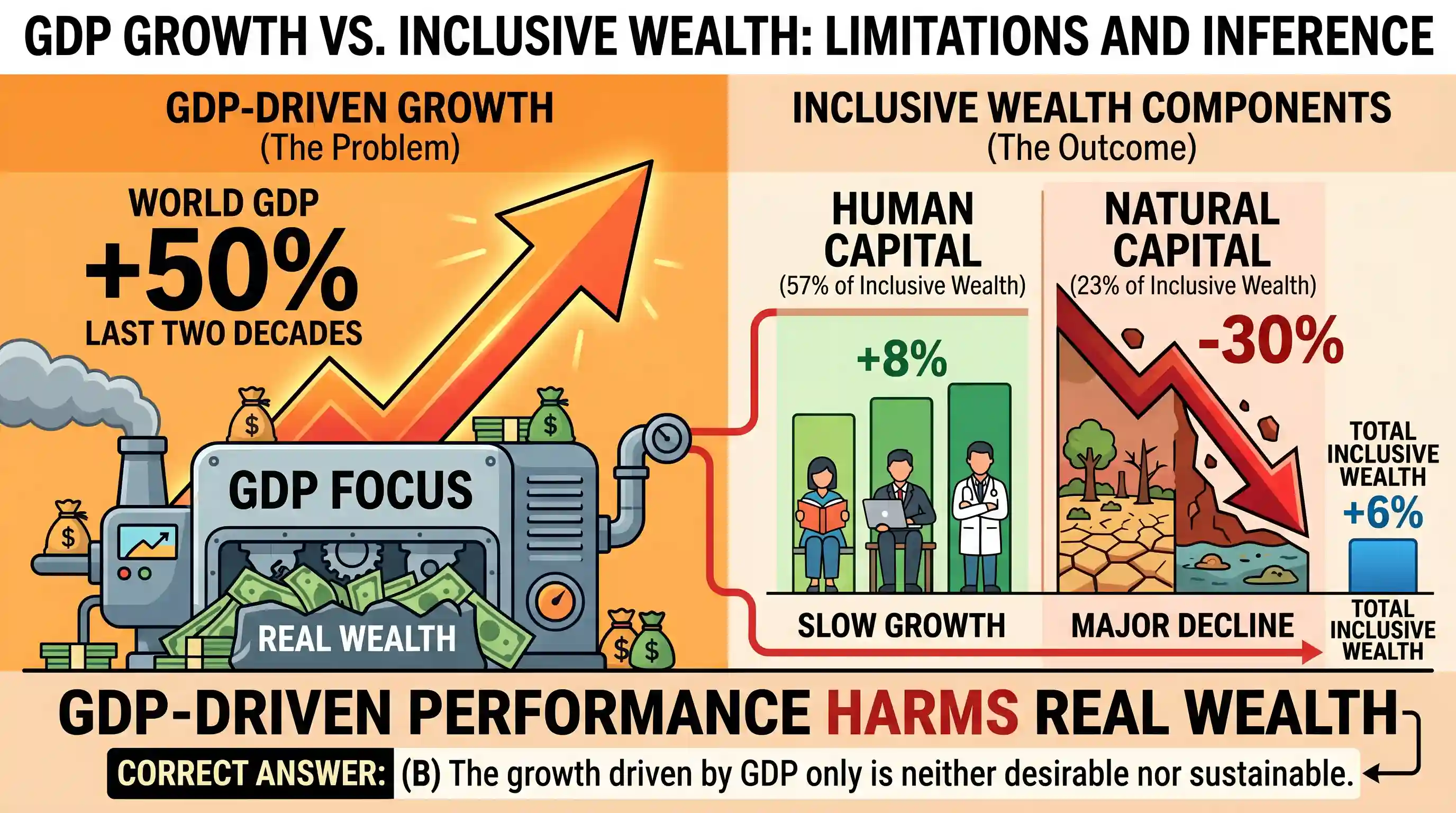
In the last two decades, the world's gross domestic product (GDP) has increased 50 percent, whereas inclusive wealth has increased by a mere 6 percent. In recent decades, GDP-driven economic performance, has only harmed inclusive wealth like human capital; and natural capital like forests, land and water. While the world's human capital which stands at 57 percent of total inclusive wealth grew by only 8 percent, the natural which is 23 percent of total inclusive wealth declined by 30 per cent worldwide in the last two decades. Which of the following is the most crucial inference from the above passage?

- AMore emphasis should be laid on the development of natural capital
- BThe growth driven by GDP only is neither desirable nor sustainableCorrect
- CThe economic performance of the countries of the world is not satisfactory
- DThe world needs more human capital under the present circumstances.
Explanation
The passage highlights a stark contrast: while GDP has increased significantly (50%), inclusive wealth (which includes human and natural capital) has barely grown (6%), with natural capital actually declining by 30%. It explicitly states that "GDP-driven economic performance, has only harmed inclusive wealth."
Let's analyze the options:
A) More emphasis should be laid on the development of natural capital. While natural capital's decline is a major concern mentioned, this option focuses only on one component of inclusive wealth. The passage points to a broader problem with the GDP-driven model affecting all inclusive wealth.
B) The growth driven by GDP only is neither desirable nor sustainable. This option directly addresses the core critique in the passage. The fact that GDP growth has "only harmed inclusive wealth" (making it undesirable) and led to a significant decline in natural capital (making it unsustainable for future well-being) strongly supports this inference. This is the most comprehensive inference, capturing the essence of the problem described.
C) The economic performance of the countries of the world is not satisfactory. This is a general statement. The passage provides specific reasons why the type of economic performance is problematic, rather than just a vague assessment of "satisfactory." It's not the most crucial inference because it lacks specificity.
D) The world needs more human capital under the present circumstances. The passage notes human capital's slow growth (8%) but does not explicitly state that the world "needs more" as the most crucial inference. The more pressing issue highlighted is the harm caused by GDP-driven growth to inclusive wealth generally, with natural capital's decline being even more severe.
Therefore, option B is the most crucial inference because it directly addresses the passage's central argument: the negative consequences of an economic model focused solely on GDP growth, which is shown to be detrimental to overall wealth and future prospects.
Related questions
More UPSC Prelims practice from the same subject and topic.
- Prelims 2017CSATReading Comprehension
Disruption of traditional institutions, identifications and loyalties is likely to lead to ambivalent situations. It is possible that some people may renew their identification with traditional groups…
- Prelims 2017CSATReading Comprehension
Disruption of traditional institutions, identifications and loyalties is likely to lead to ambivalent situations. It is possible that some people may renew their identification with traditional groups…
- Prelims 2017CSATReading Comprehension
We live in digital times. The digital is not just something we use strategically and specifically to do a few tasks. Our very perception of who we are, how we connect to the world around us, and the w…
- Prelims 2017CSATReading Comprehension
The IMF has pointed out that the fast growing economies of Asia face the risk of falling into 'middle-income trap'. It means that average incomes in these countries, which till now have been growing r…
- Prelims 2017CSATReading Comprehension
An innovative India will be inclusive as well as technologically advanced, improving the lives of all Indians. Innovation and R&D can mitigate increases in social inequality and relieve the pressures …
- Prelims 2017CSATReading Comprehension
Climate change is likely to expose a large number of people to increasing environmental risks forcing them to migrate. The international community is yet to recognize this new category of migrants. Th…