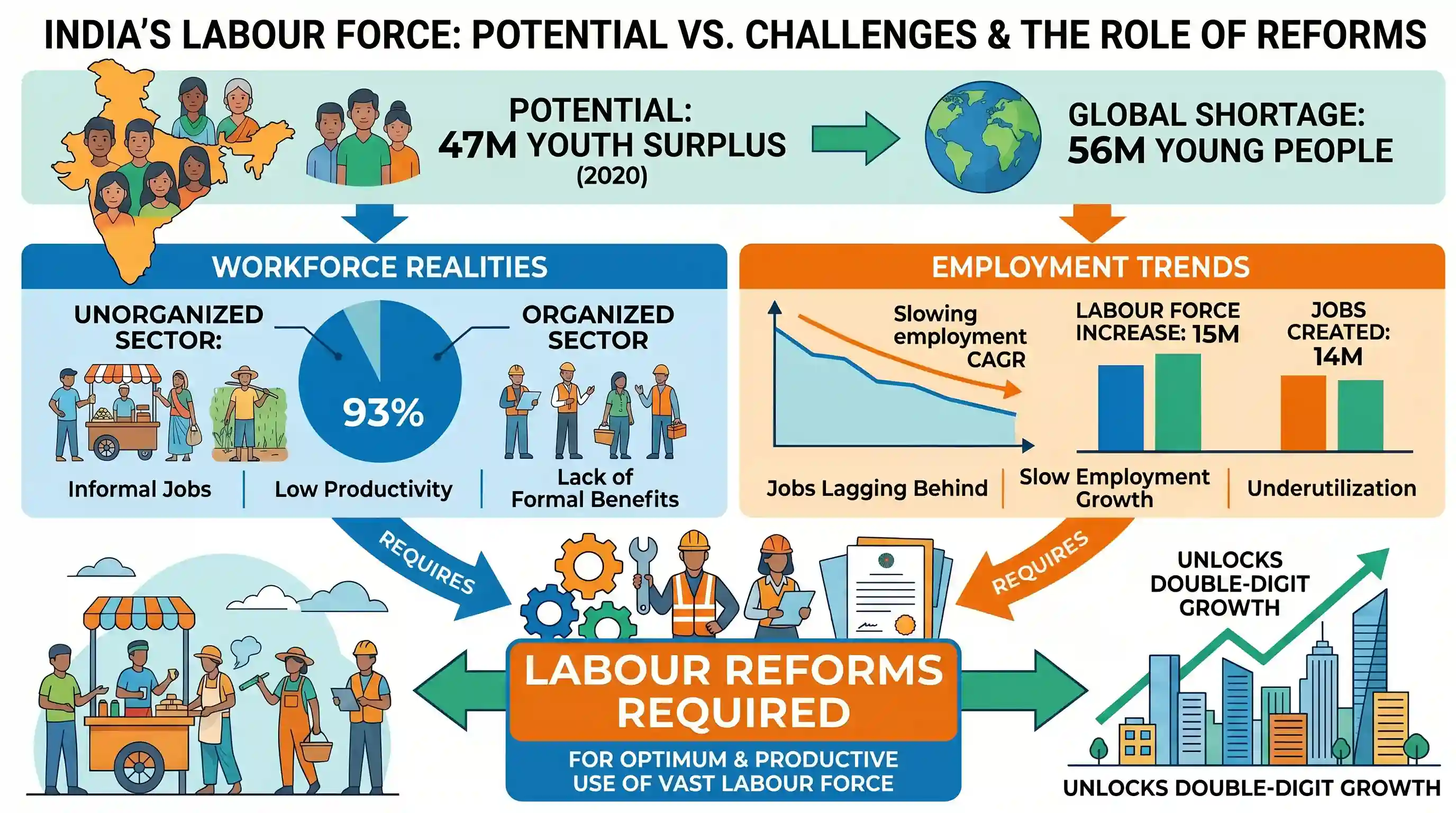
By 2020, when the global economy is expected to run short of 56 million young people, India, with its youth surplus of 47 million, could fill the gap. It is in this context that labour reforms are often cited as the way to unlock double-digit growth in India. In 2014, India's labour force was estimated to be about 40 per cent of the population, but 93 per cent of this force was in unorganized sector. Over the last decade, the compound annual growth rate (CAGR) of employment has slowed to 0.5 per cent, with about 14 million jobs created during last year when the labour force increased by about 15 million. Which of the following is most rational inference from the above passage?

- AIndia must control its population growth so as to reduce its unemployment rate
- BLabour reforms are required in India to make optimum use of its vast labour force productivelyCorrect
- CIndia is poised to achieve the double-digit growth very soon
- DIndia is capable of supplying !It, skilled young people to oil, countries
Explanation
The passage highlights India's demographic dividend (youth surplus) and the potential to fill a global shortage. It then explicitly states that "labour reforms are often cited as the way to unlock double-digit growth in India." The subsequent data about 93% of the labour force being in the unorganized sector and slowing employment growth further reinforce the idea that the current system is not optimally utilizing this vast labour force.
Let's analyze the options:
A) India must control its population growth so as to reduce its unemployment rate. This is incorrect. The passage frames India's youth surplus as an opportunity ("could fill the gap," "unlock double-digit growth"), not a problem to be solved by population control.
B) Labour reforms are required in India to make optimum use of its vast labour force productively. This is the most rational inference. The passage directly links labour reforms to "unlock double-digit growth" in the context of India's "youth surplus." The data on the large unorganized sector and slow employment growth imply that the current system is not making productive use of this force, hence reforms are needed.
C) India is poised to achieve the double-digit growth very soon. This is an overstatement. The passage states that labour reforms are "the way to unlock" double-digit growth, implying it's a condition yet to be fulfilled, not an imminent outcome. The challenges mentioned (unorganized sector, slow employment growth) suggest hurdles, not immediate readiness.
D) India is capable of supplying skilled young people to oil, countries. The passage mentions India's youth surplus could "fill the gap" globally, but it does not specify "skilled" young people or "oil countries." It's too specific and not fully supported by the general statement in the passage.
Therefore, option B directly reflects the central argument and supporting context provided in the passage.
Related questions
More UPSC Prelims practice from the same subject and topic.
- Prelims 2017CSATReading Comprehension
Disruption of traditional institutions, identifications and loyalties is likely to lead to ambivalent situations. It is possible that some people may renew their identification with traditional groups…
- Prelims 2017CSATReading Comprehension
Disruption of traditional institutions, identifications and loyalties is likely to lead to ambivalent situations. It is possible that some people may renew their identification with traditional groups…
- Prelims 2017CSATReading Comprehension
We live in digital times. The digital is not just something we use strategically and specifically to do a few tasks. Our very perception of who we are, how we connect to the world around us, and the w…
- Prelims 2017CSATReading Comprehension
The IMF has pointed out that the fast growing economies of Asia face the risk of falling into 'middle-income trap'. It means that average incomes in these countries, which till now have been growing r…
- Prelims 2017CSATReading Comprehension
An innovative India will be inclusive as well as technologically advanced, improving the lives of all Indians. Innovation and R&D can mitigate increases in social inequality and relieve the pressures …
- Prelims 2017CSATReading Comprehension
Climate change is likely to expose a large number of people to increasing environmental risks forcing them to migrate. The international community is yet to recognize this new category of migrants. Th…