The very first lesson that should be taught to us when are old enough to understand it, is that complete freedom from the obligation to work is unnatural, and ought to be illegal, as we can escape our share of the burden of work only by throwing it on someone else's shoulders. Nature ordains that the human race shall perish of famine if it stops working. We cannot escape from this tyranny. The question we have to settle is how much leisure we can afford to allow ourselves. The main idea of the passage is that

- Ait is essential for human beings to work
- Bthere should be a balance between work and leisureCorrect
- Cworking is a tyranny which we to face
- Dhuman's understanding of the nature of work is essential
Explanation
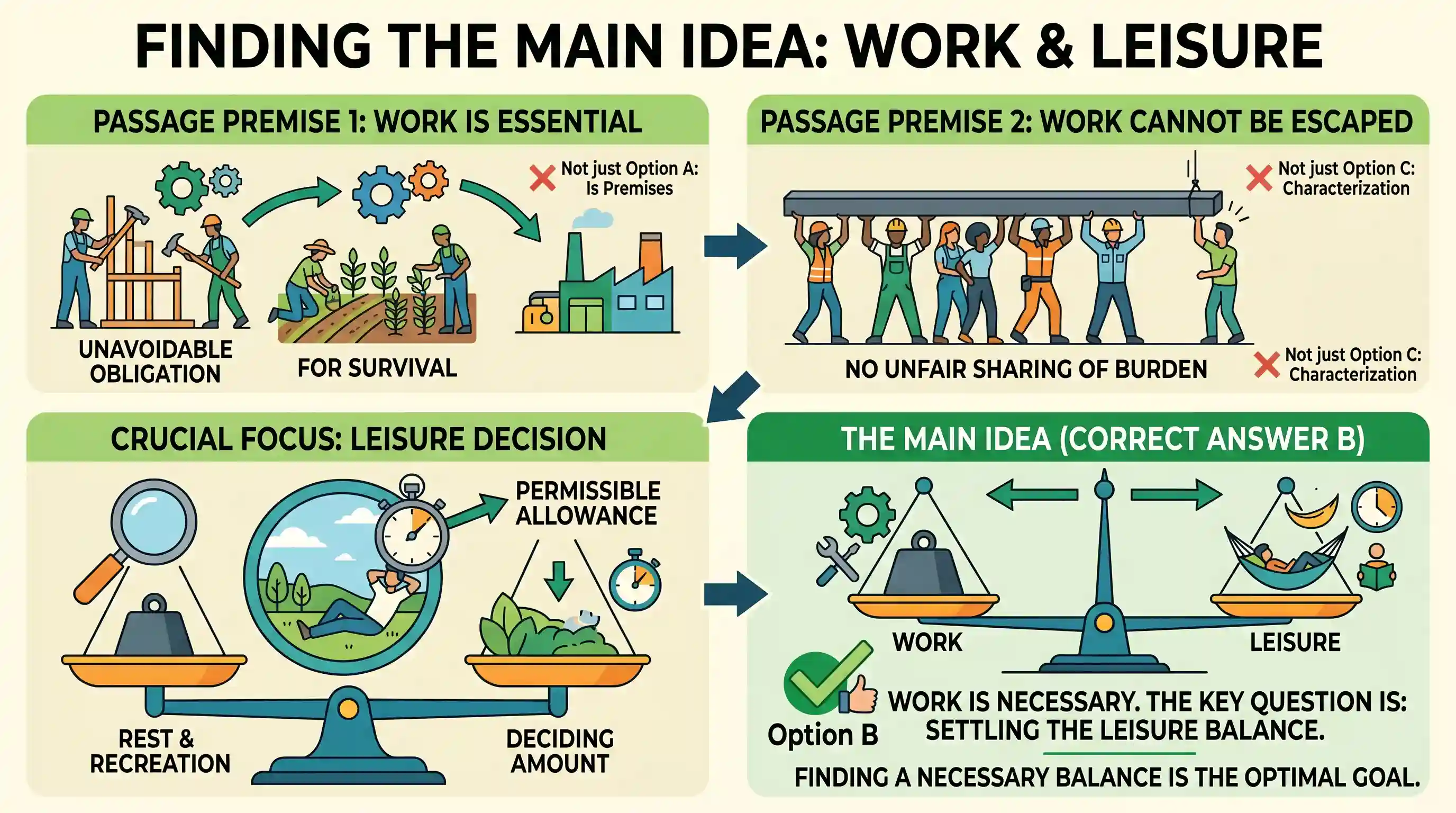
The passage first establishes that work is essential and unavoidable for human survival, calling complete freedom from it "unnatural" and a "tyranny." It emphasizes that escaping work means burdening others. However, the crucial concluding sentence, "The question we have to settle is how much leisure we can afford to allow ourselves," shifts the focus. It implies that since work is a given, the real decision lies in determining the appropriate amount of leisure. This directly points to the necessity of finding a balance between the unavoidable obligation to work and the desire for leisure.
Analysis of Options: A) it is essential for human beings to work: While the passage strongly states this, it is only the premise. The passage goes further to discuss the implication of this necessity, which is how to manage leisure. So, this option is part of the argument but not the main idea. B) there should be a balance between work and leisure: This option directly addresses the concluding sentence, which frames the core problem as deciding "how much leisure we can afford." This inherently implies finding a balance between the unavoidable work and the permissible leisure. This captures the full scope of the passage's argument. C) working is a tyranny which we to face: The passage does use the word "tyranny" to describe work, highlighting its unavoidable and burdensome nature. However, simply stating it's a tyranny is a characteristic, not the main idea, which extends to what we do about this tyranny. D) human's understanding of the nature of work is essential: The passage explains the nature of work, but its main point isn't about the understanding itself, but rather the practical consequence of that understanding: how we manage our lives, specifically leisure, given work's necessity.
Therefore, B is the correct answer because the passage, after establishing the inevitability of work, concludes by posing the question of how much leisure we can afford, thereby highlighting the need for a balance between the two.
Related questions
More UPSC Prelims practice from the same subject and topic.
- Prelims 2017CSATReading Comprehension
Disruption of traditional institutions, identifications and loyalties is likely to lead to ambivalent situations. It is possible that some people may renew their identification with traditional groups…
- Prelims 2017CSATReading Comprehension
Disruption of traditional institutions, identifications and loyalties is likely to lead to ambivalent situations. It is possible that some people may renew their identification with traditional groups…
- Prelims 2017CSATReading Comprehension
We live in digital times. The digital is not just something we use strategically and specifically to do a few tasks. Our very perception of who we are, how we connect to the world around us, and the w…
- Prelims 2017CSATReading Comprehension
The IMF has pointed out that the fast growing economies of Asia face the risk of falling into 'middle-income trap'. It means that average incomes in these countries, which till now have been growing r…
- Prelims 2017CSATReading Comprehension
An innovative India will be inclusive as well as technologically advanced, improving the lives of all Indians. Innovation and R&D can mitigate increases in social inequality and relieve the pressures …
- Prelims 2017CSATReading Comprehension
Climate change is likely to expose a large number of people to increasing environmental risks forcing them to migrate. The international community is yet to recognize this new category of migrants. Th…