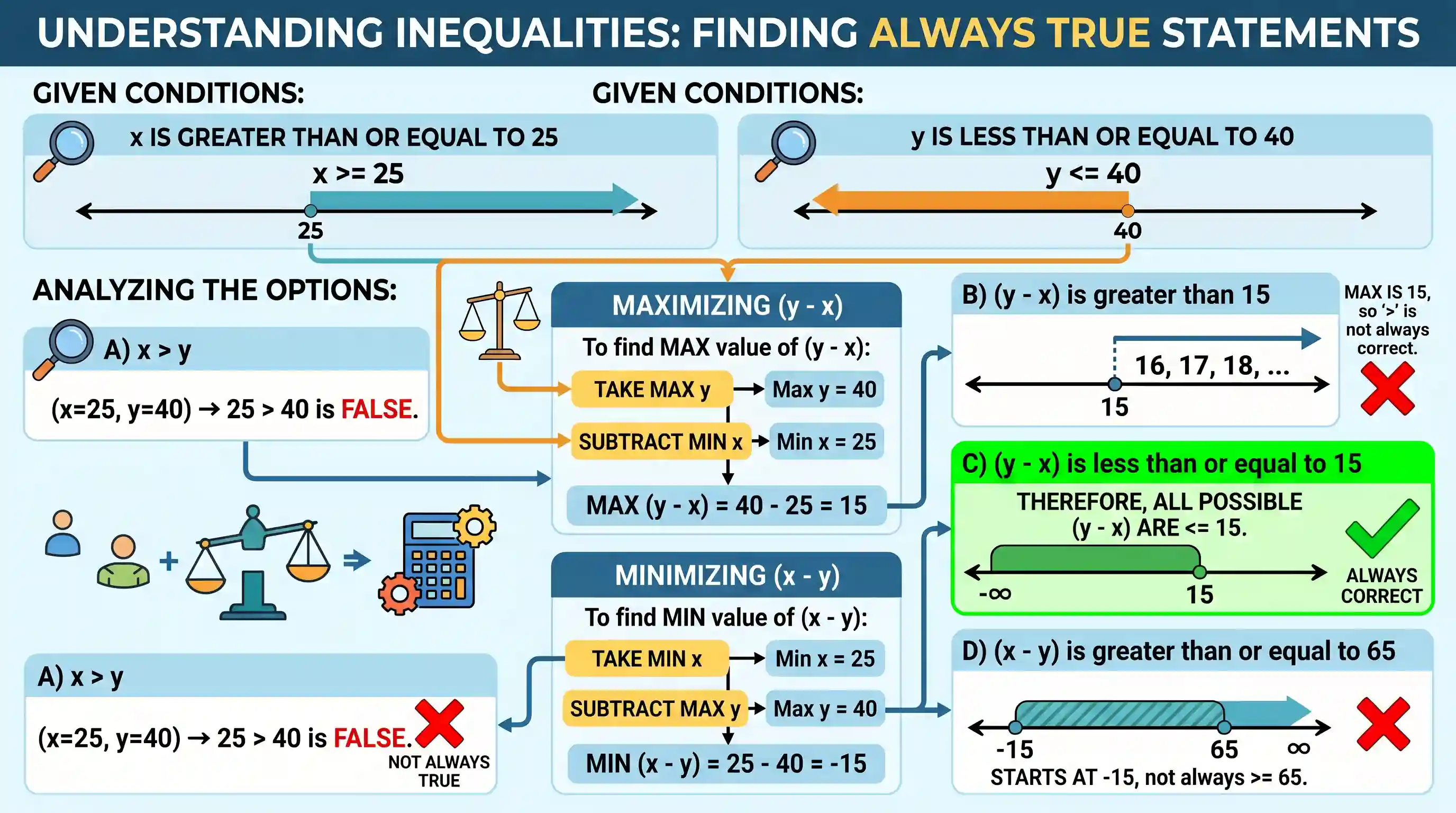
If x is greater than or equal to 25 and y is less than or equal to 40, then which one of the following is always correct?

- Ax is greater than y
- B(y - x) is greater than 15
- C(y - x) is less than or equal to 15Correct
- D(x - y) is greater than or equal to 65
Explanation
The given conditions are:
- x is greater than or equal to 25 (x >= 25)
- y is less than or equal to 40 (y = 25 which implies -x <= -25 (multiplying an inequality by -1 reverses the sign) Adding these two inequalities: y + (-x) <= 40 + (-25) y - x <= 15 This inequality is derived directly from the given conditions and is always true. Hence, this option is always correct.
D) (x - y) is greater than or equal to 65 To find the minimum possible value of (x - y), we take the minimum possible x and the maximum possible y. Minimum x = 25 Maximum y = 40 So, the minimum value of (x - y) = 25 - 40 = -15. Since (x - y) can be -15, it is not always greater than or equal to 65. Hence, this is not always correct.
Therefore, the only statement that is always correct is C.
Related questions
More UPSC Prelims practice from the same subject and topic.
- Prelims 2019CSATQuantitative Aptitude
The number of times the digit 5 will appear while writing the integers from 1 to 1000 is
- Prelims 2019CSATQuantitative Aptitude
A solid cube is painted yellow, blue and black such that opposite faces are of same colour. The cube is then cut into 36 cubes of two different sizes such that 32 cubes are small and the other four cu…
- Prelims 2019CSATQuantitative Aptitude
A and B are two heavy steel blocks. If B is placed on the top of A, the weight increases by 60%. How much weight will reduce with respect to the total weight of A and B, if B is removed from the top o…
- Prelims 2019CSATQuantitative Aptitude
The number of parallelograms that can be formed from a set of four parallel lines intersecting another set of four parallel lines, is
- Prelims 2019CSATQuantitative Aptitude
In a school every student is assigned a unique identification number. A student is a football player if and only if the identification number is divisible by 4, whereas a student is a cricketer if and…
- Prelims 2019CSATQuantitative Aptitude
When a runner was crossing the 12 km mark, she was informed that she had completed only 80% of the race. How many kilometres was the runner supposed to run in this event?