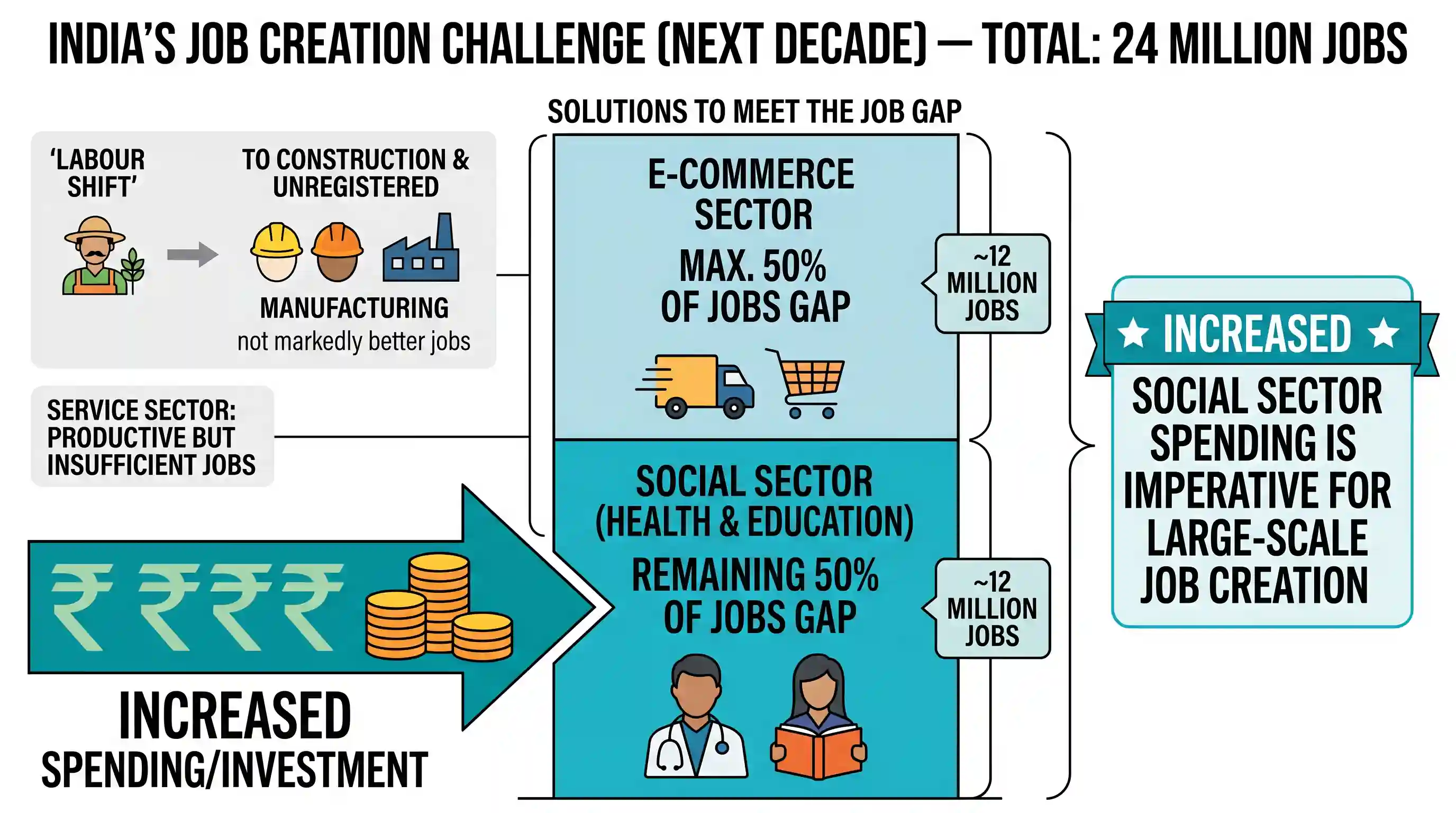
In India, over the last decade or so, labour has been departing agriculture, but is only going to construction and unregistered manufacturing which are not markedly better jobs. Services, where labour tends to be most productive, are not generating the additional jobs the country needs. India will need 24 million or so jobs over the next decade. The new sector, e-commerce, can at best close only half the jobs gap. Only those sectors that drive domestic demand such as health and education can comfortably fill the other half. Which one of the following is best Implied in the passage?

- AStrong measures need to be taken to reduce the rural to urban migration of labour
- BThe working condition in construction and unregistered manufacturing needs to be improved
- Cservice sector has been reducing the problem of unemployment
- DIncreased social sector spending is imperative for large-scale job creation.Correct
Explanation
The passage highlights a significant job gap (24 million over the next decade) that cannot be fully met by existing sectors or even new ones like e-commerce. It explicitly states that "Only those sectors that drive domestic demand such as health and education can comfortably fill the other half" of the job gap. Health and education are key components of the social sector. For these sectors to generate the necessary jobs, there must be increased investment or spending in them. Therefore, increased social sector spending is presented as an imperative for large-scale job creation.
Analyzing the options:
A) Strong measures need to be taken to reduce the rural to urban migration of labour - The passage notes labor departing agriculture but doesn't imply that stopping this migration is the solution or even desirable. The focus is on the quality and quantity of jobs available, not on preventing movement.
B) The working condition in construction and unregistered manufacturing needs to be improved - The passage mentions these jobs are "not markedly better," implying poor conditions. While improving them is good, the central problem addressed is the creation of millions of new jobs, which is a different issue from improving existing ones.
C) service sector has been reducing the problem of unemployment - The passage directly contradicts this, stating, "Services... are not generating the additional jobs the country needs."
D) Increased social sector spending is imperative for large-scale job creation - This aligns perfectly with the passage's conclusion that health and education (social sectors) are the only sectors that can fill a significant portion of the job gap. To do so, investment/spending in these sectors would be essential.
Related questions
More UPSC Prelims practice from the same subject and topic.
- Prelims 2020CSATReading Comprehension
In India, the current focus on the right to privacy is based on some new realities of the digital age. A right is a substantive right only if it works in all situations, and for everyone. A right to f…
- Prelims 2020CSATReading Comprehension
One of the biggest ironies around water is that it comes from rivers and other wetlands. Yet it is seen as divorced from them. While water is used as a resource, public policy does not always grasp th…
- Prelims 2020CSATReading Comprehension
Asset allocation is the most important investment decision we will ever make, and sadly, most of us do not give that decision the importance it deserves. We are adamant about seeking predictability wi…
- Prelims 2020CSATReading Comprehension
Although most of the Genetically Modified (GM) crops cultivated now are genetically engineered for a single trait, in future, crops genetically engineered for more than one trait will be the norm. Thu…
- Prelims 2020CSATReading Comprehension
Although most of the Genetically Modified (GM) crops cultivated now are genetically engineered for a single trait, in future, crops genetically engineered for more than one trait will be the norm. Thu…
- Prelims 2020CSATReading Comprehension
Private investment in general is volatile. Foreign private investment is more volatile because the available investment avenues are significantly greater (i.e., the entire world). Therefore, the respo…