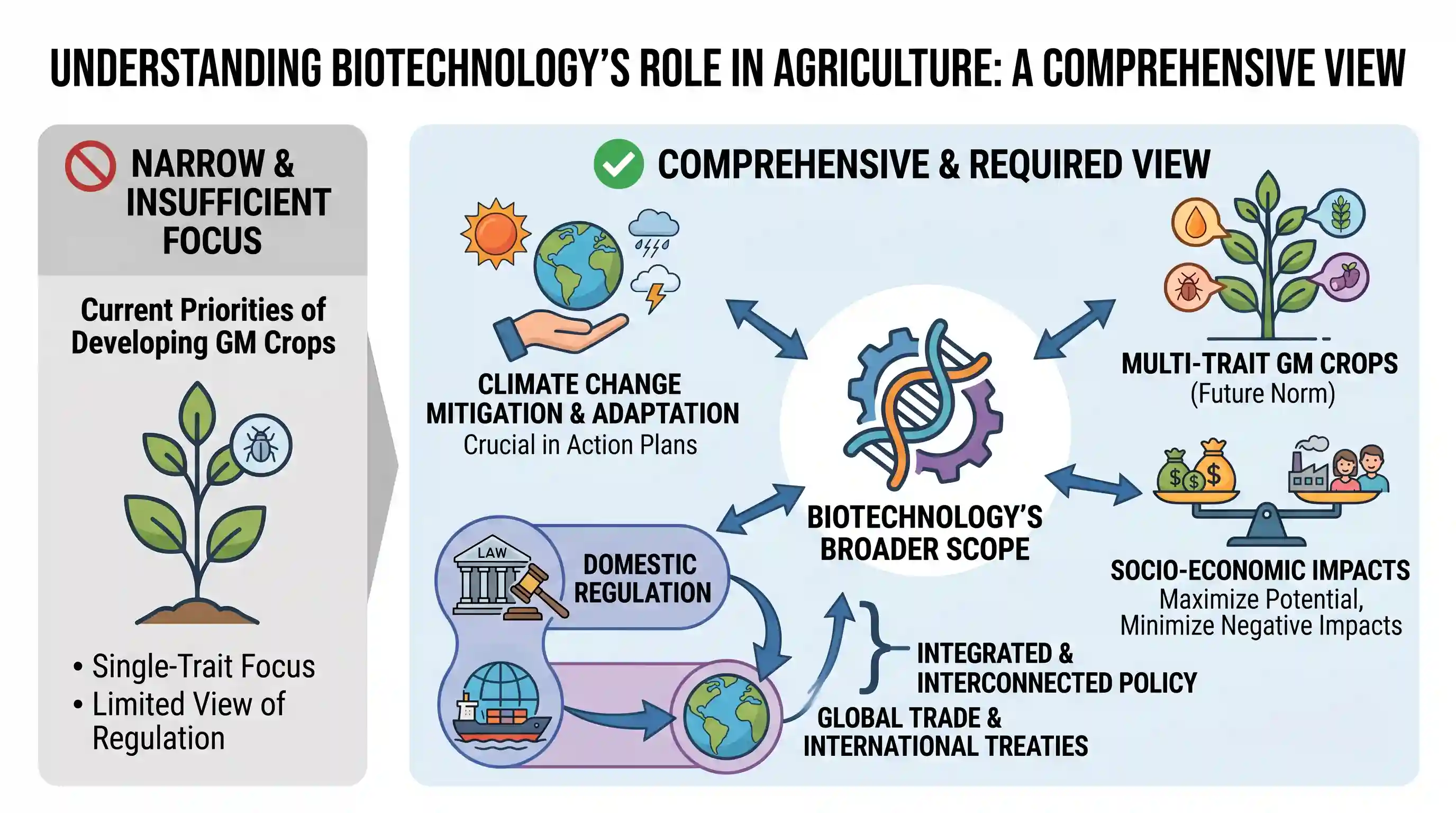
Although most of the Genetically Modified (GM) crops cultivated now are genetically engineered for a single trait, in future, crops genetically engineered for more than one trait will be the norm. Thus, biotechnology's role in agriculture and the regulation or the same cannot be understood solely in the context of the current generation of GM crops. Instead, there is a need to take a comprehensive look, taking into account various aspects, including socio-economic impacts, so that the potential or the technology can be harnessed while minimizing negative impacts. Given the importance of biotechnology in developing varieties that can help in climate change mitigation and adaptation, not using biotechnology as a part of the climate change action plan cannot be an option. Domestic regulation of biotechnology cannot be viewed in isolation of trade policy and obligations under various international treaties and conventions. Which one of the following statements best implies the crux of the passage?

- APrecautionary principle is not given importance in current debate on developing GM crops
- BBiotechnology is not currently used in climate change mitigation and adaptation mechanisms
- CBiotechnology's role is not confined to the current priorities of developing GM cropsCorrect
- DThe negative Impacts of not biotechnology are properly understood
Explanation
The passage argues that our understanding and regulation of biotechnology should not be limited to the current generation of Genetically Modified (GM) crops, which are mostly single-trait. It emphasizes that future crops will be multi-trait, and biotechnology has a crucial role in climate change mitigation and adaptation, socio-economic impacts, trade policy, and international obligations.
Let's analyze the options:
A) Precautionary principle is not given importance in current debate on developing GM crops The passage mentions "minimizing negative impacts," which aligns with the precautionary principle, but it doesn't state that the principle is not given importance. It rather calls for a more comprehensive application of such considerations.
B) Biotechnology is not currently used in climate change mitigation and adaptation mechanisms The passage states that "not using biotechnology as a part of the climate change action plan cannot be an option," implying its critical importance and future necessity. It doesn't explicitly state that it's not currently used, but rather highlights its potential and required future role, expanding its scope.
C) Biotechnology's role is not confined to the current priorities of developing GM crops This statement directly captures the crux. The passage explicitly states that "biotechnology's role in agriculture and the regulation or the same cannot be understood solely in the context of the current generation of GM crops." It then goes on to list various other aspects (multi-trait crops, climate change, socio-economic impacts, trade, international treaties) that expand its role beyond current priorities.
D) The negative Impacts of not biotechnology are properly understood The passage states that not using biotechnology for climate change is "not an option," implying severe negative consequences if it's not used. However, it doesn't explicitly say these negative impacts are properly understood. The focus is more on understanding the technology's broader potential and impacts, rather than the understanding of the specific negative impacts of not using it.
Therefore, option C best implies the central message that the scope and understanding of biotechnology's role are much broader than its current, limited application and perception.
Related questions
More UPSC Prelims practice from the same subject and topic.
- Prelims 2020CSATReading Comprehension
In India, over the last decade or so, labour has been departing agriculture, but is only going to construction and unregistered manufacturing which are not markedly better jobs. Services, where labour…
- Prelims 2020CSATReading Comprehension
In India, the current focus on the right to privacy is based on some new realities of the digital age. A right is a substantive right only if it works in all situations, and for everyone. A right to f…
- Prelims 2020CSATReading Comprehension
One of the biggest ironies around water is that it comes from rivers and other wetlands. Yet it is seen as divorced from them. While water is used as a resource, public policy does not always grasp th…
- Prelims 2020CSATReading Comprehension
Asset allocation is the most important investment decision we will ever make, and sadly, most of us do not give that decision the importance it deserves. We are adamant about seeking predictability wi…
- Prelims 2020CSATReading Comprehension
Although most of the Genetically Modified (GM) crops cultivated now are genetically engineered for a single trait, in future, crops genetically engineered for more than one trait will be the norm. Thu…
- Prelims 2020CSATReading Comprehension
Private investment in general is volatile. Foreign private investment is more volatile because the available investment avenues are significantly greater (i.e., the entire world). Therefore, the respo…