In India, the current focus on the right to privacy is based on some new realities of the digital age. A right is a substantive right only if it works in all situations, and for everyone. A right to free expression for an individual about her exploitation, for instance, is meaningless without actual availability of security that guarantees that private force cannot be used to thwart this right. The role of the State, therefore, is not just to abstain from preventing rightful free expression, but also to actively ensure that private parties are not able to block it. On the basis of the above passage, the following assumptions have been made: 1. State should have some institutions to ensure its appropriate role in a digital society. 2. State should ensure that private parties do not violate the citizens' right to privacy. 3. Digital economy is not compatible with the idea of not violating the citizens' privacy. Which of the above assumptions is/are valid?

- A1 and 2Correct
- B3 Only
- C1 and 3
- D2 only
Explanation
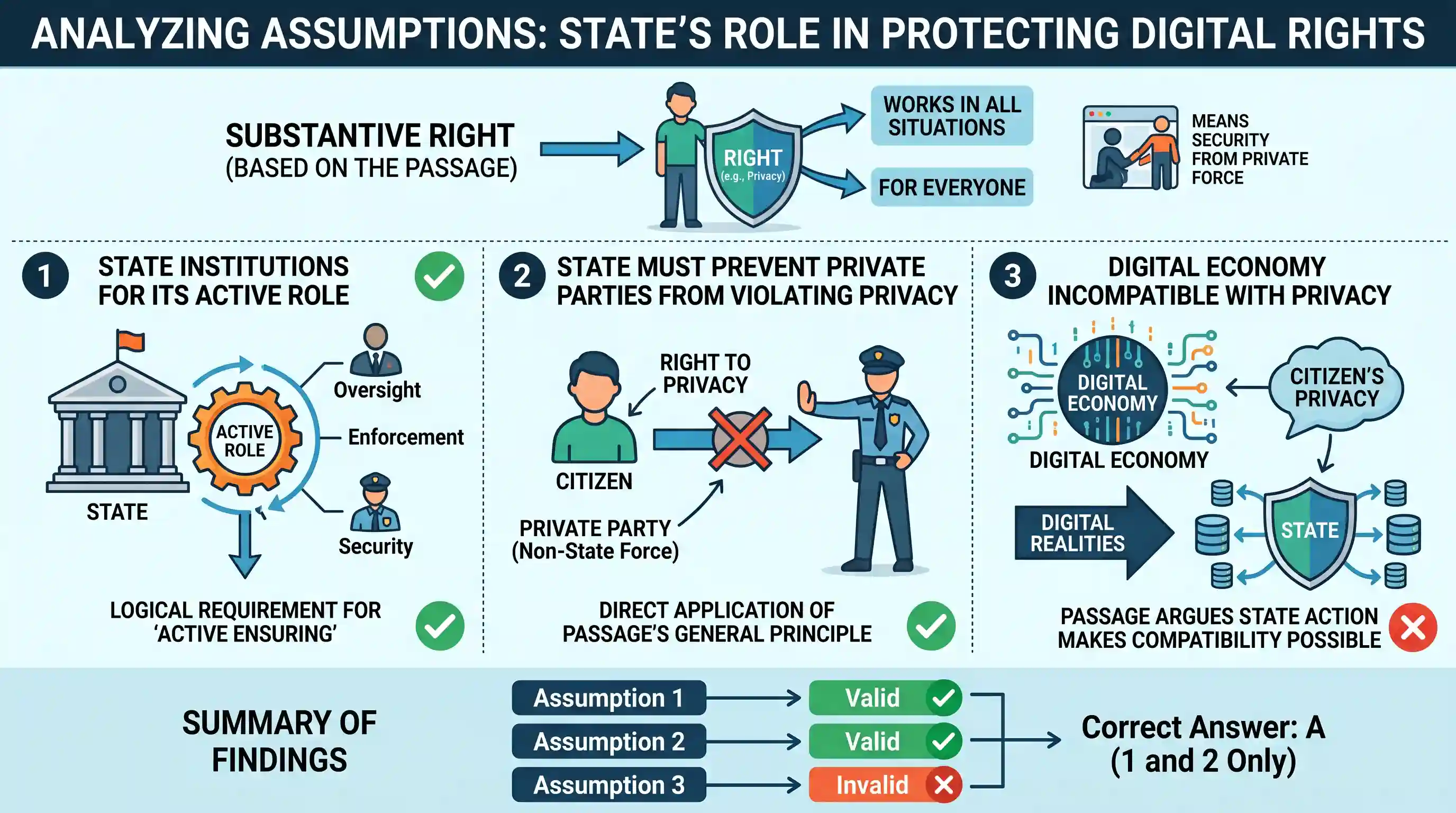
The passage argues that in the digital age, a right (like privacy or free expression) is substantive only if the State actively ensures that private parties cannot block or violate it.
Let's analyze each assumption:
-
State should have some institutions to ensure its appropriate role in a digital society.
- The passage states the State's role is "not just to abstain... but also to actively ensure that private parties are not able to block it." For the State to "actively ensure" something, it implicitly needs mechanisms, structures, or institutions to carry out this active role. This is a logical necessity for the State to fulfill its described responsibility. Thus, this assumption is valid.
-
State should ensure that private parties do not violate the citizens' right to privacy.
- The passage begins by focusing on "the right to privacy" in the digital age. It then uses the example of "free expression" to illustrate the broader principle that the State must "actively ensure that private parties are not able to block it." Applying this general principle back to the initial subject of privacy, it directly implies that the State should actively ensure private parties do not violate the citizens' right to privacy. Thus, this assumption is valid.
-
Digital economy is not compatible with the idea of not violating the citizens' privacy.
- The passage highlights the challenges to privacy in the digital age and the State's necessary role in protecting it. It does not state or imply that the digital economy is inherently incompatible with privacy. Instead, it suggests that with active state intervention, privacy can be protected even amidst the realities of the digital age. This assumption is not supported by the passage.
Based on this analysis, assumptions 1 and 2 are valid.
The final answer is A.
Related questions
More UPSC Prelims practice from the same subject and topic.
- Prelims 2020CSATReading Comprehension
In India, over the last decade or so, labour has been departing agriculture, but is only going to construction and unregistered manufacturing which are not markedly better jobs. Services, where labour…
- Prelims 2020CSATReading Comprehension
One of the biggest ironies around water is that it comes from rivers and other wetlands. Yet it is seen as divorced from them. While water is used as a resource, public policy does not always grasp th…
- Prelims 2020CSATReading Comprehension
Asset allocation is the most important investment decision we will ever make, and sadly, most of us do not give that decision the importance it deserves. We are adamant about seeking predictability wi…
- Prelims 2020CSATReading Comprehension
Although most of the Genetically Modified (GM) crops cultivated now are genetically engineered for a single trait, in future, crops genetically engineered for more than one trait will be the norm. Thu…
- Prelims 2020CSATReading Comprehension
Although most of the Genetically Modified (GM) crops cultivated now are genetically engineered for a single trait, in future, crops genetically engineered for more than one trait will be the norm. Thu…
- Prelims 2020CSATReading Comprehension
Private investment in general is volatile. Foreign private investment is more volatile because the available investment avenues are significantly greater (i.e., the entire world). Therefore, the respo…