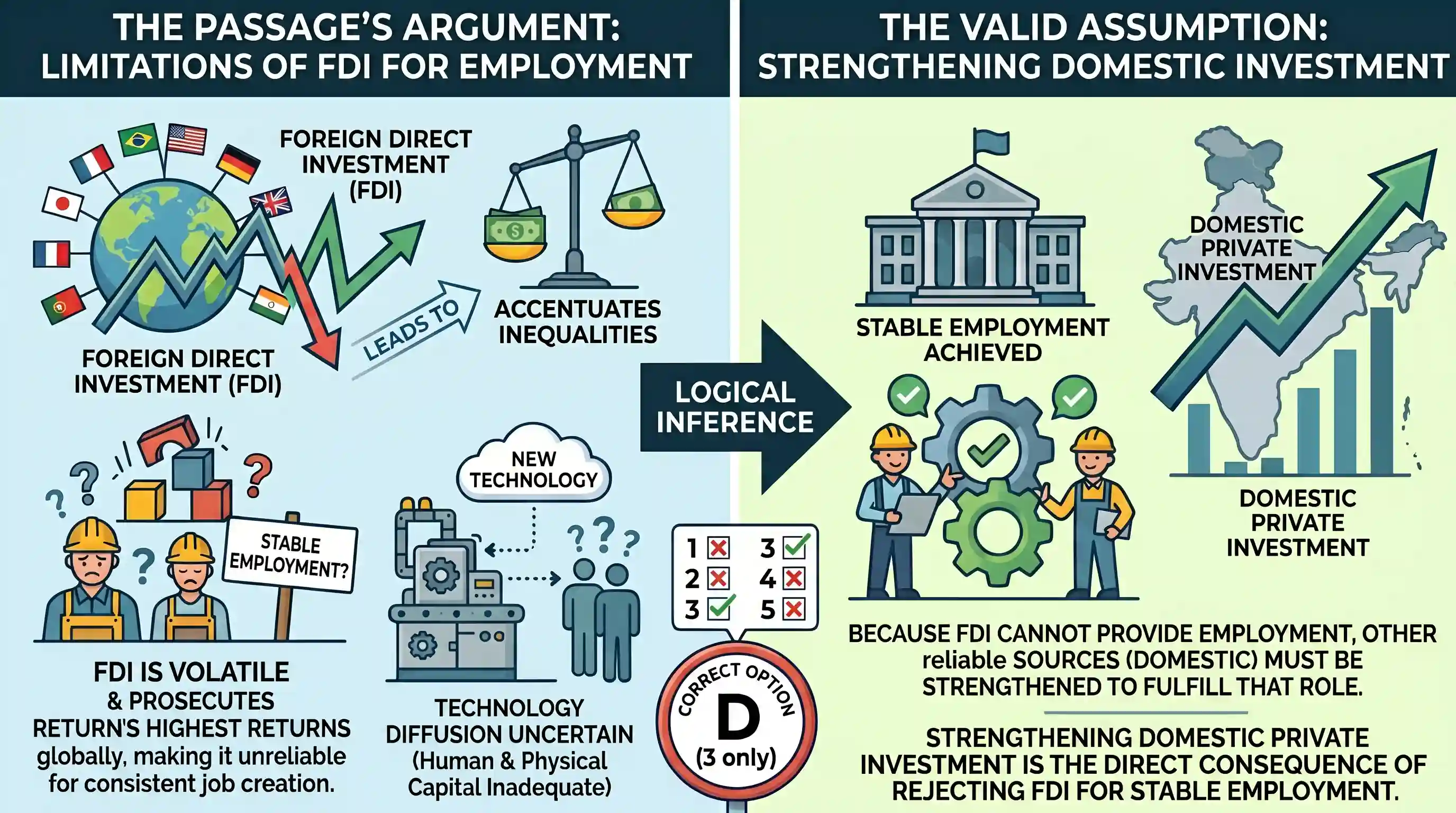
Private investment in general is volatile. Foreign private investment is more volatile because the available investment avenues are significantly greater (i.e., the entire world). Therefore, the responsibility of providing employment cannot be left to Foreign Direct investment (FDI). The current FDI inflows are volatile over time and across sectors and regions, which is a necessary consequence of their search for the highest returns. The adverse consequences are unstable employment and an accentuation of income and regional inequalities. A probable positive consequence of foreign investment is the inflow of new technology and its subsequent diffusion. However, the technology diffusion is not at all certain because the existing state of physical and human capital in India may prove inadequate for the diffusion. With reference to the above passage, the following assumptions have been made: Relying on foreign investment in the long run is not an economically sound policy. Policies must be undertaken to reduce volatility in foreign private investment. Policies must be undertaken to strengthen domestic private investment. Public investment should be given priority over private investment. Substantial public investment in education and health should be undertaken. Which of the above assumptions is/are valid?

- A1,2,4
- B1,3,5
- C2,4,5
- D3Correct
Explanation
The passage highlights that Foreign Direct Investment (FDI) is volatile, unsuitable for providing stable employment, and its positive consequence of technology diffusion is uncertain due to India's inadequate human and physical capital.
Let's analyze each assumption:
-
Relying on foreign investment in the long run is not an economically sound policy.
- The passage argues that FDI cannot be relied upon for employment and casts doubt on technology diffusion. While this implies that reliance on FDI for these specific aspects is unsound, the passage does not make a general statement that relying on FDI in the long run for all purposes is an unsound policy. It focuses on specific limitations rather than a blanket condemnation. Therefore, this is an overgeneralization beyond the passage's scope.
-
Policies must be undertaken to reduce volatility in foreign private investment.
- The passage describes FDI volatility as a "necessary consequence of their search for the highest returns" and due to "significantly greater" investment avenues globally. It presents this volatility as an inherent characteristic, not something that policies can or should necessarily reduce. Instead, the passage suggests that because of this inherent volatility, FDI should not be relied upon for employment.
-
Policies must be undertaken to strengthen domestic private investment.
- The passage explicitly states that "the responsibility of providing employment cannot be left to Foreign Direct investment (FDI)" due to its volatility. If employment generation is a crucial goal and FDI is deemed unreliable for it, then logically, other sources of investment, particularly domestic ones (including domestic private investment), must be strengthened to fulfill this responsibility. This is a direct and strong inference from the passage's argument.
-
Public investment should be given priority over private investment.
- The passage discusses the limitations of foreign private investment. It does not compare public investment with private investment or suggest that one should be prioritized over the other.
-
Substantial public investment in education and health should be undertaken.
- The passage mentions that "the existing state of physical and human capital in India may prove inadequate for the diffusion" of new technology. While this points to a need for improving human capital, the passage does not specifically prescribe public investment, nor does it recommend that such investment be substantial. It merely identifies a deficiency without detailing a specific policy solution or its scale.
Based on this analysis, only assumption 3 is a valid inference directly supported by the passage's arguments.
The final answer is D
Related questions
More UPSC Prelims practice from the same subject and topic.
- Prelims 2020CSATReading Comprehension
In India, over the last decade or so, labour has been departing agriculture, but is only going to construction and unregistered manufacturing which are not markedly better jobs. Services, where labour…
- Prelims 2020CSATReading Comprehension
In India, the current focus on the right to privacy is based on some new realities of the digital age. A right is a substantive right only if it works in all situations, and for everyone. A right to f…
- Prelims 2020CSATReading Comprehension
One of the biggest ironies around water is that it comes from rivers and other wetlands. Yet it is seen as divorced from them. While water is used as a resource, public policy does not always grasp th…
- Prelims 2020CSATReading Comprehension
Asset allocation is the most important investment decision we will ever make, and sadly, most of us do not give that decision the importance it deserves. We are adamant about seeking predictability wi…
- Prelims 2020CSATReading Comprehension
Although most of the Genetically Modified (GM) crops cultivated now are genetically engineered for a single trait, in future, crops genetically engineered for more than one trait will be the norm. Thu…
- Prelims 2020CSATReading Comprehension
Although most of the Genetically Modified (GM) crops cultivated now are genetically engineered for a single trait, in future, crops genetically engineered for more than one trait will be the norm. Thu…