Many opportunities to harness the highly skewed, seasonal and spatial distribution of monsoon flows, which occur in a four-month period from June to September annually, have been lost. Since these few months account for most or the rainfall and consequent freshwater availability, the need for holding rainwater in reservoirs, for subsequently releasing it for use over the year, is a necessity nobody can afford to overlook. Climate change will continue to affect weather conditions and create water shortages and excesses. While millions suffer from droughts and floods, waters in the country's many rivers flow unutilized, and are discharged into the sea every year With reference to the above passage, which of the following could be the most rational and practical implications for India? Inter- linking of rivers should be undertaken. A network of dams and canals should be built across the country for proper distribution of water. Farmers should be provided easy loans for digging borewells. Usage or water for agriculture should be regulated by law. Distribution of river water among regions should be regulated by the Union Government. Select the correct answer using the code given below

- A1,2Correct
- B2,4,5
- C1,3,4
- D2,3,5
Explanation
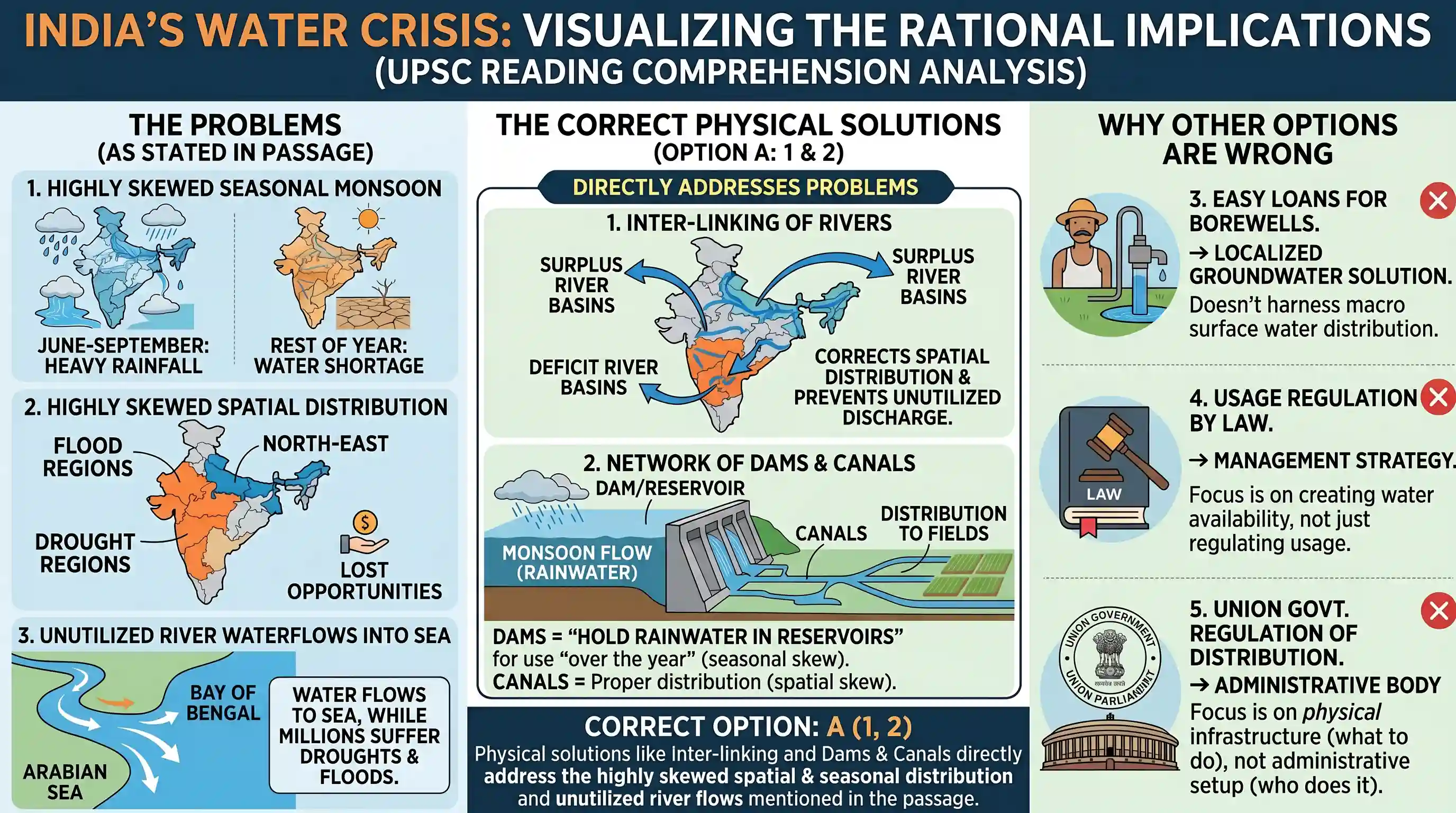
The passage highlights two main problems:
- The highly skewed, seasonal, and spatial distribution of monsoon flows, leading to lost opportunities, water shortages, and excesses (droughts and floods).
- Unutilized river waters flowing into the sea.
It emphasizes the "need for holding rainwater in reservoirs, for subsequently releasing it for use over the year."
Let's analyze each statement:
-
Inter-linking of rivers should be undertaken. This directly addresses the "spatial distribution" problem by moving water from surplus to deficit regions and helps utilize "unutilized" river waters that otherwise flow into the sea. This is a rational and practical implication.
-
A network of dams and canals should be built across the country for proper distribution of water. "Dams" fulfill the "need for holding rainwater in reservoirs" for use "over the year." "Canals" are essential for "proper distribution of water" from these reservoirs, addressing both seasonal and spatial distribution issues. This is a direct and practical implication.
-
Farmers should be provided easy loans for digging borewells. While borewells can help individual farmers, they are a localized solution for groundwater extraction and do not address the macro-level problems of harnessing monsoon flows, preventing unutilized river water discharge, or large-scale surface water distribution mentioned in the passage. This is not the most rational and practical implication for the broad issues discussed.
-
Usage of water for agriculture should be regulated by law. The passage focuses on the availability and distribution of water, not primarily on regulating its usage. While efficient usage is important, the passage's core problem is the failure to capture and distribute available water, not necessarily over-usage as the primary issue.
-
Distribution of river water among regions should be regulated by the Union Government. The passage implies a need for better distribution, but it doesn't specifically advocate for Union Government regulation over other bodies. It focuses on the physical infrastructure and management (what needs to be done), rather than the specific administrative body (who should do it). Statements 1 and 2 are about the physical solutions directly implied by the passage.
Therefore, statements 1 and 2 are the most direct, rational, and practical implications derived from the problems and suggested solutions in the passage.
The final answer is A
Related questions
More UPSC Prelims practice from the same subject and topic.
- Prelims 2020CSATReading Comprehension
In India, over the last decade or so, labour has been departing agriculture, but is only going to construction and unregistered manufacturing which are not markedly better jobs. Services, where labour…
- Prelims 2020CSATReading Comprehension
In India, the current focus on the right to privacy is based on some new realities of the digital age. A right is a substantive right only if it works in all situations, and for everyone. A right to f…
- Prelims 2020CSATReading Comprehension
One of the biggest ironies around water is that it comes from rivers and other wetlands. Yet it is seen as divorced from them. While water is used as a resource, public policy does not always grasp th…
- Prelims 2020CSATReading Comprehension
Asset allocation is the most important investment decision we will ever make, and sadly, most of us do not give that decision the importance it deserves. We are adamant about seeking predictability wi…
- Prelims 2020CSATReading Comprehension
Although most of the Genetically Modified (GM) crops cultivated now are genetically engineered for a single trait, in future, crops genetically engineered for more than one trait will be the norm. Thu…
- Prelims 2020CSATReading Comprehension
Although most of the Genetically Modified (GM) crops cultivated now are genetically engineered for a single trait, in future, crops genetically engineered for more than one trait will be the norm. Thu…