Although most of the Genetically Modified (GM) crops cultivated now are genetically engineered for a single trait, in future, crops genetically engineered for more than one trait will be the norm. Thus, biotechnology's role in agriculture and the regulation or the same cannot be understood solely in the context of the current generation of GM crops. Instead, there is a need to take a comprehensive look, taking into account various aspects, including socio- economic impacts, so that the potential or the technology can be harnessed while minimizing negative impacts. Given the importance of biotechnology in developing varieties that can help in climate change mitigation and adaptation, not using biotechnology as a part of the climate change action plan cannot be an option. Domestic regulation of biotechnology cannot be viewed in isolation of trade policy and obligations under various international treaties and conventions. With reference to the above passage, the following assumptions have been made: Biotechnology regulation is an evolving process. Participation of people is needed in policy decisions regarding biotechnology regulation. Biotechnology regulation should take into account socio- economic aspects in decision- making. Wider involvement of political executive in biotechnology regulation improves its effectiveness in dealing with the country's trade Policies and international obligations. Which of the above assumptions are valid?

- A1, 2 and 4 only
- B1 and 3 onlyCorrect
- C2, 3 and 4 only
- D1, 2, 3 and 4
Explanation
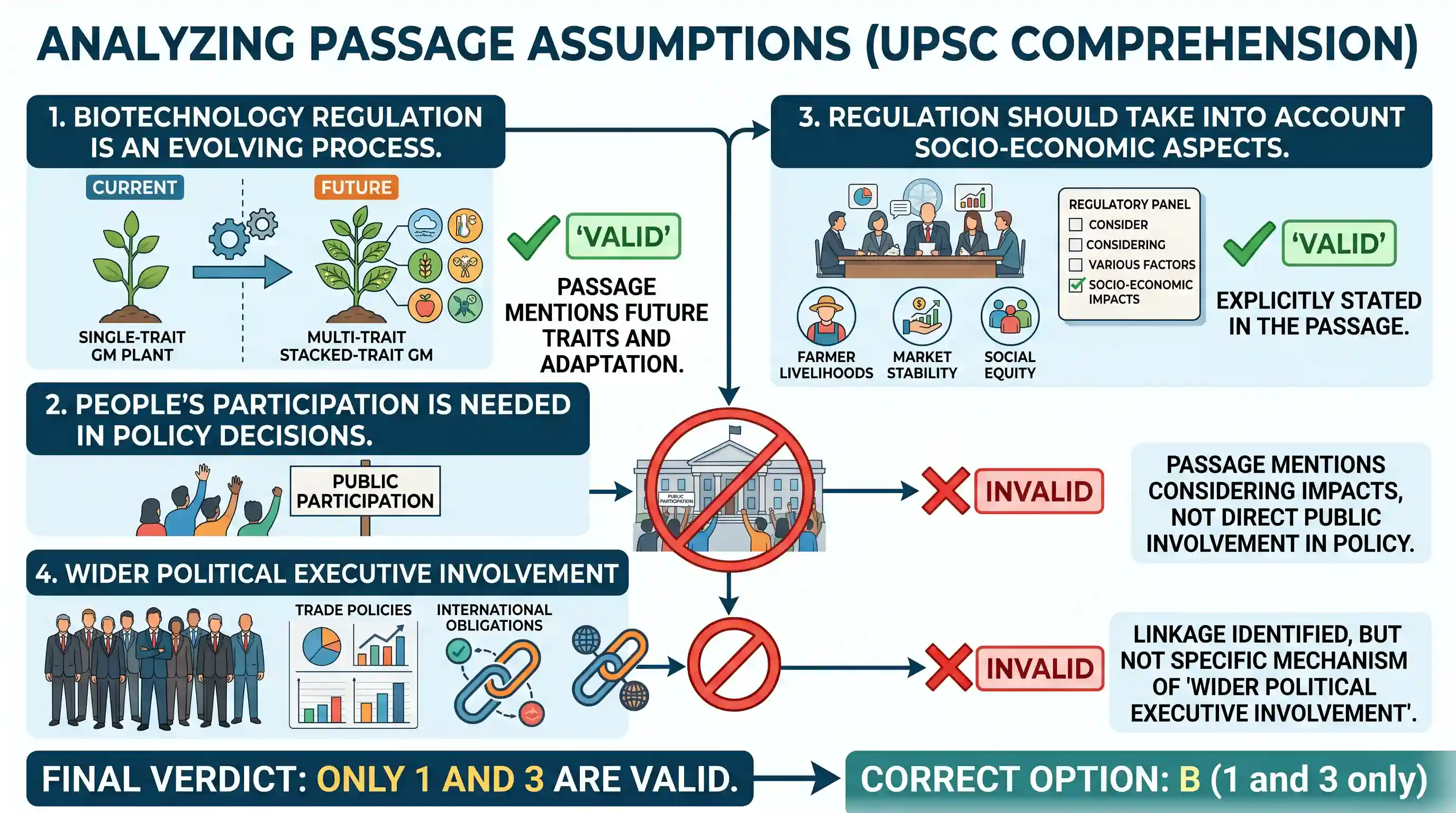
The passage supports assumptions 1 and 3.
-
Biotechnology regulation is an evolving process. The passage states that "in future, crops genetically engineered for more than one trait will be the norm" and that regulation "cannot be understood solely in the context of the current generation of GM crops." This clearly implies that regulation must adapt to future advancements and changing contexts, indicating an evolving process.
-
Participation of people is needed in policy decisions regarding biotechnology regulation. The passage mentions taking into account "socio-economic impacts" but does not explicitly state or imply that the participation of people in policy decisions is needed. It talks about a comprehensive look and considering impacts, which can be done by experts or policymakers without direct public participation in the decision-making process.
-
Biotechnology regulation should take into account socio-economic aspects in decision-making. The passage explicitly states, "there is a need to take a comprehensive look, taking into account various aspects, including socio- economic impacts." This directly supports the assumption.
-
Wider involvement of political executive in biotechnology regulation improves its effectiveness in dealing with the country's trade Policies and international obligations. The passage states that "Domestic regulation of biotechnology cannot be viewed in isolation of trade policy and obligations under various international treaties and conventions." While it highlights the interconnectedness, it does not suggest that wider involvement of the political executive is the specific solution or mechanism to improve effectiveness in this regard. It only points out the necessity of considering these linkages.
Therefore, only assumptions 1 and 3 are valid.
Related questions
More UPSC Prelims practice from the same subject and topic.
- Prelims 2020CSATReading Comprehension
In India, over the last decade or so, labour has been departing agriculture, but is only going to construction and unregistered manufacturing which are not markedly better jobs. Services, where labour…
- Prelims 2020CSATReading Comprehension
In India, the current focus on the right to privacy is based on some new realities of the digital age. A right is a substantive right only if it works in all situations, and for everyone. A right to f…
- Prelims 2020CSATReading Comprehension
One of the biggest ironies around water is that it comes from rivers and other wetlands. Yet it is seen as divorced from them. While water is used as a resource, public policy does not always grasp th…
- Prelims 2020CSATReading Comprehension
Asset allocation is the most important investment decision we will ever make, and sadly, most of us do not give that decision the importance it deserves. We are adamant about seeking predictability wi…
- Prelims 2020CSATReading Comprehension
Although most of the Genetically Modified (GM) crops cultivated now are genetically engineered for a single trait, in future, crops genetically engineered for more than one trait will be the norm. Thu…
- Prelims 2020CSATReading Comprehension
Private investment in general is volatile. Foreign private investment is more volatile because the available investment avenues are significantly greater (i.e., the entire world). Therefore, the respo…