People will invest in education whenever they are granted the economic freedom to fully enjoy benefits Again, this is for the obvious reason that the return on education increases as the level of economic freedom rises. When people, thanks to lower tax rates, are allowed to retain of the higher income that they gain from incremental level of education, it makes sense to invest in education. On the other hand, when the government decides to tax the higher income of educated individuals at even higher rates, it makes very little sense to invest in educating oneself further. The same incentives apply to parents who decide on whether to invest in their children's education. With reference to the above passage, the following assumptions have been made: Lower tax rates in a country invariably translate into greater investments in higher education. Investment in the education of children ensures their economic freedom. Economic freedom has a positive impact on building up human capital. Which of the above assumptions is/are valid?

- A1 onlyCorrect
- B2 only
- C3 only
- D1,2 and 3
Explanation
The passage argues that people invest in education when they have the economic freedom to enjoy its benefits, and that lower tax rates increase this incentive by allowing individuals to retain more of the higher income gained from education.
Let's analyze each statement:
-
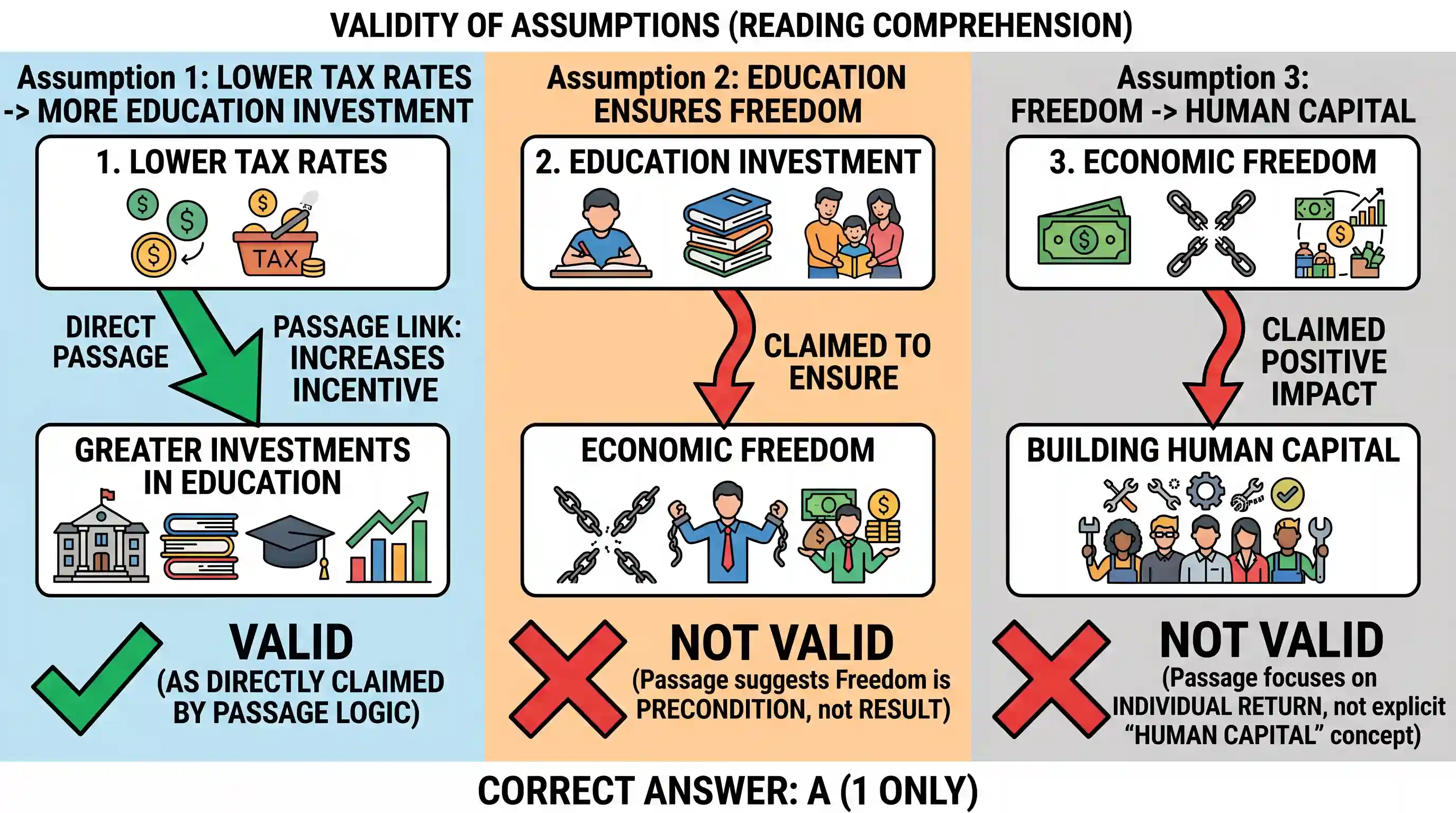
Lower tax rates in a country invariably translate into greater investments in higher education. The passage states, "When people, thanks to lower tax rates, are allowed to retain of the higher income that they gain from incremental level of education, it makes sense to invest in education." It also says, "On the other hand, when the government decides to tax the higher income of educated individuals at even higher rates, it makes very little sense to invest in educating oneself further." This establishes a direct, cause-and-effect relationship where lower tax rates are presented as a consistent driver for increased investment in education. The passage assumes this direct translation for its argument to hold. Therefore, this is a valid assumption made by the passage.
-
Investment in the education of children ensures their economic freedom. The passage discusses parents deciding "whether to invest in their children's education" based on the same incentives (economic freedom to enjoy benefits, return on education). It implies that education, combined with economic freedom, allows individuals to enjoy benefits and higher income. However, it does not state that investment in education ensures economic freedom. Economic freedom is presented as a prerequisite for enjoying the benefits of education, not an assured outcome of education itself. Therefore, this statement is not a valid assumption.
-
Economic freedom has a positive impact on building up human capital. The passage states, "People will invest in education whenever they are granted the economic freedom to fully enjoy benefits." Investment in education is a primary way to build human capital. So, if economic freedom leads to more investment in education, it logically follows that economic freedom has a positive impact on building human capital. However, the passage focuses on individual incentives and the "return on education" or "higher income" rather than explicitly discussing "human capital" as a concept. The passage states that economic freedom leads to investment in education. The link between investment in education and human capital is a widely accepted economic concept, but the passage's argument about incentives does not rely on explicitly assuming the broader concept of "human capital" for its internal logic. It relies on the assumption that people respond to higher returns from education. This is more of a logical deduction or an external economic truth, rather than an unstated assumption made by the passage to support its specific argument about incentives.
Based on this analysis, only statement 1 is a valid assumption made by the passage.
The final answer is A
Related questions
More UPSC Prelims practice from the same subject and topic.
- Prelims 2020CSATReading Comprehension
In India, over the last decade or so, labour has been departing agriculture, but is only going to construction and unregistered manufacturing which are not markedly better jobs. Services, where labour…
- Prelims 2020CSATReading Comprehension
In India, the current focus on the right to privacy is based on some new realities of the digital age. A right is a substantive right only if it works in all situations, and for everyone. A right to f…
- Prelims 2020CSATReading Comprehension
One of the biggest ironies around water is that it comes from rivers and other wetlands. Yet it is seen as divorced from them. While water is used as a resource, public policy does not always grasp th…
- Prelims 2020CSATReading Comprehension
Asset allocation is the most important investment decision we will ever make, and sadly, most of us do not give that decision the importance it deserves. We are adamant about seeking predictability wi…
- Prelims 2020CSATReading Comprehension
Although most of the Genetically Modified (GM) crops cultivated now are genetically engineered for a single trait, in future, crops genetically engineered for more than one trait will be the norm. Thu…
- Prelims 2020CSATReading Comprehension
Although most of the Genetically Modified (GM) crops cultivated now are genetically engineered for a single trait, in future, crops genetically engineered for more than one trait will be the norm. Thu…