India has tremendous potential for solar energy. We all realize that we have to stop burning fossil fuels to meet our energy needs. But certain renewable resources are still going through their cost Curves and learning curves to get the required amount of output. The Indian Government has strongly committed to its targets of reducing emissions by 33 percent by 2030, and towards this it has initiated a strong push towards a gas-based economy and has also invested heavily in renewable energy. However, business houses are wary of investing too heavily in renewable energy at a time when the technology is not yet ready. Which one of the following is the most logical and rational inference that can be made from the above passage?

- AIndia's commitment to reduce emissions by 33% is unlikely to be achieved
- BIndia should import gas rather than invest in renewable resources
- CGetting renewable resources to market too soon may be costlyCorrect
- DIndia should put in more efforts in the exploration of natural gas.
Explanation
The passage highlights two main points regarding renewable energy:
- Renewable resources are "still going through their cost Curves and learning curves to get the required amount of output." This implies they are not yet fully cost-effective or efficient.
- "Business houses are wary of investing too heavily in renewable energy at a time when the technology is not yet ready." This directly indicates that current investment in renewable technology is perceived as risky or expensive due to its immaturity.
Let's analyze the options:
A) India's commitment to reduce emissions by 33% is unlikely to be achieved. The passage mentions the government's strong commitment and push towards both gas and renewables. While challenges exist, the passage does not conclude that the target is "unlikely to be achieved." It merely presents the current state of affairs and concerns.
B) India should import gas rather than invest in renewable resources. The passage states the government is pushing a gas-based economy AND investing heavily in renewable energy. It does not suggest abandoning renewables for gas, nor does it specifically advocate importing gas over other solutions. The government's strategy is dual.
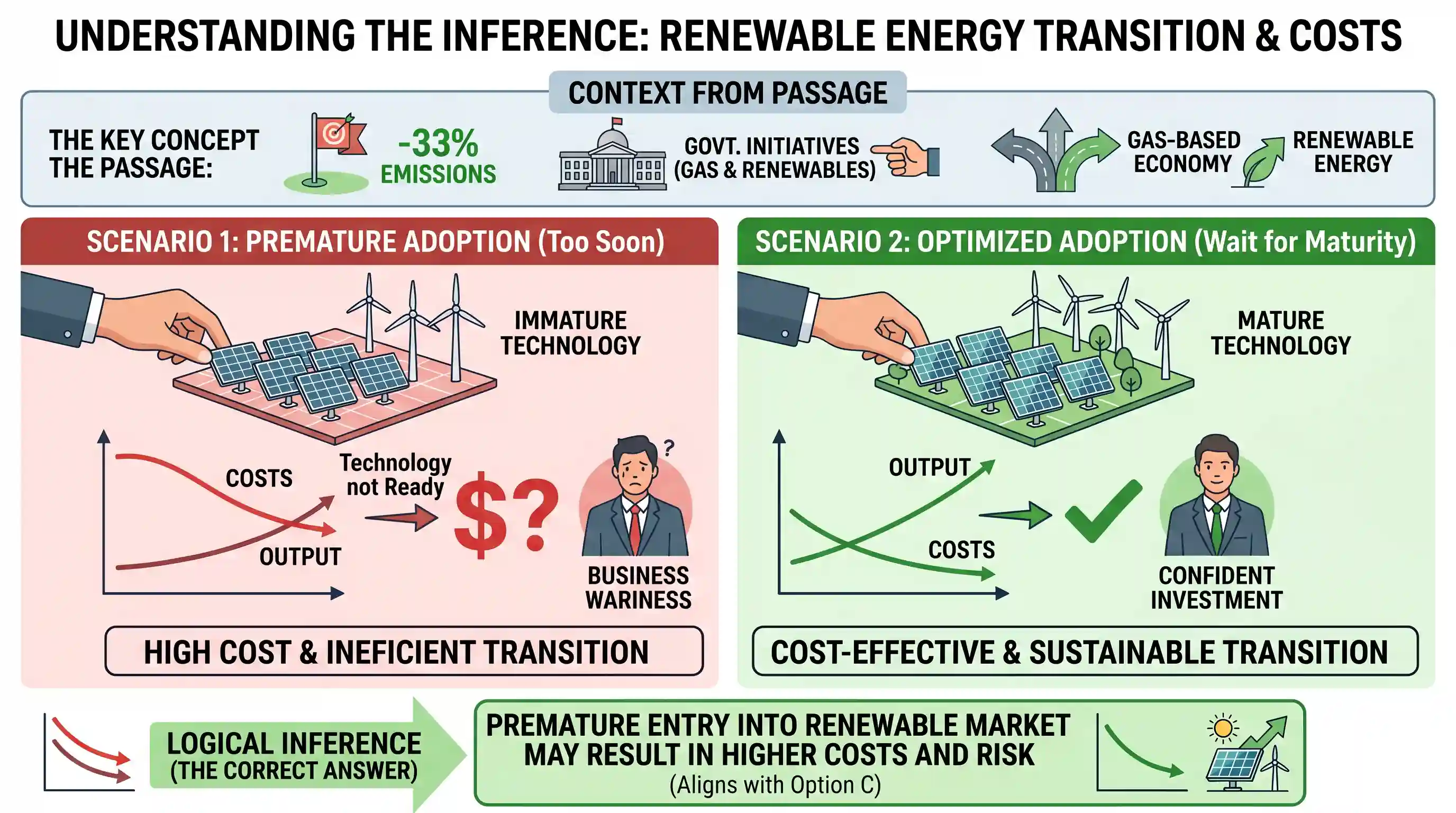
C) Getting renewable resources to market too soon may be costly. This option directly aligns with the passage. The phrases "cost Curves and learning curves" and "technology is not yet ready" leading to businesses being "wary of investing too heavily" strongly imply that premature or large-scale investment in the current state of renewable technology would be financially burdensome or inefficient.
D) India should put in more efforts in the exploration of natural gas. The passage mentions a "strong push towards a gas-based economy" but does not discuss the source of this gas (domestic exploration vs. imports) or suggest that increased exploration efforts are the most logical inference from the given information. The primary focus of the challenges discussed is related to renewable energy technology and its costs.
Therefore, the most logical and rational inference from the passage is that introducing renewable resources widely before their technology matures could be costly.
The final answer is C
Related questions
More UPSC Prelims practice from the same subject and topic.
- Prelims 2020CSATReading Comprehension
In India, over the last decade or so, labour has been departing agriculture, but is only going to construction and unregistered manufacturing which are not markedly better jobs. Services, where labour…
- Prelims 2020CSATReading Comprehension
In India, the current focus on the right to privacy is based on some new realities of the digital age. A right is a substantive right only if it works in all situations, and for everyone. A right to f…
- Prelims 2020CSATReading Comprehension
One of the biggest ironies around water is that it comes from rivers and other wetlands. Yet it is seen as divorced from them. While water is used as a resource, public policy does not always grasp th…
- Prelims 2020CSATReading Comprehension
Asset allocation is the most important investment decision we will ever make, and sadly, most of us do not give that decision the importance it deserves. We are adamant about seeking predictability wi…
- Prelims 2020CSATReading Comprehension
Although most of the Genetically Modified (GM) crops cultivated now are genetically engineered for a single trait, in future, crops genetically engineered for more than one trait will be the norm. Thu…
- Prelims 2020CSATReading Comprehension
Although most of the Genetically Modified (GM) crops cultivated now are genetically engineered for a single trait, in future, crops genetically engineered for more than one trait will be the norm. Thu…