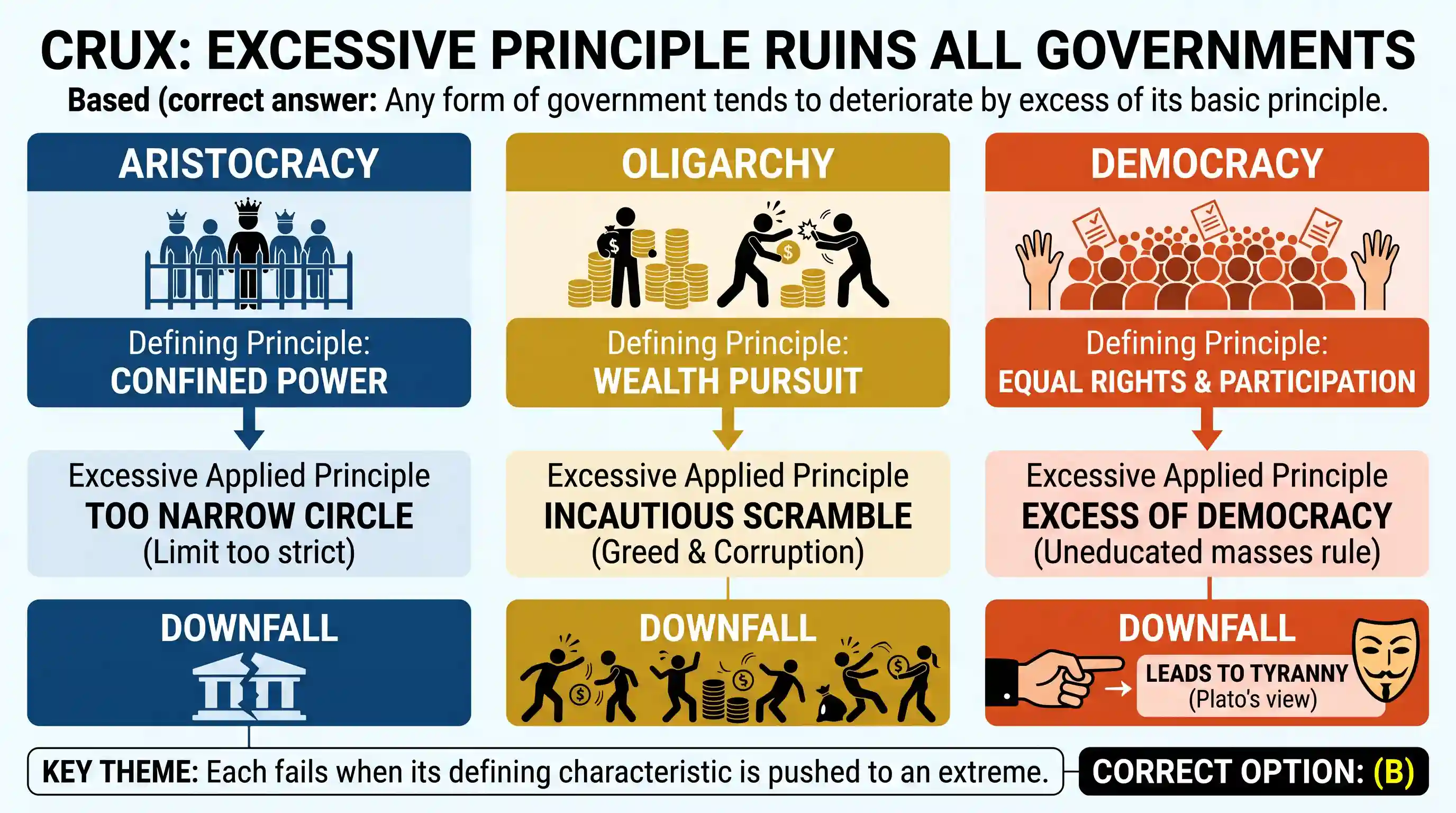
Aristocratic government ruins itself by limiting too narrowly the circle within which power is confined; oligarchic government ruins itself by the incautious scramble for immediate wealth. But even democracy ruins itself by excess of democracy. Its basic principle is the equal right of all to hold office and determine public policy. This is, at first glance, a delightful arrangement; it becomes disastrous because the people are not properly equipped by education to select the best rulers and the wisest courses. The people have no understanding and only repeat what their rulers are pleased to tell them. Such a democracy is tyranny or autocracy - Plato Which one of the following statements best reflects the crux of the passage given above?

- AHuman societies experiment with different forms of governments
- BAny form of government tends to deteriorate by excess of its basic principleCorrect
- CEducation of all citizens ensures a perfect, functional and sustainable democracy
- DHaving a government is a necessary evil because tyranny is inherent in any form of government.
Explanation
The passage describes how three different forms of government – aristocratic, oligarchic, and democratic – each ruin themselves.
- Aristocracy fails by "limiting too narrowly the circle within which power is confined" (an excess of its principle of confined power).
- Oligarchy fails by "the incautious scramble for immediate wealth" (an excess of its principle of wealth pursuit).
- Democracy fails by "excess of democracy" because people are not equipped by education, leading to tyranny (an excess of its principle of equal rights without proper foundation).
The common thread across all three examples is that their downfall is caused by an excessive application or manifestation of their defining characteristic or basic principle.
Let's analyze the options:
A) Human societies experiment with different forms of governments. This statement is true in a general sense, and the passage discusses different forms, but it's not the crux. The passage's main point is how these governments fail, not merely that they exist or are experimented with.
B) Any form of government tends to deteriorate by excess of its basic principle. This statement perfectly encapsulates the common theme presented for aristocracy, oligarchy, and democracy. Each form is shown to ruin itself by pushing its core principle or characteristic to an extreme or an undesirable excess. This is the central argument Plato makes in the passage.
C) Education of all citizens ensures a perfect, functional and sustainable democracy. The passage implies that a lack of education is why democracy fails, suggesting education is crucial. However, the passage doesn't go so far as to claim that education ensures a perfect, functional, and sustainable democracy. It hints at a solution, but the crux of the passage is the diagnosis of failure due to excess, not the guaranteed success of a specific solution.
D) Having a government is a necessary evil because tyranny is inherent in any form of government. The passage mentions tyranny as an outcome for democracy when it goes into excess. While it critiques governments, it doesn't explicitly state that having a government is a "necessary evil" or that tyranny is inherent in any form from the outset. It highlights how governments can lead to tyranny due to specific failures (excesses), rather than stating it's an inherent evil.
Therefore, option B best reflects the central message and common pattern of failure described for all the government forms in the passage.
The final answer is B.
Related questions
More UPSC Prelims practice from the same subject and topic.
- Prelims 2021CSATReading Comprehension
India faces a challenging immediate future in energy and climate policy- making. The problems are multiple: sputtering fossil fuel production capabilities; limited access to electricity and modern coo…
- Prelims 2021CSATReading Comprehension
There are reports that some of the antibiotics sold in the market are fed to poultry and other livestock as growth promoters. Overusing these substances can create superbugs, pathogens that are resist…
- Prelims 2021CSATReading Comprehension
Policymakers and media have placed the blame for skyrocketing food prices on a variety of factors, including high fuel prices, bad weather in key food producing countries, and the diversion of land to…
- Prelims 2021CSATReading Comprehension
A central message of modern development economics is the importance of income growth, by which is meant growth in Gross Domestic Product (GDP). In theory, rising GDP creates employment and investment …
- Prelims 2021CSATReading Comprehension
Researchers simulated street lighting on artificial grassland plots containing pea- aphids, sap- sucking insects, at night. These were exposed to two different types of light - a white light similar t…
- Prelims 2021CSATReading Comprehension
Approximately 80 percent of all flowering plant species are pollinated by animals, including birds and mammals, but the main pollinators are insects. Pollination is responsible for providing us with a…