Inequality violates a basic democratic norm: the equal standing of citizens. Equality is a relation that obtains between persons in respect of some fundamental characteristic that they share in common. Equality is, morally speaking, a default principle. Therefore, persons should not be discriminated on grounds such as race, caste, gender, ethnicity, disability, or class. These features of human condition are morally irrelevant. The idea that one should treat persons with respect not only because. some of these persons possess some special features or talent, for example skilled cricketers, gifted musicians, or literary giants, but because persons are human beings, is by now part of commonsense morality. With reference to the above passage, the following assumptions have been made: 1. Equality is a prerequisite for people to participate in the multiple transactions of society from a position of confidence. 2. Occurrence of inequality is detrimental to the survival of democracy. 3. Equal standing of all citizens is an idea that cannot actually be realised even in a democracy. 4. Right to equality should be incorporated into our values and day-to-day political vocabulary. Which of the above assumptions are valid?

- A1 and 2 onlyCorrect
- B2 and 3 only
- C1 and 4 only
- D3 and 4 only
Explanation
The passage makes a strong case for equality as a fundamental democratic norm and a moral principle. Let's analyze each statement:
-
Equality is a prerequisite for people to participate in the multiple transactions of society from a position of confidence.
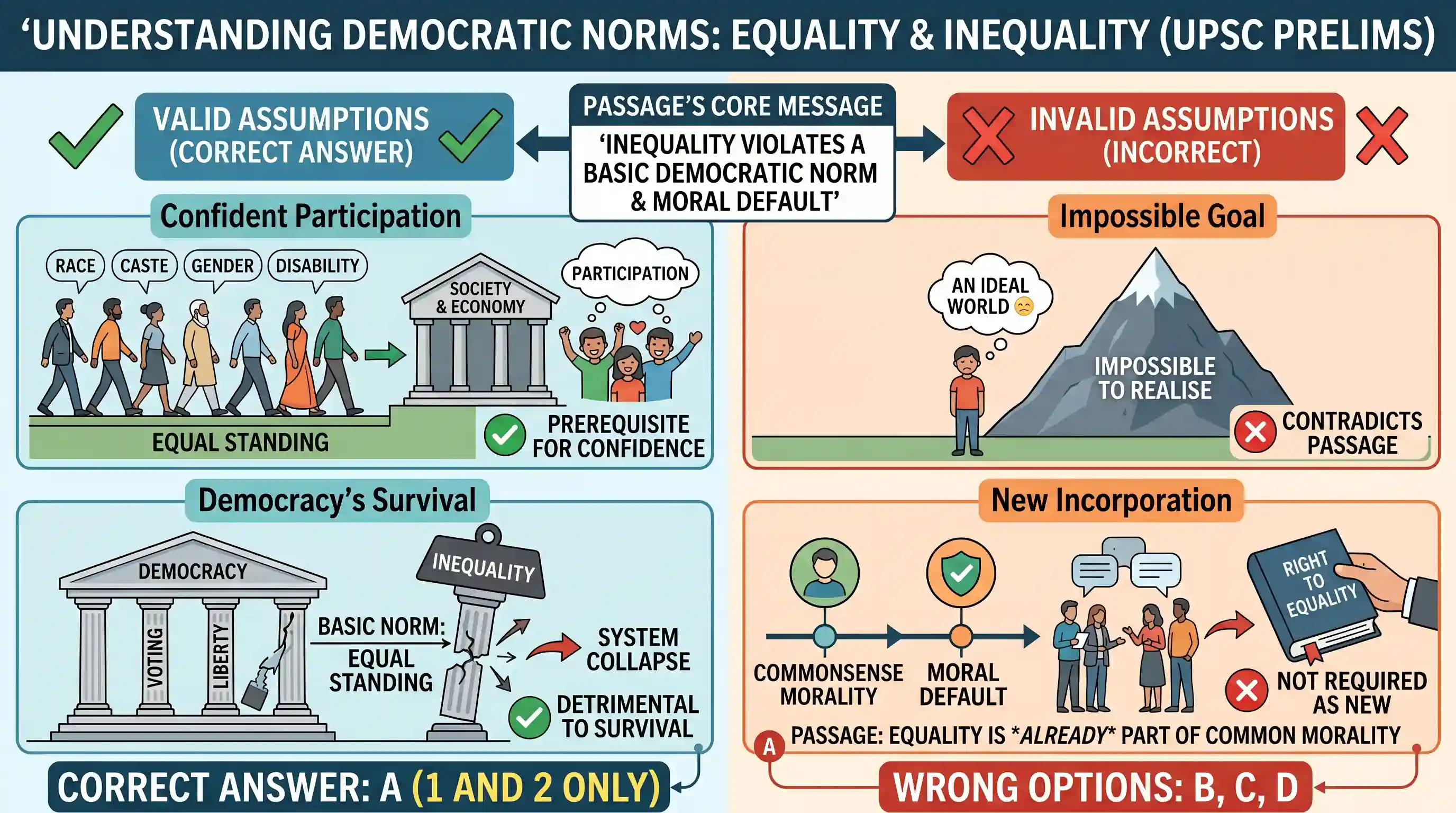
- The passage states that "Inequality violates a basic democratic norm: the equal standing of citizens." It also emphasizes treating persons with respect because they are human beings, not just for special talents. If citizens have equal standing and are respected as human beings, it implies they can participate fully and confidently in society. Conversely, if there is inequality and discrimination, their ability to participate confidently would be undermined. This is a reasonable underlying assumption for why "equal standing" is so crucial.
-
Occurrence of inequality is detrimental to the survival of democracy.
- The passage explicitly states: "Inequality violates a basic democratic norm: the equal standing of citizens." If a basic norm of a system like democracy is violated, it logically follows that such a violation is harmful or detrimental to the system itself. A consistent violation of its fundamental principles would threaten the very survival of democracy.
-
Equal standing of all citizens is an idea that cannot actually be realised even in a democracy.
- This statement directly contradicts the entire premise of the passage. The passage argues for equality and equal standing as a basic democratic norm and a moral principle, implying that it is an achievable and desirable state, not an impossible one.
-
Right to equality should be incorporated into our values and day-to-day political vocabulary.
- The passage states that "Equality is, morally speaking, a default principle" and "The idea that one should treat persons with respect... is by now part of commonsense morality." This suggests that the idea of equality is already considered a default principle and part of commonsense morality. The passage is arguing for the application and recognition of this existing moral truth, rather than assuming it needs to be newly incorporated into values or vocabulary.
Based on this analysis, statements 1 and 2 are valid assumptions made by the passage.
The final answer is A) 1 and 2 only.
Related questions
More UPSC Prelims practice from the same subject and topic.
- Prelims 2021CSATReading Comprehension
India faces a challenging immediate future in energy and climate policy- making. The problems are multiple: sputtering fossil fuel production capabilities; limited access to electricity and modern coo…
- Prelims 2021CSATReading Comprehension
There are reports that some of the antibiotics sold in the market are fed to poultry and other livestock as growth promoters. Overusing these substances can create superbugs, pathogens that are resist…
- Prelims 2021CSATReading Comprehension
Policymakers and media have placed the blame for skyrocketing food prices on a variety of factors, including high fuel prices, bad weather in key food producing countries, and the diversion of land to…
- Prelims 2021CSATReading Comprehension
A central message of modern development economics is the importance of income growth, by which is meant growth in Gross Domestic Product (GDP). In theory, rising GDP creates employment and investment …
- Prelims 2021CSATReading Comprehension
Researchers simulated street lighting on artificial grassland plots containing pea- aphids, sap- sucking insects, at night. These were exposed to two different types of light - a white light similar t…
- Prelims 2021CSATReading Comprehension
Approximately 80 percent of all flowering plant species are pollinated by animals, including birds and mammals, but the main pollinators are insects. Pollination is responsible for providing us with a…