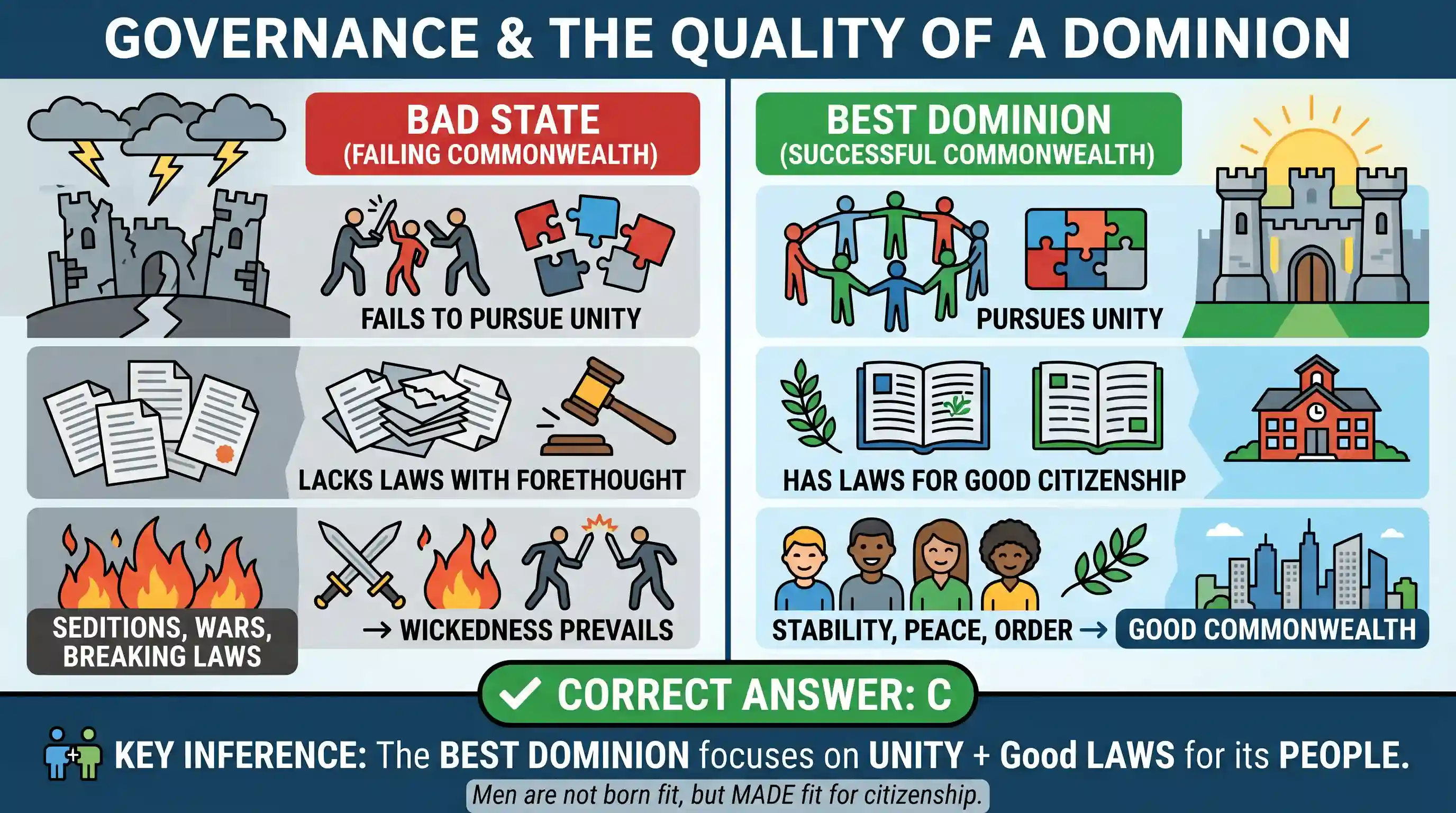
It is certain, that seditions, wars, and contempt or breach of the laws are not so much to be imputed to the wickedness of the subjects, as to the bad state of a dominion. For men are not born fit for citizenship, but must be made so. Besides, men's natural passions are everywhere the same; and if wickedness more prevails, and more offences are committed in one commonwealth than in another, it is certain that the former has neither enough pursued the end of unity, nor framed its laws with sufficient forethought; and that, therefore, it has failed in making quite good its right as a commonwealth. Which among the following is the most logical and rational inference that can be made from the passage given above?

- ASeditions, wars and breach of the laws: are inevitable in every dominion
- BIt is not the people, but the sovereign who is responsible for all the problems of any dominion
- CThat dominion is the best which pursues the aim of unity and has laws for good citizenshipCorrect
- DIt is impossible for men to establish a good dominion.
Explanation
The passage argues that societal problems like seditions and wars are not due to inherently wicked subjects, but to the "bad state of a dominion." It emphasizes that men are not born citizens but must be "made so," implying the role of the dominion's structure and laws. It further states that if wickedness prevails, it's because the commonwealth "has neither enough pursued the end of unity, nor framed its laws with sufficient forethought."
Let's analyze the options:
A) Seditions, wars and breach of the laws: are inevitable in every dominion Incorrect. The passage attributes these problems to a "bad state of a dominion" and a failure to pursue unity and frame good laws, implying they are preventable if the dominion is well-ordered.
B) It is not the people, but the sovereign who is responsible for all the problems of any dominion Partially correct in spirit, but not the most logical and rational inference. The passage blames the "state of a dominion" and its failure to pursue unity and frame laws, which are typically responsibilities of the governing authority (sovereign). However, the passage focuses on the qualities of the dominion (unity, laws) rather than explicitly naming the "sovereign" and claiming responsibility for "all problems." Option C is a more direct inference about what constitutes a good dominion based on the criteria given.
C) That dominion is the best which pursues the aim of unity and has laws for good citizenship Correct. The passage states that problems arise when a commonwealth "has neither enough pursued the end of unity, nor framed its laws with sufficient forethought." By logical inversion, a dominion that does pursue unity and frames its laws with sufficient forethought (especially since "men are not born fit for citizenship, but must be made so") would be the one that avoids these problems, thus making it a good or "best" dominion. This option directly synthesizes the positive conditions implied by the passage's critique of failing dominions.
D) It is impossible for men to establish a good dominion. Incorrect. The passage implies the opposite. It suggests that if a dominion fails, it's due to specific shortcomings (lack of unity, poor laws), which means that if these shortcomings are addressed, a good dominion can be established.
Therefore, option C is the most logical and rational inference as it directly reflects the conditions for a successful dominion derived from the passage's explanation of why dominions fail.
Related questions
More UPSC Prelims practice from the same subject and topic.
- Prelims 2021CSATReading Comprehension
India faces a challenging immediate future in energy and climate policy- making. The problems are multiple: sputtering fossil fuel production capabilities; limited access to electricity and modern coo…
- Prelims 2021CSATReading Comprehension
There are reports that some of the antibiotics sold in the market are fed to poultry and other livestock as growth promoters. Overusing these substances can create superbugs, pathogens that are resist…
- Prelims 2021CSATReading Comprehension
Policymakers and media have placed the blame for skyrocketing food prices on a variety of factors, including high fuel prices, bad weather in key food producing countries, and the diversion of land to…
- Prelims 2021CSATReading Comprehension
A central message of modern development economics is the importance of income growth, by which is meant growth in Gross Domestic Product (GDP). In theory, rising GDP creates employment and investment …
- Prelims 2021CSATReading Comprehension
Researchers simulated street lighting on artificial grassland plots containing pea- aphids, sap- sucking insects, at night. These were exposed to two different types of light - a white light similar t…
- Prelims 2021CSATReading Comprehension
Approximately 80 percent of all flowering plant species are pollinated by animals, including birds and mammals, but the main pollinators are insects. Pollination is responsible for providing us with a…