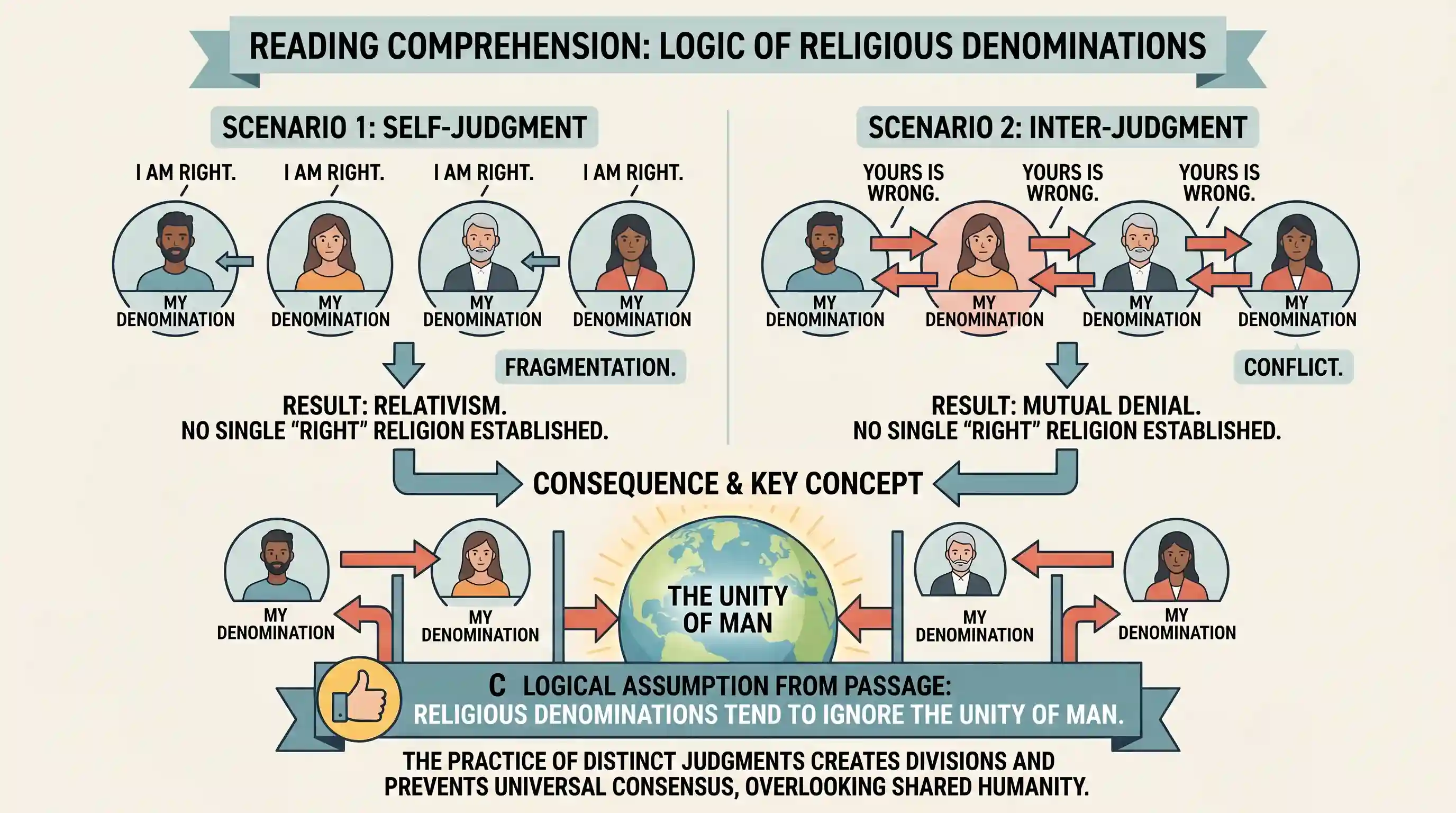
With respect to what are called denominations of religion, if everyone is left to be a judge of his own religion, there is no such thing as religion that is a but if they are to be a judge of each other's religion, there is no such thing as a religion that is right, and therefore all the world is right or all the world is wrong in the matter of religion. What is the most logical assumption that can be made from the passage given above?

- ANo man can live without adhering to some religious denomination
- BIt is the duty of everyone to propagate one's religious denomination
- CReligious denominations tend to ignore the unity of manCorrect
- DMen do not understand their own religious denomination.
Explanation
The passage explores the difficulty in establishing a universally "right" religion when individuals or groups judge religious denominations.
Let's break down the options:
A) No man can live without adhering to some religious denomination The passage discusses the judgment of religion, not the necessity of adhering to one for survival. This statement is an external idea not supported by the text.
B) It is the duty of everyone to propagate one's religious denomination The passage focuses on the evaluation or judgment of religions, not on the duty to spread them. Propagation is not mentioned or implied.
C) Religious denominations tend to ignore the unity of man The passage describes a scenario where if everyone judges their own religion, no single religion is definitively "right." If they judge each other's, it leads to a situation where all are right or all are wrong. This highlights the inherent conflict, relativism, or division that arises from the existence and judgment of separate religious denominations. The inability to find a universal truth or common ground, and the focus on "my religion" versus "your religion" (implied by judging each other), inherently creates divisions among people rather than fostering a sense of shared humanity or unity. The problem described in the passage is precisely one where the distinct nature and judgment of denominations prevent a unified perspective, thus tending to ignore human unity.
D) Men do not understand their own religious denomination. The passage states that "everyone is left to be a judge of his own religion." To judge, one must have some understanding. The problem isn't a lack of understanding, but the outcome of that judgment (no universal "right" religion) and the resulting fragmentation.
Therefore, the most logical assumption is that the distinctions and judgments inherent in religious denominations tend to create divisions that overlook the unity of mankind.
The final answer is C
Related questions
More UPSC Prelims practice from the same subject and topic.
- Prelims 2021CSATReading Comprehension
India faces a challenging immediate future in energy and climate policy- making. The problems are multiple: sputtering fossil fuel production capabilities; limited access to electricity and modern coo…
- Prelims 2021CSATReading Comprehension
There are reports that some of the antibiotics sold in the market are fed to poultry and other livestock as growth promoters. Overusing these substances can create superbugs, pathogens that are resist…
- Prelims 2021CSATReading Comprehension
Policymakers and media have placed the blame for skyrocketing food prices on a variety of factors, including high fuel prices, bad weather in key food producing countries, and the diversion of land to…
- Prelims 2021CSATReading Comprehension
A central message of modern development economics is the importance of income growth, by which is meant growth in Gross Domestic Product (GDP). In theory, rising GDP creates employment and investment …
- Prelims 2021CSATReading Comprehension
Researchers simulated street lighting on artificial grassland plots containing pea- aphids, sap- sucking insects, at night. These were exposed to two different types of light - a white light similar t…
- Prelims 2021CSATReading Comprehension
Approximately 80 percent of all flowering plant species are pollinated by animals, including birds and mammals, but the main pollinators are insects. Pollination is responsible for providing us with a…