Fig trees (genus Ficus) are considered sacred in India, East Asia and Africa and are common in agricultural and urban landscapes where other large trees are absent. In natural forests, fig trees provide food for wildlife when other resources are scarce and support a high density and diversity of frugivores (fruit- eating animals). If frugivorous birds and bats continue to visit fig trees located in sites with high human sacred fig trees frugivore Under microclimate, plenty of seedlings of other tree disturbance, may promote abundance. favourable species would grow around fig trees. On the basis of the passage given above, the following assumptions have been made: 1. Fig trees can often be keystone species in natural forests. 2. Fig trees can grow where other large woody species cannot grow. 3. Sacred trees can have a role in biodiversity conservation. 4. Fig trees have a role in the seed dispersal of other tree species. which of the above assumptions is/are valid?

- A1 and 2 only
- B3 only
- C2 and 4 only
- D1, 3 and 4 onlyCorrect
Explanation
Let's analyze each statement based on the provided passage:
-
Fig trees can often be keystone species in natural forests.
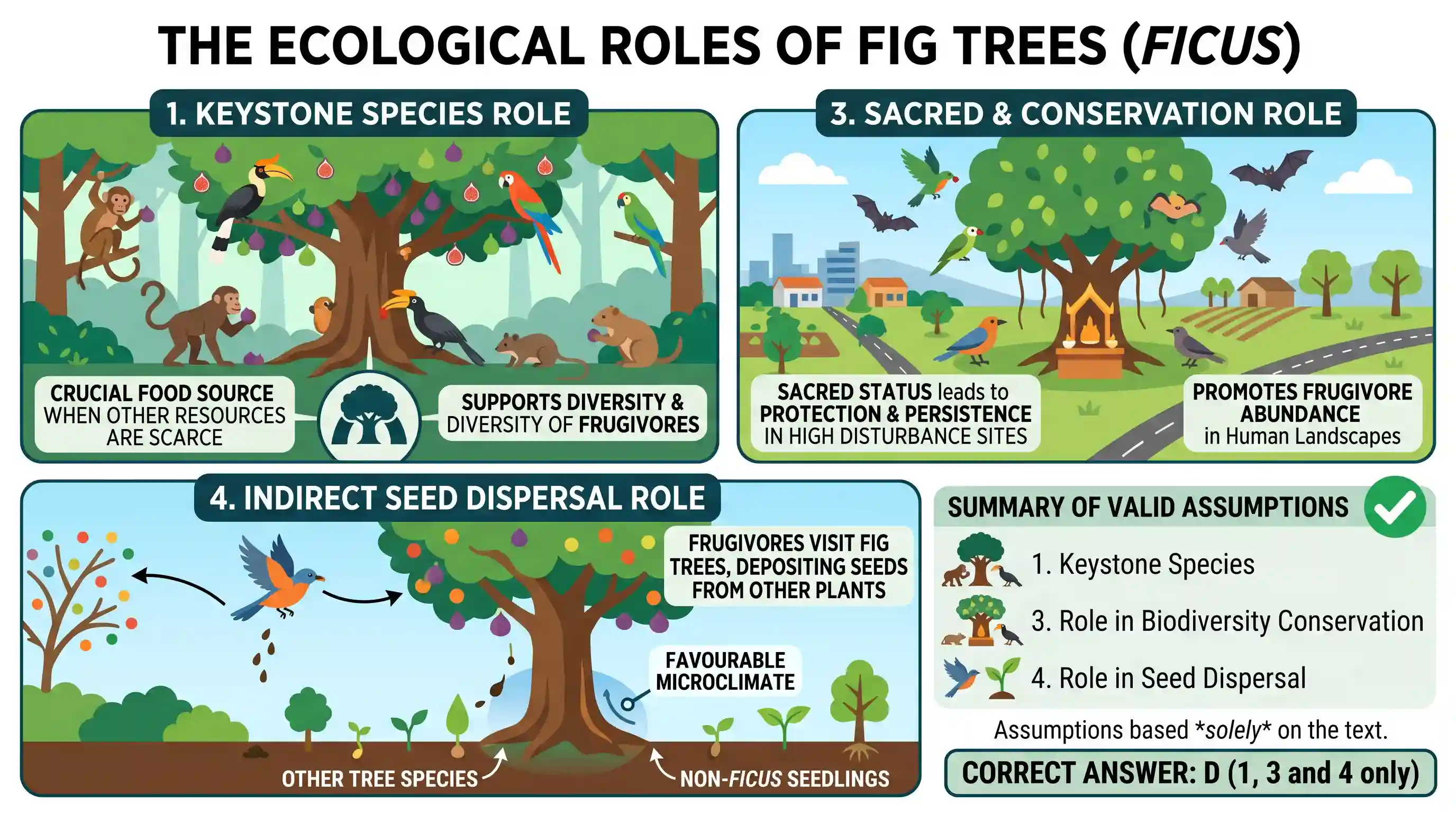
- The passage states: "In natural forests, fig trees provide food for wildlife when other resources are scarce and support a high density and diversity of frugivores (fruit-eating animals)." This describes a classic role of a keystone species – providing critical resources that support many other species, especially during times of scarcity, thereby maintaining the ecosystem's structure and diversity.
- Therefore, statement 1 is a valid assumption.
-
Fig trees can grow where other large woody species cannot grow.
- The passage states: "Fig trees... are common in agricultural and urban landscapes where other large trees are absent." While this suggests fig trees are present where others are not, "absent" does not definitively mean "cannot grow." Other large trees might be absent due to human activities (clearing, land use, lack of planting) rather than an ecological inability to grow. Fig trees might be present due to their resilience, sacred status (protection), or pioneer characteristics, not necessarily because no other large woody species could grow there. This is a subtle but important distinction.
- Therefore, statement 2 is not necessarily a valid assumption based solely on the word "absent."
-
Sacred trees can have a role in biodiversity conservation.
- The passage mentions that fig trees are "considered sacred" and "are common in agricultural and urban landscapes where other large trees are absent." It also states: "If frugivorous birds and bats continue to visit fig trees located in sites with high human disturbance, may promote frugivore abundance." The sacred status often leads to the protection and preservation of these trees, allowing them to persist in disturbed areas. By providing food and habitat, even in human-modified landscapes, they support frugivore populations, thus contributing to biodiversity conservation.
- Therefore, statement 3 is a valid assumption.
-
Fig trees have a role in the seed dispersal of other tree species.
- The passage states that fig trees "support a high density and diversity of frugivores" and "Under favourable microclimate, plenty of seedlings of other tree species would grow around fig trees." Frugivores (birds and bats) eat fruits from various plants and then disperse seeds through their droppings. By attracting a high density of these seed-dispersing animals and creating a favorable microclimate for germination, fig trees indirectly facilitate the dispersal and growth of other tree species.
- Therefore, statement 4 is a valid assumption.
Based on the analysis, statements 1, 3, and 4 are valid assumptions. Statement 2 is not a strong enough inference from the given text.
The final answer is D
Related questions
More UPSC Prelims practice from the same subject and topic.
- Prelims 2021CSATReading Comprehension
India faces a challenging immediate future in energy and climate policy- making. The problems are multiple: sputtering fossil fuel production capabilities; limited access to electricity and modern coo…
- Prelims 2021CSATReading Comprehension
There are reports that some of the antibiotics sold in the market are fed to poultry and other livestock as growth promoters. Overusing these substances can create superbugs, pathogens that are resist…
- Prelims 2021CSATReading Comprehension
Policymakers and media have placed the blame for skyrocketing food prices on a variety of factors, including high fuel prices, bad weather in key food producing countries, and the diversion of land to…
- Prelims 2021CSATReading Comprehension
A central message of modern development economics is the importance of income growth, by which is meant growth in Gross Domestic Product (GDP). In theory, rising GDP creates employment and investment …
- Prelims 2021CSATReading Comprehension
Researchers simulated street lighting on artificial grassland plots containing pea- aphids, sap- sucking insects, at night. These were exposed to two different types of light - a white light similar t…
- Prelims 2021CSATReading Comprehension
Approximately 80 percent of all flowering plant species are pollinated by animals, including birds and mammals, but the main pollinators are insects. Pollination is responsible for providing us with a…