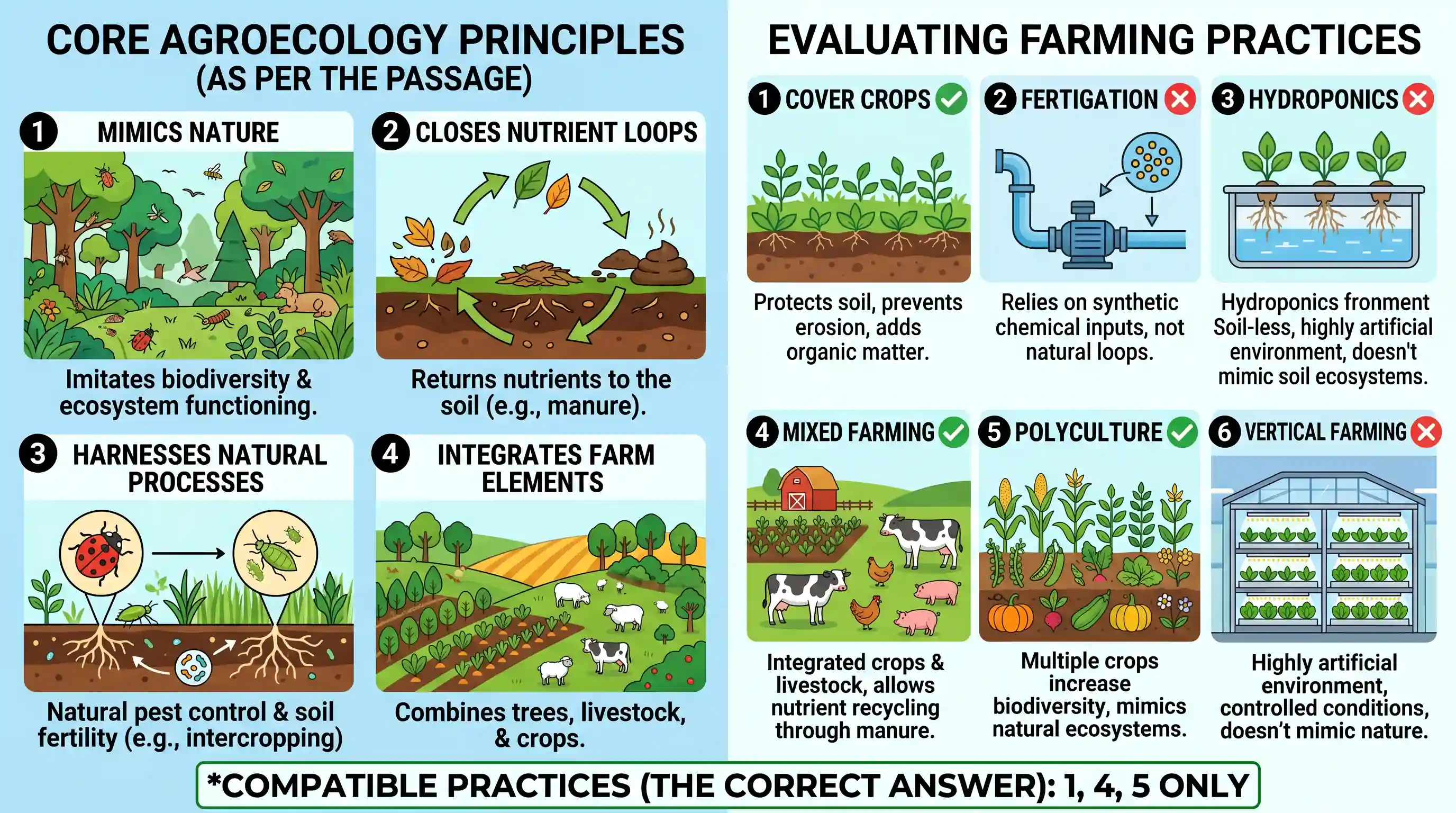
At the heart of agroecology is the idea that agroecosystems should mimic the biodiversity levels and functioning of natural ecosystems. Such agricultural mimics, like their natural models, can be productive, pest- resistant, nutrient conserving, and resilient to shocks and stresses. In ecosystems there is no 'waste', nutrients are recycled indefinitely. Agroecology aims at closing nutrient loops, i.e., returning all nutrients that come out of the soil back to the soil such as through application of farmyard manure. It also harnesses natural processes to control pests and build soil fertility i.e., through intercropping. Agroecological practices include integrating trees with livestock and crops. Consider the following : 1. Cover crops 2. Fertigation 3. Hydroponics 4. Mixed farming 5. Polyculture 6. Vertical farming Which of the above farming practices can be compatible with agroecology, as implied by the passage?

- A1, 4 and 5 onlyCorrect
- B2, 3, 4 and 5 only
- C1, 2, 3 and 6 only
- D4 and 6 only
Explanation
The passage defines agroecology by emphasizing several core principles:
- Mimicking biodiversity and functioning of natural ecosystems.
- Being productive, pest-resistant, nutrient-conserving, and resilient.
- Closing nutrient loops (returning all nutrients to the soil, e.g., farmyard manure).
- Harnessing natural processes for pest control and soil fertility (e.g., intercropping).
- Integrating trees with livestock and crops.
Let's evaluate each practice:
-
Cover crops: These are planted to cover the soil rather than for harvest. They mimic natural processes by protecting soil, preventing erosion, adding organic matter, and improving soil fertility, thus conserving nutrients and building soil health. This is compatible.
-
Fertigation: This involves applying fertilizers (often synthetic) through irrigation water. While it delivers nutrients, it typically relies on external, often non-organic, inputs rather than closing natural nutrient loops or harnessing natural processes for fertility, which is central to agroecology. This is not compatible.
-
Hydroponics: This is growing plants without soil, using mineral nutrient solutions. It does not mimic natural ecosystems or soil processes, nor does it involve returning nutrients to the soil in the way described by agroecology. This is not compatible.
-
Mixed farming: This involves growing crops and raising livestock on the same farm. This directly aligns with the agroecological principle of "integrating trees with livestock and crops" and facilitates closing nutrient loops through the use of farmyard manure. This is compatible.
-
Polyculture: This is growing multiple crops in the same area, which increases biodiversity and mimics the complexity of natural ecosystems. The passage explicitly mentions "intercropping" (a form of polyculture) as harnessing natural processes for pest control and soil fertility. This is compatible.
-
Vertical farming: This involves growing crops in vertically stacked layers, often in controlled indoor environments. Like hydroponics, it is a highly artificial system that does not mimic natural ecosystems or soil processes. This is not compatible.
Therefore, the farming practices compatible with agroecology as implied by the passage are Cover crops (1), Mixed farming (4), and Polyculture (5).
The final answer is A) 1, 4 and 5 only.
Related questions
More UPSC Prelims practice from the same subject and topic.
- Prelims 2021CSATReading Comprehension
India faces a challenging immediate future in energy and climate policy- making. The problems are multiple: sputtering fossil fuel production capabilities; limited access to electricity and modern coo…
- Prelims 2021CSATReading Comprehension
There are reports that some of the antibiotics sold in the market are fed to poultry and other livestock as growth promoters. Overusing these substances can create superbugs, pathogens that are resist…
- Prelims 2021CSATReading Comprehension
Policymakers and media have placed the blame for skyrocketing food prices on a variety of factors, including high fuel prices, bad weather in key food producing countries, and the diversion of land to…
- Prelims 2021CSATReading Comprehension
A central message of modern development economics is the importance of income growth, by which is meant growth in Gross Domestic Product (GDP). In theory, rising GDP creates employment and investment …
- Prelims 2021CSATReading Comprehension
Researchers simulated street lighting on artificial grassland plots containing pea- aphids, sap- sucking insects, at night. These were exposed to two different types of light - a white light similar t…
- Prelims 2021CSATReading Comprehension
Approximately 80 percent of all flowering plant species are pollinated by animals, including birds and mammals, but the main pollinators are insects. Pollination is responsible for providing us with a…