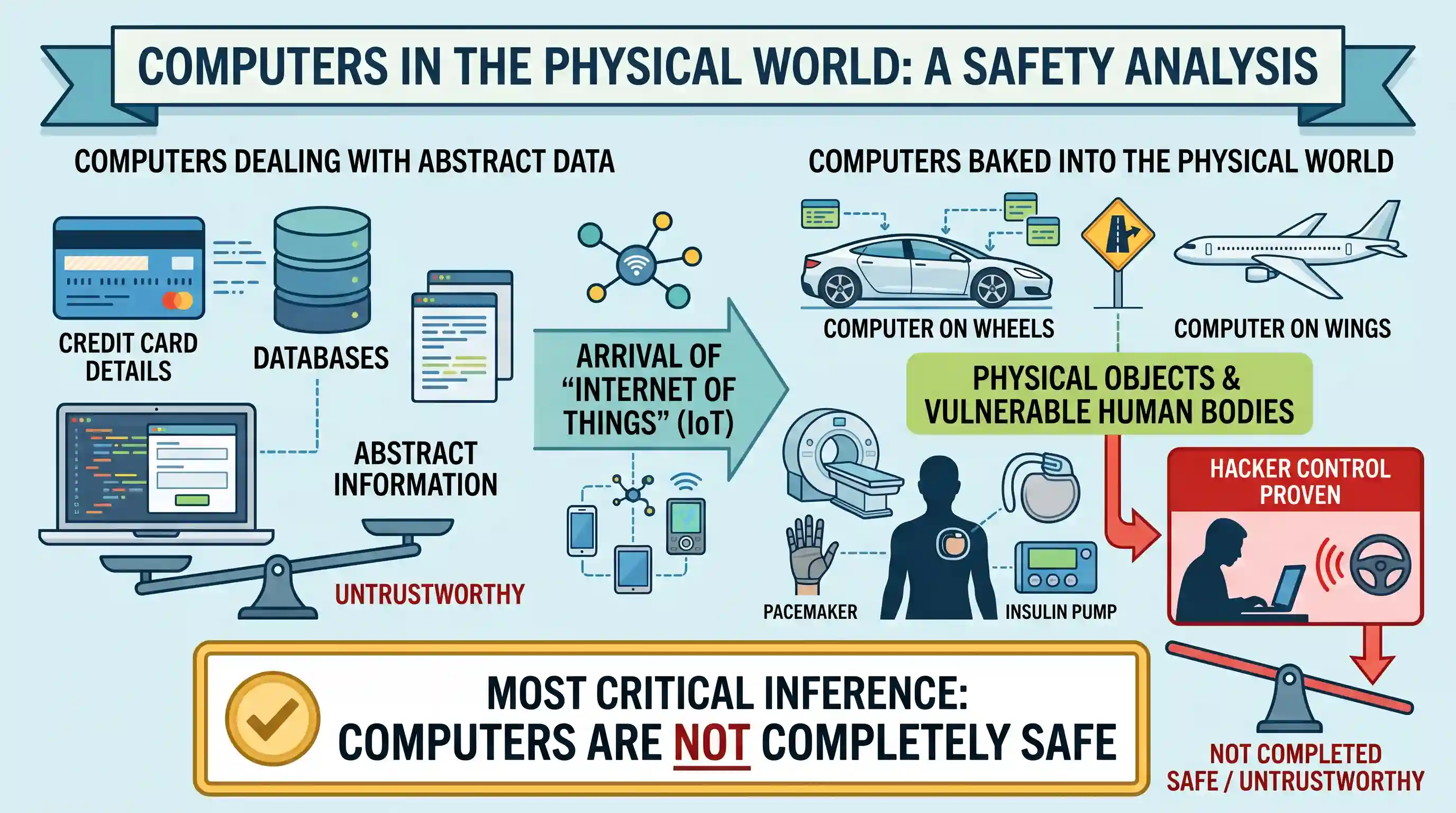
Computers increasingly deal not just with abstract data like credit card, details and databases, but also with the real world of physical objects and vulnerable human bodies. A modern car is a computer on wheels; an aeroplane is a computer on wings. The arrival of the "Internet of Things" will see computers baked into everything from road signs and MRI scanners to prosthetics and insulin pumps. There is little evidence that these gadgets will be any more trustworthy than their desktop counterparts. Hackers have already proved that they can take remote control of internet connected cars and pacemakers. Which one of the following statements best reflects the most critical inference that can be made from the passage given above?

- AComputers are not completely safeCorrect
- BCompanies producing the software do not take cyber security seriously
- CStringent data security laws are needed
- DThe present trend of communication technologies will affect our lives in future.
Explanation
The passage highlights that computers are increasingly integrated into physical objects and human bodies (cars, planes, IoT devices, medical implants) and warns that these new systems are not likely to be any more trustworthy than traditional desktops. It provides concrete examples of hackers taking remote control of cars and pacemakers.
Let's analyze each option:
A) Computers are not completely safe. This statement directly reflects the core message. The passage explicitly states that these gadgets won't be "any more trustworthy" and gives examples of hackers taking "remote control" of cars and pacemakers, which directly implies a lack of complete safety and trustworthiness. This is the most critical inference because the entire passage is built around demonstrating this vulnerability and potential danger.
B) Companies producing the software do not take cyber security seriously. While this might be an underlying reason for the vulnerabilities, the passage does not explicitly state or provide evidence about the companies' intent or seriousness regarding cybersecurity. It focuses on the outcome (vulnerability) rather than the cause related to corporate behavior. Therefore, it's not the most direct or critical inference from the given text.
C) Stringent data security laws are needed. The passage describes a problem (vulnerability of connected devices) but does not propose solutions or policy recommendations like "stringent data security laws." While such laws might be a logical consequence or a desired outcome, the passage itself does not make this inference. The most critical inference should be about the problem presented, not a potential remedy.
D) The present trend of communication technologies will affect our lives in future. This statement is true and supported by the passage, which describes the "Internet of Things" affecting everything from cars to medical devices. However, it is too broad and general. The passage doesn't just say technologies will affect lives; it specifically highlights the critical negative aspect of safety and trustworthiness due to hacking. Option A captures the specific and critical concern raised by the passage (the danger/lack of safety), which is more precise than just "affect our lives."
Therefore, option A best reflects the most critical inference as it directly addresses the central concern of vulnerability and lack of safety in increasingly connected computer systems.
Related questions
More UPSC Prelims practice from the same subject and topic.
- Prelims 2021CSATReading Comprehension
India faces a challenging immediate future in energy and climate policy- making. The problems are multiple: sputtering fossil fuel production capabilities; limited access to electricity and modern coo…
- Prelims 2021CSATReading Comprehension
There are reports that some of the antibiotics sold in the market are fed to poultry and other livestock as growth promoters. Overusing these substances can create superbugs, pathogens that are resist…
- Prelims 2021CSATReading Comprehension
Policymakers and media have placed the blame for skyrocketing food prices on a variety of factors, including high fuel prices, bad weather in key food producing countries, and the diversion of land to…
- Prelims 2021CSATReading Comprehension
A central message of modern development economics is the importance of income growth, by which is meant growth in Gross Domestic Product (GDP). In theory, rising GDP creates employment and investment …
- Prelims 2021CSATReading Comprehension
Researchers simulated street lighting on artificial grassland plots containing pea- aphids, sap- sucking insects, at night. These were exposed to two different types of light - a white light similar t…
- Prelims 2021CSATReading Comprehension
Approximately 80 percent of all flowering plant species are pollinated by animals, including birds and mammals, but the main pollinators are insects. Pollination is responsible for providing us with a…