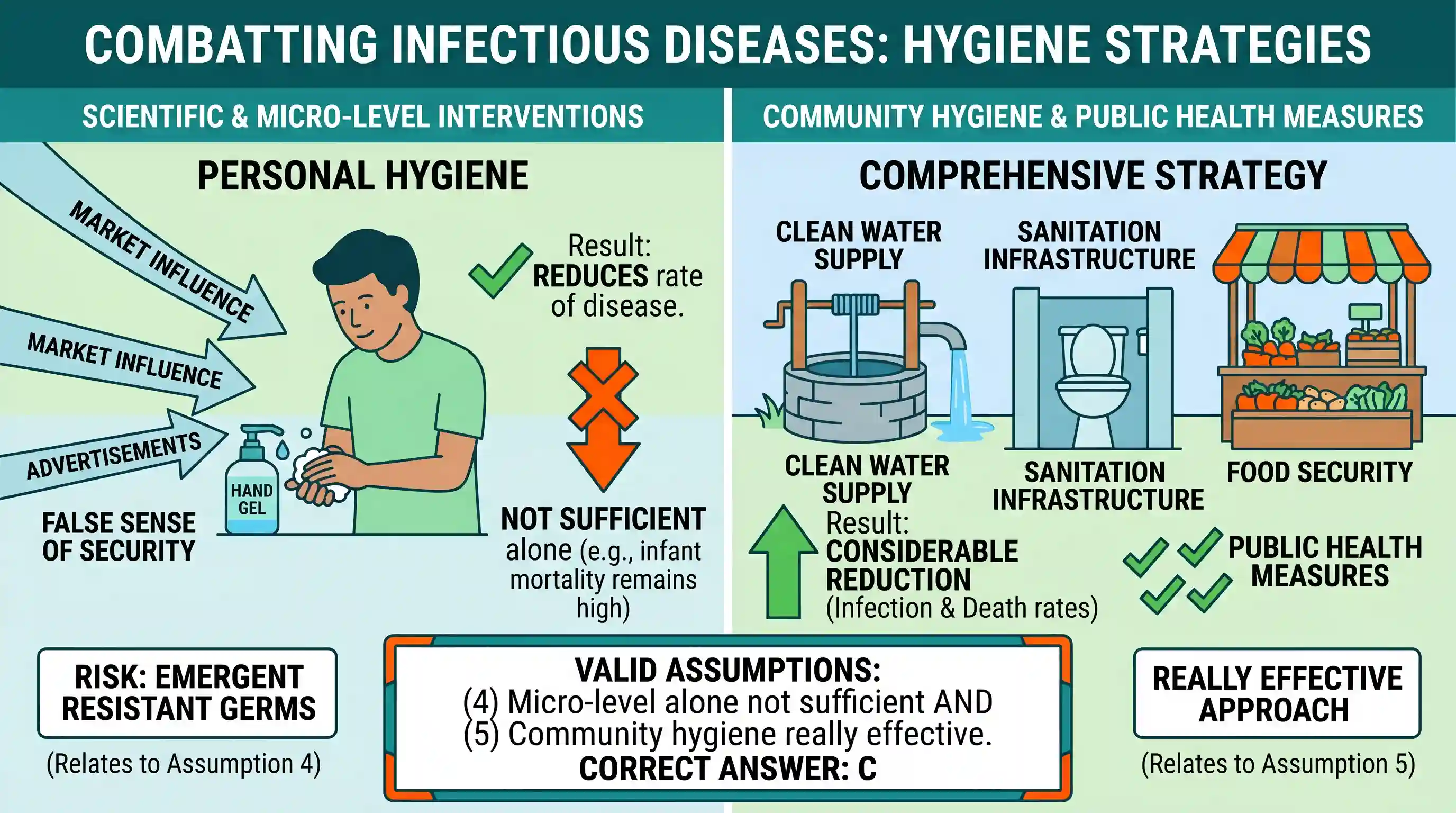
A social and physical environment riddled with poverty, inequities, unhygienic and insanitary conditions generates the risk of infectious diseases. Hygiene has different levels: personal, domestic and community hygiene. There is no doubt that personal cleanliness brings down the rate of infectious diseases. But the entry of the market into this domain has created a false sense of security that gets conditioned and reinforced by the onslaught of advertisements. Experience in Western Europe shows that along with personal hygiene, general improvements in environmental conditions and components like clean water, sanitation and food security have brought down infant/child death/infection rates considerably. The obsession with hand hygiene also brings in the persisting influence of the market on personal health, overriding or marginalising the negative impact on ecology and the emergence of resistant germs. On the basis of the passage given above, the following assumptions have been made : 1. People who are obsessed with personal hygiene tend to ignore the community hygiene. 2. Emergence of multi-drug resistant germs can be prevented by personal cleanliness. 3. Entry of the market in the domain of hygiene increases the risk of infectious diseases. 4. Scientific and micro-level interventions are not sufficient to bring down the burden of infectious diseases. 5. It is community hygiene implemented through public health measures that is really effective in the battle against infectious diseases. Which of the above assumptions are valid?

- A1 and 2 only
- B3 and 4 only
- C4 and 5 onlyCorrect
- D1, 2 and 4 only
Explanation
The passage evaluates different aspects of hygiene and their impact on infectious diseases. Let's analyze each assumption:
-
People who are obsessed with personal hygiene tend to ignore the community hygiene. The passage states that the market's influence on personal health is "overriding or marginalising the negative impact on ecology and the emergence of resistant germs." This implies a prioritization of personal hygiene over broader ecological concerns and the problem of resistant germs, but it does not explicitly state that people tend to ignore community hygiene. It's an inference that goes beyond the direct text.
-
Emergence of multi-drug resistant germs can be prevented by personal cleanliness. The passage explicitly states the opposite: "The obsession with hand hygiene also brings in the persisting influence of the market on personal health, overriding or marginalising the negative impact on ecology and the emergence of resistant germs." This implies that excessive or market-driven personal hygiene contributes to, rather than prevents, resistant germs. So, this assumption is invalid.
-
Entry of the market in the domain of hygiene increases the risk of infectious diseases. The passage states that the market "has created a false sense of security" and contributes to "the emergence of resistant germs." A false sense of security can lead to neglecting other crucial factors, and resistant germs certainly increase the risk of infectious diseases. Thus, the market's entry, by creating these conditions, indirectly increases risks. This assumption is plausible, but let's check others for stronger support.
-
Scientific and micro-level interventions are not sufficient to bring down the burden of infectious diseases. The passage acknowledges that "personal cleanliness brings down the rate of infectious diseases" (a micro-level intervention). However, it immediately follows with "But the entry of the market... has created a false sense of security." More importantly, it states that "along with personal hygiene, general improvements in environmental conditions and components like clean water, sanitation and food security have brought down infant/child death/infection rates considerably." This clearly indicates that personal hygiene alone (a micro-level intervention) is not sufficient; broader environmental and community-level interventions are crucial for significant impact. Therefore, micro-level interventions alone are not sufficient. This assumption is valid.
-
It is community hygiene implemented through public health measures that is really effective in the battle against infectious diseases. The passage highlights that "general improvements in environmental conditions and components like clean water, sanitation and food security" (which are examples of community hygiene and public health measures) "have brought down infant/child death/infection rates considerably." This directly supports the idea that these measures are "really effective." This assumption is valid.
Comparing the assumptions, 4 and 5 are most strongly and directly supported by the passage. Assumption 3 is plausible but perhaps a slightly broader interpretation than 4 and 5, which are almost direct restatements of the passage's conclusions.
The final answer is C) 4 and 5 only.
The final answer is C
Related questions
More UPSC Prelims practice from the same subject and topic.
- Prelims 2021CSATReading Comprehension
India faces a challenging immediate future in energy and climate policy- making. The problems are multiple: sputtering fossil fuel production capabilities; limited access to electricity and modern coo…
- Prelims 2021CSATReading Comprehension
There are reports that some of the antibiotics sold in the market are fed to poultry and other livestock as growth promoters. Overusing these substances can create superbugs, pathogens that are resist…
- Prelims 2021CSATReading Comprehension
Policymakers and media have placed the blame for skyrocketing food prices on a variety of factors, including high fuel prices, bad weather in key food producing countries, and the diversion of land to…
- Prelims 2021CSATReading Comprehension
A central message of modern development economics is the importance of income growth, by which is meant growth in Gross Domestic Product (GDP). In theory, rising GDP creates employment and investment …
- Prelims 2021CSATReading Comprehension
Researchers simulated street lighting on artificial grassland plots containing pea- aphids, sap- sucking insects, at night. These were exposed to two different types of light - a white light similar t…
- Prelims 2021CSATReading Comprehension
Approximately 80 percent of all flowering plant species are pollinated by animals, including birds and mammals, but the main pollinators are insects. Pollination is responsible for providing us with a…