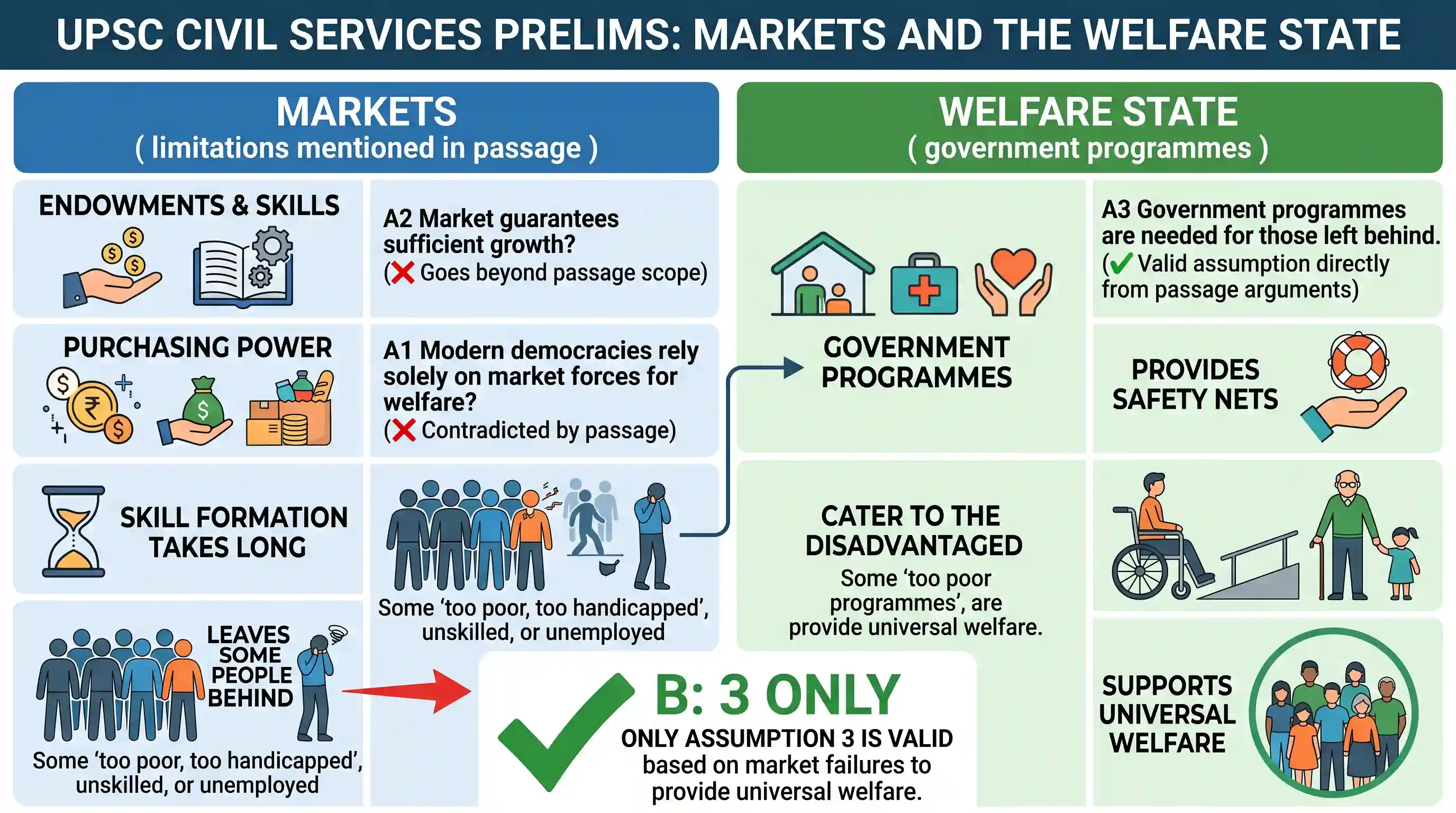
Can a democracy avoid being a welfare state for long ? Why cannot mass welfare be left entirely to the markets ? There is a built- in tension between markets and democracy. Markets do not work on a one- person- one- vote principle as democracies do. What one gets out of the market place depends on one's endowments, skills, purchasing power and the forces of demand and supply. Markets reward individual initiative and skill, and may also lift many from the bottom rungs of society, but some people never get the opportunity to develop skills that markets demand; they are simply too poor and too handicapped; or skill formation takes too long. By creating jobs, markets may be able to help even unskilled people, but capitalism has always witnessed bursts of unemployment. With reference to the above passage, the following assumptions have been made: 1. Modern democracies rely on the forces to enable them to be welfare states. 2. Markets ensure sufficient economic growth necessary for democracies to be effective. 3. Government programmes are needed for those left behind in economic growth. Which of the above assumptions is/are valid?

- A1 and 3 only
- B3 onlyCorrect
- C2 and 3 only
- D1, 2 and 3
Explanation
The passage highlights the limitations of markets in ensuring universal welfare and the inherent tension between market principles and democratic ideals.
Let's analyze each assumption:
-
Modern democracies rely on the forces to enable them to be welfare states.
- The passage explicitly asks, "Why cannot mass welfare be left entirely to the markets?" and discusses the "built-in tension between markets and democracy." It details how markets fail to provide for everyone ("some people never get the opportunity... too poor and too handicapped"). This suggests that democracies cannot solely rely on market forces to be welfare states; rather, markets are insufficient for this purpose. Therefore, this assumption is not supported and is contradicted by the passage.
-
Markets ensure sufficient economic growth necessary for democracies to be effective.
- While the passage mentions markets "reward individual initiative and skill, and may also lift many from the bottom rungs of society, but some people never get the opportunity to develop skills that markets demand," it does not explicitly state or assume that markets ensure sufficient economic growth necessary for democracies to be effective. The focus is on the failure of markets to provide universal welfare, not on their role in guaranteeing the economic growth required for effective democracies. This assumption goes beyond the scope and direct statements of the passage.
-
Government programmes are needed for those left behind in economic growth.
- The passage clearly states that "some people never get the opportunity to develop skills that markets demand; they are simply too poor and too handicapped; or skill formation takes too long." It also mentions "capitalism has always witnessed bursts of unemployment." The opening question, "Can a democracy avoid being a welfare state for long? Why cannot mass welfare be left entirely to the markets?", strongly implies that a welfare state (which involves government intervention and programmes) is necessary precisely because markets leave certain groups behind. This assumption is directly supported by the passage's arguments about market failures and the necessity of a welfare state.
Based on the analysis, only assumption 3 is valid according to the passage.
The final answer is B
Related questions
More UPSC Prelims practice from the same subject and topic.
- Prelims 2021CSATReading Comprehension
India faces a challenging immediate future in energy and climate policy- making. The problems are multiple: sputtering fossil fuel production capabilities; limited access to electricity and modern coo…
- Prelims 2021CSATReading Comprehension
There are reports that some of the antibiotics sold in the market are fed to poultry and other livestock as growth promoters. Overusing these substances can create superbugs, pathogens that are resist…
- Prelims 2021CSATReading Comprehension
Policymakers and media have placed the blame for skyrocketing food prices on a variety of factors, including high fuel prices, bad weather in key food producing countries, and the diversion of land to…
- Prelims 2021CSATReading Comprehension
A central message of modern development economics is the importance of income growth, by which is meant growth in Gross Domestic Product (GDP). In theory, rising GDP creates employment and investment …
- Prelims 2021CSATReading Comprehension
Researchers simulated street lighting on artificial grassland plots containing pea- aphids, sap- sucking insects, at night. These were exposed to two different types of light - a white light similar t…
- Prelims 2021CSATReading Comprehension
Approximately 80 percent of all flowering plant species are pollinated by animals, including birds and mammals, but the main pollinators are insects. Pollination is responsible for providing us with a…