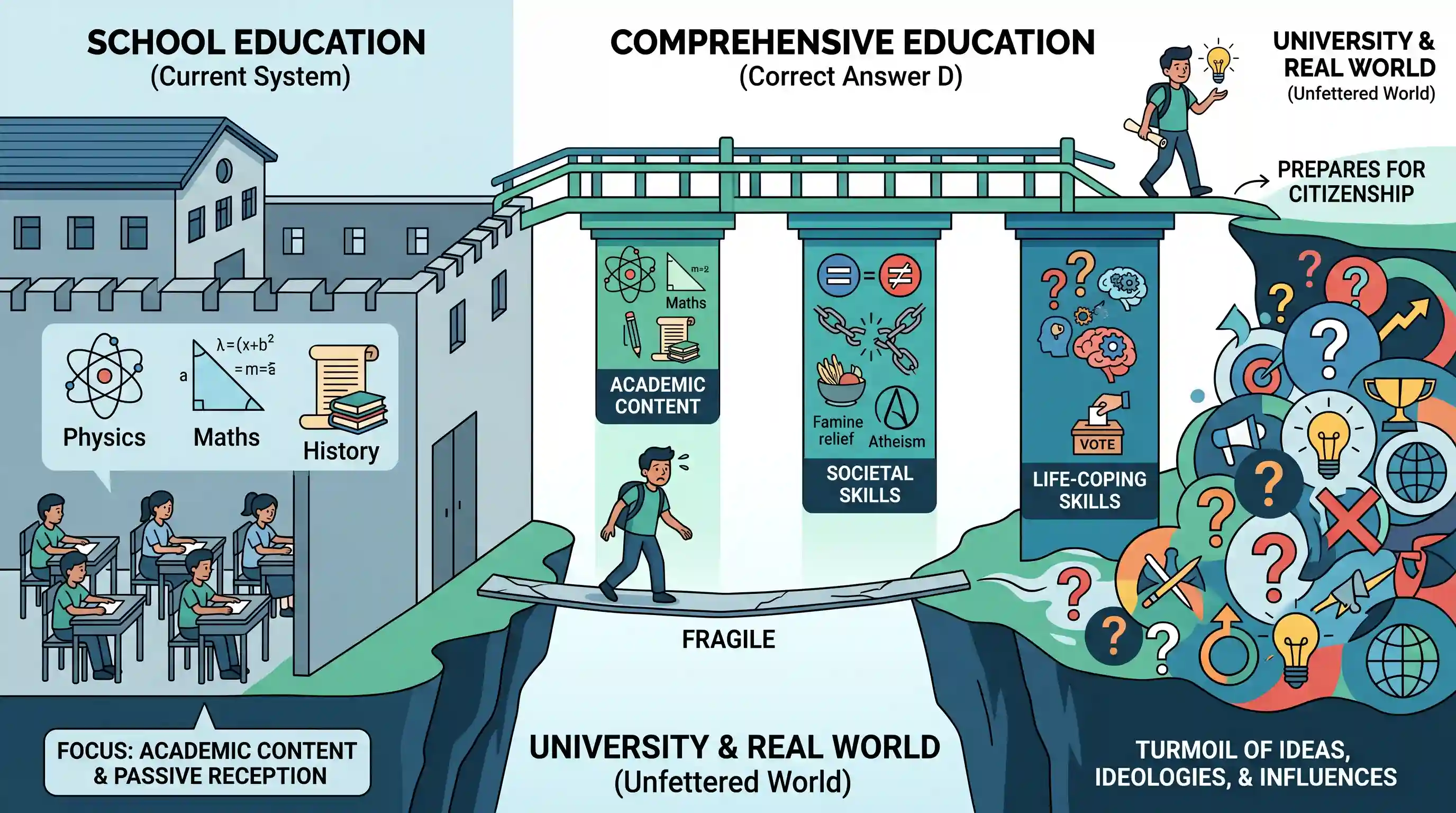
Read the following passage and answer the items that follow. Your answers to these items should be based on the passages only. In our schools, we teach our children all that is there to know about physics, maths and history and what have you. But do we teach them about the bitter caste divide that plagues the country, about the spectre of famine that stalks large parts of our land, about gender sensitivity, about the possibility of atheism as a choice, etc.? Equally important, do we teach them to ask questions, or do we teach them only to passively receive our wisdom? From the cocooned world of school, suddenly, the adolescent finds himself/herself in the unfettered world of university. Here he/she is swept up in a turmoil of ideas, influences and ideologies. For someone who has been discouraged from asking questions and forming an opinion, this transition can be painful. Which one of the following statements best reflects the central idea of the passage given above?

- ASchool curriculum is not compatible with. the expectations of children and parents
- BEmphasis on academic achievements does give time for development of personality and skills
- CPreparing the children to be better citizens should be the responsibility of the education system
- DTo be a better citizen, the present world order demands societal and life-coping skills in addition to academic content.Correct
Explanation
The passage criticizes the current school system for two main reasons:
- It focuses only on academic subjects (physics, maths, history) but neglects crucial societal issues (caste, famine, gender sensitivity, atheism as a choice).
- It teaches children to passively receive wisdom instead of encouraging them to ask questions and form opinions. The passage then explains the consequence: this lack of preparation makes the transition to the "unfettered world of university" (which represents the broader world) painful, as students are ill-equipped to handle the "turmoil of ideas, influences and ideologies."
Let's analyze the options:
A) School curriculum is not compatible with the expectations of children and parents.
- The passage does not mention the expectations of children or parents. It focuses on what the school teaches and its impact on the student's readiness for the world.
B) Emphasis on academic achievements does give time for development of personality and skills.
- This statement contradicts the passage. The passage implies that the emphasis on academic subjects does not give time or attention to the development of critical thinking, societal awareness, and opinion formation (which are aspects of personality and skills). It highlights the lack of these developments.
C) Preparing the children to be better citizens should be the responsibility of the education system.
- This is a true statement and aligns with the passage's implied critique (that schools should teach about societal issues and critical thinking, which contribute to good citizenship). However, it's a general principle. The passage goes further by specifying what kind of skills are missing and why they are needed in the "present world order" (represented by university life).
D) To be a better citizen, the present world order demands societal and life-coping skills in addition to academic content.
- "Academic content" is covered by physics, maths, history.
- "Societal skills" are covered by teaching about caste divide, famine, gender sensitivity.
- "Life-coping skills" are covered by teaching to ask questions and form opinions, which helps navigate the "turmoil of ideas, influences and ideologies" in university. The "painful" transition highlights the necessity of these coping skills.
- "Present world order demands" is reflected in the description of the "unfettered world of university" and the difficulty students face without these skills.
- "To be a better citizen" encompasses the broader goal of teaching about societal issues and critical thinking.
- This option comprehensively captures all key elements of the passage: the critique of academic-only focus, the specific types of missing skills (societal and life-coping), and the reason for their necessity in the real world. It best reflects the central idea that current education is inadequate for preparing individuals for the complexities of life beyond school.
The final answer is D because it synthesizes all the core arguments of the passage, detailing both the shortcomings of the current system and the essential requirements for students to thrive in the real world.
Related questions
More UPSC Prelims practice from the same subject and topic.
- Prelims 2021CSATReading Comprehension
India faces a challenging immediate future in energy and climate policy- making. The problems are multiple: sputtering fossil fuel production capabilities; limited access to electricity and modern coo…
- Prelims 2021CSATReading Comprehension
There are reports that some of the antibiotics sold in the market are fed to poultry and other livestock as growth promoters. Overusing these substances can create superbugs, pathogens that are resist…
- Prelims 2021CSATReading Comprehension
Policymakers and media have placed the blame for skyrocketing food prices on a variety of factors, including high fuel prices, bad weather in key food producing countries, and the diversion of land to…
- Prelims 2021CSATReading Comprehension
A central message of modern development economics is the importance of income growth, by which is meant growth in Gross Domestic Product (GDP). In theory, rising GDP creates employment and investment …
- Prelims 2021CSATReading Comprehension
Researchers simulated street lighting on artificial grassland plots containing pea- aphids, sap- sucking insects, at night. These were exposed to two different types of light - a white light similar t…
- Prelims 2021CSATReading Comprehension
Approximately 80 percent of all flowering plant species are pollinated by animals, including birds and mammals, but the main pollinators are insects. Pollination is responsible for providing us with a…