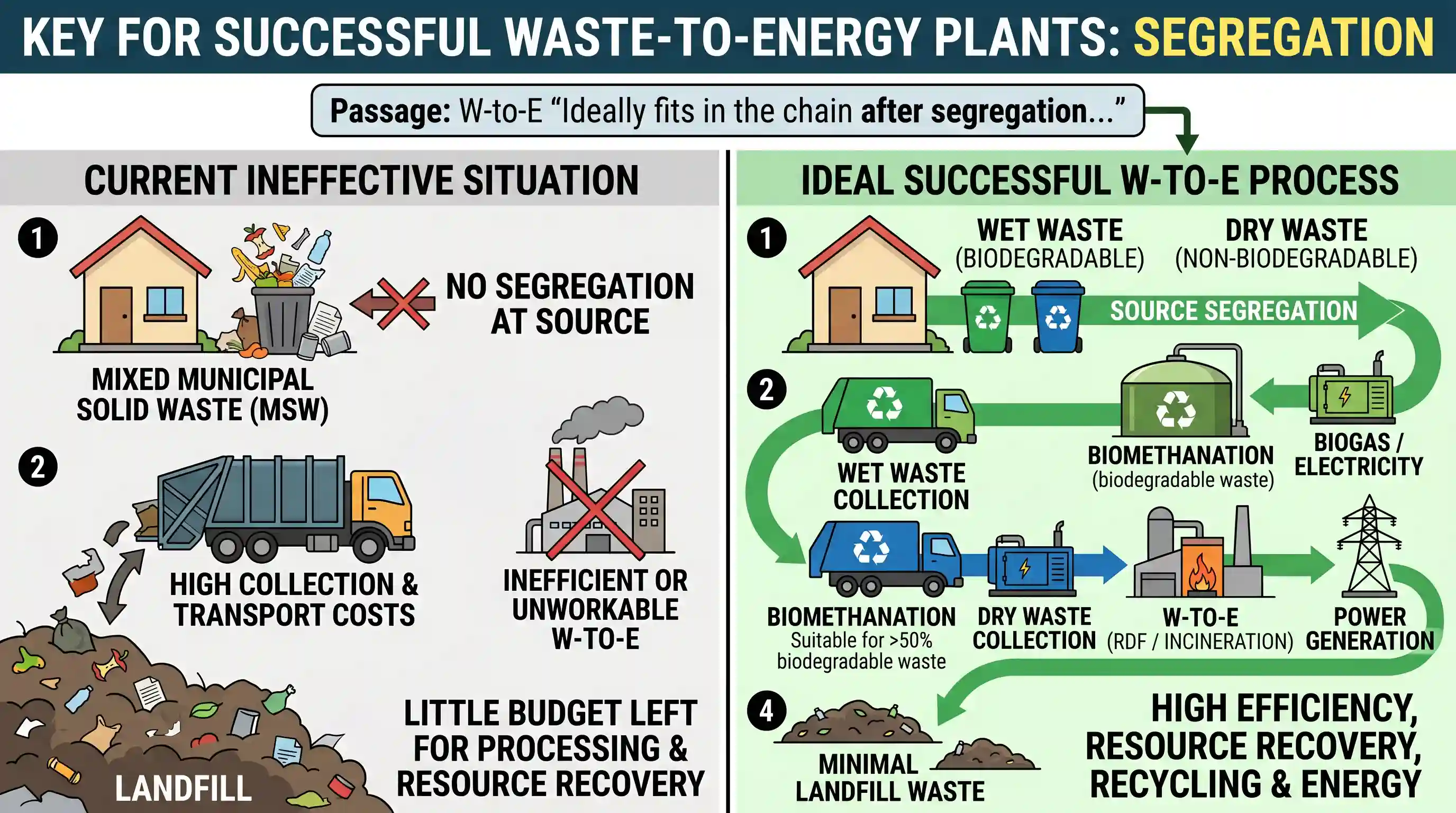
In India, the segregation of municipal waste at source is rare. Recycling is mostly with the informal sector. More than three- fourths of the municipal budget goes into collection and transportation, which leaves very little for processing/resource recovery and disposal. Where does waste- to- energy fit into all this? Ideally it fits in the chain after segregation (between wet waste and the rest), collection, recycling, and before getting to the landfill. Which technology is most appropriate in converting waste to energy depends on what is in the waste (that is biodegradable versus non- biodegradable component) and its calorific value. The biodegradable component of India's municipal solid waste is a little over 50 per cent, and biomethanation offers a major solution for processing this. Which one of the following statements best reflects the crux of the passage?

- AGeneration of energy from municipal solid waste is inexpensive.
- BBiomethanation is the most ideal way of generating energy from municipal solid waste.
- CSegregation of municipal solid waste is the first step in ensuring the success of waste-to-energy plants.Correct
- DThe biodegradable component of India's municipal solid waste is not adequate to provide energy from waste efficiently/effectively.
Explanation
The passage highlights that "segregation of municipal waste at source is rare" and then states that waste-to-energy "Ideally it fits in the chain after segregation (between wet waste and the rest), collection, recycling, and before getting to the landfill." This directly implies that segregation is a necessary preceding step for waste-to-energy to fit ideally and function effectively.
Let's analyze the options:
A) Generation of energy from municipal solid waste is inexpensive. The passage states that most of the municipal budget goes into collection and transportation, leaving "very little for processing/resource recovery and disposal." This suggests that processing (which includes waste-to-energy) is not inexpensive, or at least not prioritized due to budget constraints elsewhere. The passage does not claim it is inexpensive.
B) Biomethanation is the most ideal way of generating energy from municipal solid waste. The passage says biomethanation "offers a major solution for processing this [biodegradable] component" (which is a little over 50%). It also states that the "most appropriate" technology depends on the waste composition. This indicates biomethanation is ideal for a part of the waste, not necessarily the most ideal way for the entire municipal solid waste, which also contains non-biodegradable components.
C) Segregation of municipal solid waste is the first step in ensuring the success of waste-to-energy plants. The passage explicitly states that waste-to-energy "Ideally it fits in the chain after segregation." Since segregation is rare, and WtE ideally comes after it, the passage strongly suggests that segregation is a crucial prerequisite for the successful integration and operation of waste-to-energy. This statement directly reflects a key point about the ideal process flow.
D) The biodegradable component of India's municipal solid waste is not adequate to provide energy from waste efficiently/effectively. The passage states that the biodegradable component is "a little over 50 per cent, and biomethanation offers a major solution for processing this." This implies that it is adequate and can be effectively processed for energy, contradicting the statement.
Therefore, option C best reflects the crux of the passage by emphasizing the critical role of segregation for waste-to-energy.
The final answer is C
Related questions
More UPSC Prelims practice from the same subject and topic.
- Prelims 2023CSATReading Comprehension
We often hear about conflicts among different States in India over river waters. Of the 20 major river systems, 14 are already water- stressed; 75% of the population lives in water- stressed regions, …
- Prelims 2023CSATReading Comprehension
More than half of Indian women and almost a quarter of Indian men of working age suffer from anaemia. According to studies, they are anywhere from 5 - 15% less productive than they could be, as a resu…
- Prelims 2023CSATReading Comprehension
In India, a majority of farmers are marginal and small, less educated and possess low adaptive capabilities to climate change, perhaps because of credit and other constraints. So, one cannot expect au…
- Prelims 2023CSATReading Comprehension
The emissions humans put into the atmosphere now will affect the climate in the middle of the century and onwards. Technological change, meanwhile, could make a future transition away from fossil fuel…
- Prelims 2023CSATReading Comprehension
Environmental problems cause health problems. Substantial changes in lifestyle can reduce environmental or health problems, but this idea appears almost impossible to adopt. With environmental problem…
- Prelims 2023CSATReading Comprehension
Many people are not eating the right food. For some, it is simply a decision to stick with food they enjoy but which is not too healthy. This is leading to an increase in non- communicable diseases. T…