There is a claim that organic farming is inherently safer and healthier. The reality is that because the organic farming industry is still young and not well- regulated in India, farmers and consumers, alike, are not only confused about what products are best for them, but sometimes use products in ways that could harm them as well. For example, since organic fertilizers are difficult to obtain on a large scale in India, farmers often use farmyard manure, which may contain toxic chemicals and heavy metals. Certain plant sprays, such as Datura flower and leaf spray, have an element called atropine. If it is not applied in the right dose, it can act on the nervous system of the consumer. Unfortunately, how much and when to use it are not well- researched or regulated issues. Based on the above passage, the following assumptions have been made: 1. Organic farming is inherently unsafe for both farmers and consumers. 2. Farmers and consumers need to be educated about eco-friendly food. Which of the assumptions given above is/are correct?

- A1 only
- B2 onlyCorrect
- CBoth 1 and 2
- DNeither 1 nor 2
Explanation
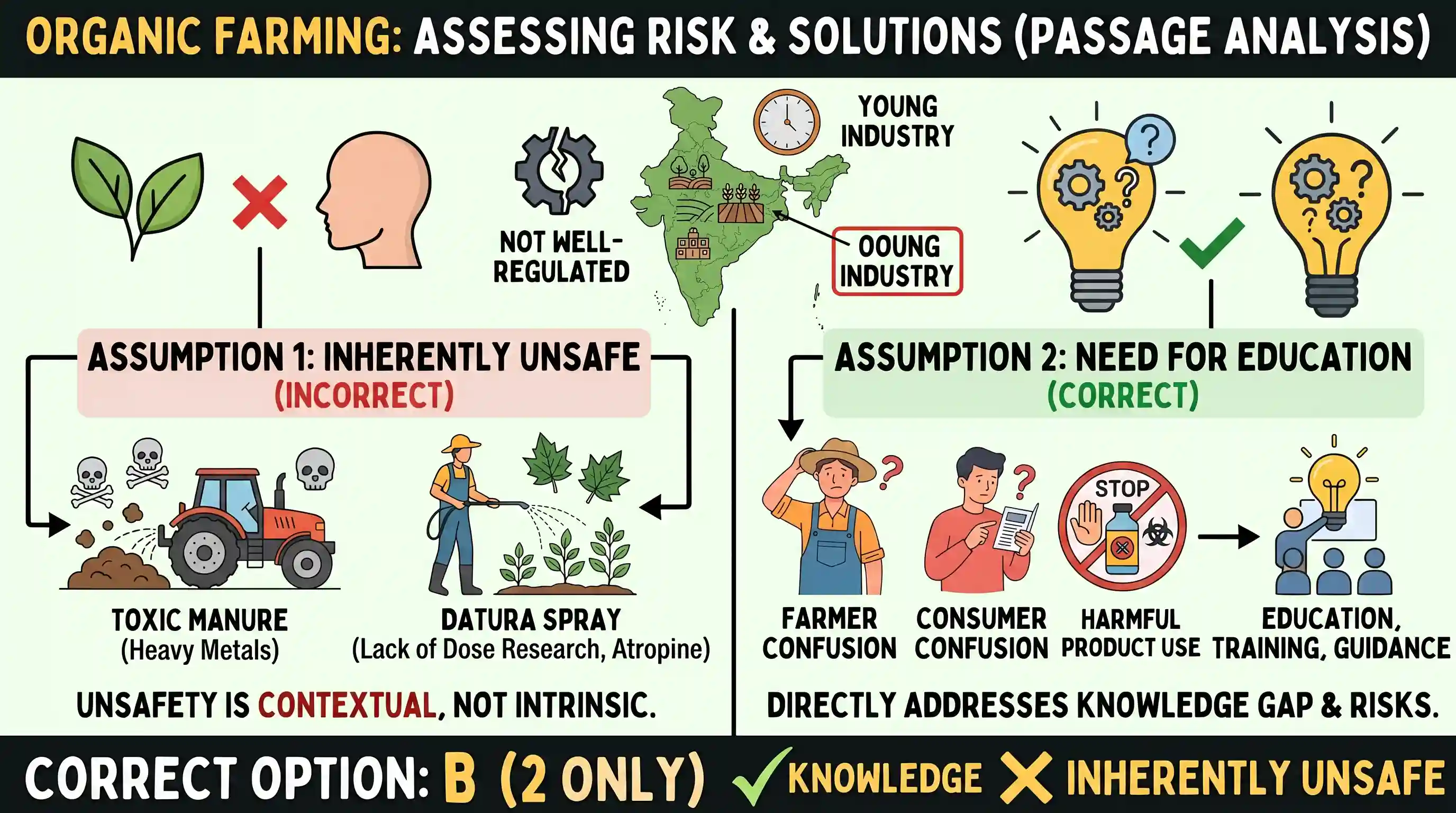
The passage highlights problems in organic farming in India due to a lack of regulation, research, and knowledge, leading to confusion and potentially harmful practices.
-
Organic farming is inherently unsafe for both farmers and consumers. This assumption is incorrect. The passage does not claim organic farming is inherently unsafe. Instead, it states that the current state of the industry in India (being young, not well-regulated, and lacking research) leads to unsafe practices. It implies that with proper regulation and knowledge, these risks could be mitigated, suggesting the unsafety is not intrinsic to organic farming itself.
-
Farmers and consumers need to be educated about eco-friendly food. This assumption is correct. The passage explicitly states that farmers and consumers are "confused about what products are best for them" and "sometimes use products in ways that could harm them." It also mentions that "how much and when to use it are not well- researched or regulated issues." This directly points to a need for education, research, and regulation to ensure safe practices within eco-friendly (organic) farming.
Therefore, only assumption 2 is correct.
Related questions
More UPSC Prelims practice from the same subject and topic.
- Prelims 2023CSATReading Comprehension
We often hear about conflicts among different States in India over river waters. Of the 20 major river systems, 14 are already water- stressed; 75% of the population lives in water- stressed regions, …
- Prelims 2023CSATReading Comprehension
More than half of Indian women and almost a quarter of Indian men of working age suffer from anaemia. According to studies, they are anywhere from 5 - 15% less productive than they could be, as a resu…
- Prelims 2023CSATReading Comprehension
In India, a majority of farmers are marginal and small, less educated and possess low adaptive capabilities to climate change, perhaps because of credit and other constraints. So, one cannot expect au…
- Prelims 2023CSATReading Comprehension
The emissions humans put into the atmosphere now will affect the climate in the middle of the century and onwards. Technological change, meanwhile, could make a future transition away from fossil fuel…
- Prelims 2023CSATReading Comprehension
Environmental problems cause health problems. Substantial changes in lifestyle can reduce environmental or health problems, but this idea appears almost impossible to adopt. With environmental problem…
- Prelims 2023CSATReading Comprehension
Many people are not eating the right food. For some, it is simply a decision to stick with food they enjoy but which is not too healthy. This is leading to an increase in non- communicable diseases. T…