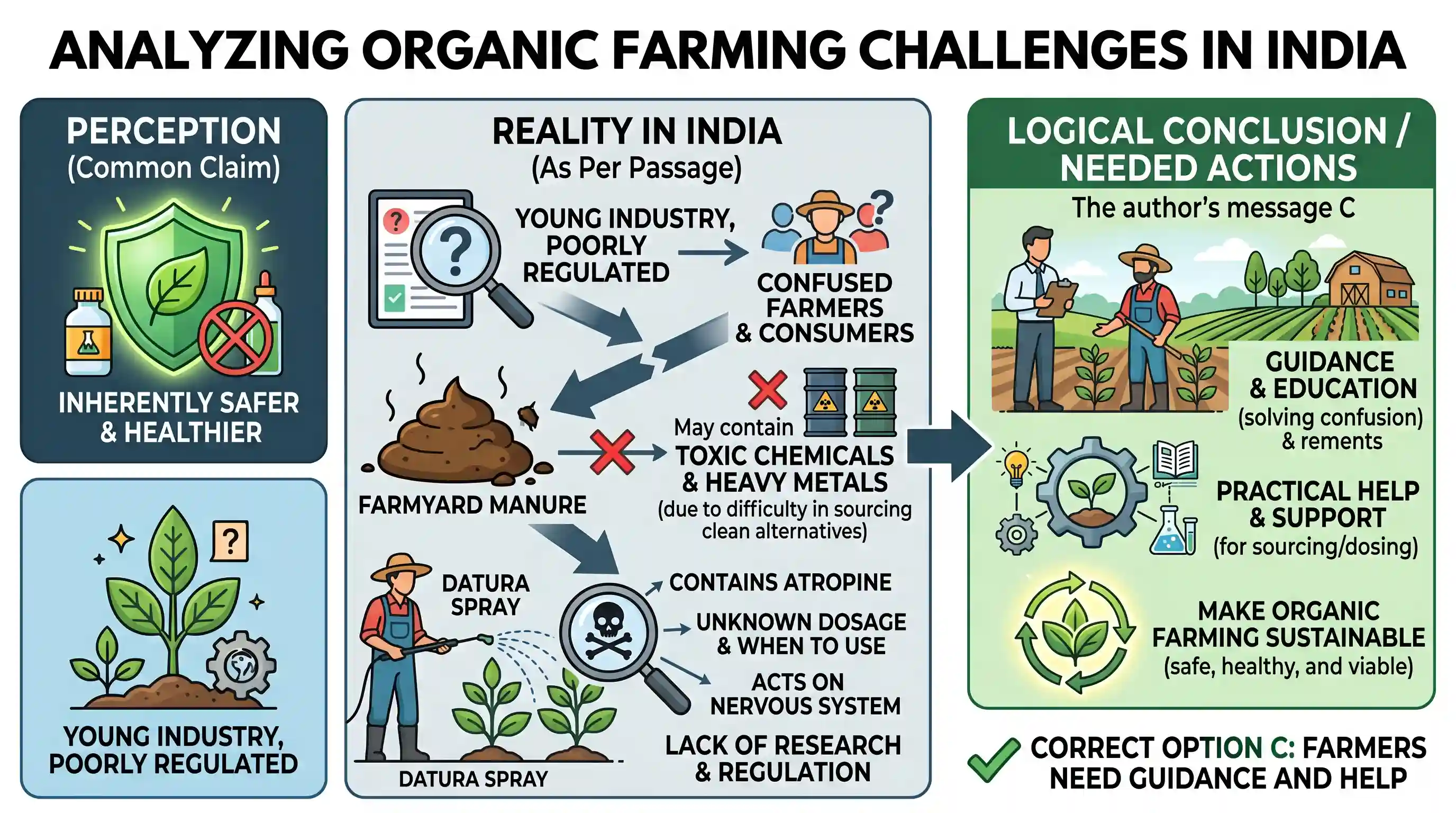
There is a claim that organic farming is inherently safer and healthier. The reality is that because the organic farming industry is still young and not well- regulated in India, farmers and consumers, alike, are not only confused about what products are best for them, but sometimes use products in ways that could harm them as well. For example, since organic fertilizers are difficult to obtain on a large scale in India, farmers often use farmyard manure, which may contain toxic chemicals and heavy metals. Certain plant sprays, such as Datura flower and leaf spray, have an element called atropine. If it is not applied in the right dose, it can act on the nervous system of the consumer. Unfortunately, how much and when to use it are not well- researched or regulated issues. Which one of the following statements best reflects the most logical, rational and practical message conveyed by the author of the passage?

- AIn India, organic farming should not be promoted as a substitute for conventional farming.
- BThere are no safe organic alternatives to chemical fertilizers.
- CIn India, farmers need to be guided and helped to make their organic farming sustainable.Correct
- DThe aim of organic farming should not be to generate huge profits as there is still no global market for its products.
Explanation
The passage highlights several issues with organic farming in India: lack of regulation, confusion among farmers and consumers, potential harm from misapplication of organic products (like contaminated farmyard manure or improperly dosed plant sprays), and difficulty in obtaining organic fertilizers. All these points underscore a critical need for better guidance, research, and support for farmers.
Let's analyze the options:
A) In India, organic farming should not be promoted as a substitute for conventional farming. The passage points out problems with the current practice and lack of regulation in organic farming, not that it inherently cannot be a substitute. It suggests that if promoted, it needs to be done correctly and safely, rather than outright dismissing its potential. This statement is too strong and goes beyond the author's message, which focuses on improving existing practices.
B) There are no safe organic alternatives to chemical fertilizers. The passage states that organic fertilizers are "difficult to obtain on a large scale" and that farmyard manure "may contain toxic chemicals." This highlights a problem with availability and safety of certain current alternatives, not a blanket claim that no safe organic alternatives exist. This is an overgeneralization not supported by the text.
C) In India, farmers need to be guided and helped to make their organic farming sustainable. This statement perfectly encapsulates the author's message. The passage details how farmers are confused, lack proper knowledge (e.g., dosage of sprays), face difficulties in sourcing materials, and operate in an unregulated environment. All these issues point to a clear need for guidance, education, research, and practical help to make organic farming safe, effective, and therefore sustainable in the long run. "Sustainable" here implies not just environmental, but also social (health and safety) and practical viability.
D) The aim of organic farming should not be to generate huge profits as there is still no global market for its products. The passage does not discuss profits, markets (global or local), or economic aims of organic farming at all. It focuses solely on the safety, health, regulation, and practical application aspects within India. This option introduces irrelevant information.
Therefore, option C is the most logical, rational, and practical message conveyed by the author, directly addressing the core problems highlighted in the passage.
Related questions
More UPSC Prelims practice from the same subject and topic.
- Prelims 2023CSATReading Comprehension
We often hear about conflicts among different States in India over river waters. Of the 20 major river systems, 14 are already water- stressed; 75% of the population lives in water- stressed regions, …
- Prelims 2023CSATReading Comprehension
More than half of Indian women and almost a quarter of Indian men of working age suffer from anaemia. According to studies, they are anywhere from 5 - 15% less productive than they could be, as a resu…
- Prelims 2023CSATReading Comprehension
In India, a majority of farmers are marginal and small, less educated and possess low adaptive capabilities to climate change, perhaps because of credit and other constraints. So, one cannot expect au…
- Prelims 2023CSATReading Comprehension
The emissions humans put into the atmosphere now will affect the climate in the middle of the century and onwards. Technological change, meanwhile, could make a future transition away from fossil fuel…
- Prelims 2023CSATReading Comprehension
Environmental problems cause health problems. Substantial changes in lifestyle can reduce environmental or health problems, but this idea appears almost impossible to adopt. With environmental problem…
- Prelims 2023CSATReading Comprehension
Many people are not eating the right food. For some, it is simply a decision to stick with food they enjoy but which is not too healthy. This is leading to an increase in non- communicable diseases. T…