Food consumption patterns have changed substantially in India over the past few decades. This has resulted in the disappearance of many nutritious foods such as millets. While food grain production has increased over five times since independence, it has not sufficiently addressed the issue of malnutrition. For long, the agriculture sector focussed on increasing food production particularly staples, which led to lower production and consumption of indigenous traditional crops/grains, fruits and other vegetables, impacting food and nutrition security in the process. Further, intensive, monoculture agriculture practices can perpetuate the food and nutrition security problem by degrading the quality of land, water and food derived through them. Based on the above passage, the following assumptions have been made: 1. To implement the Sustainable Development Goals and to achieve zero-hunger goal, monoculture agriculture practices are inevitable even if they do not address malnutrition. 2. Dependence on a few crops has negative consequences for human health and the ecosystem. 3. Government policies regarding food planning need to incorporate nutritional security. 4. For the present monoculture agriculture practices, farmers receive subsidies in various ways and government offers remunerative prices for grains and therefore they do not tend to consider crop diversity. Which of the above assumptions are valid?

- A1, 2 and 4 only
- B2 and 3 onlyCorrect
- C3 and 4 only
- D1, 2, 3 and 4
Explanation
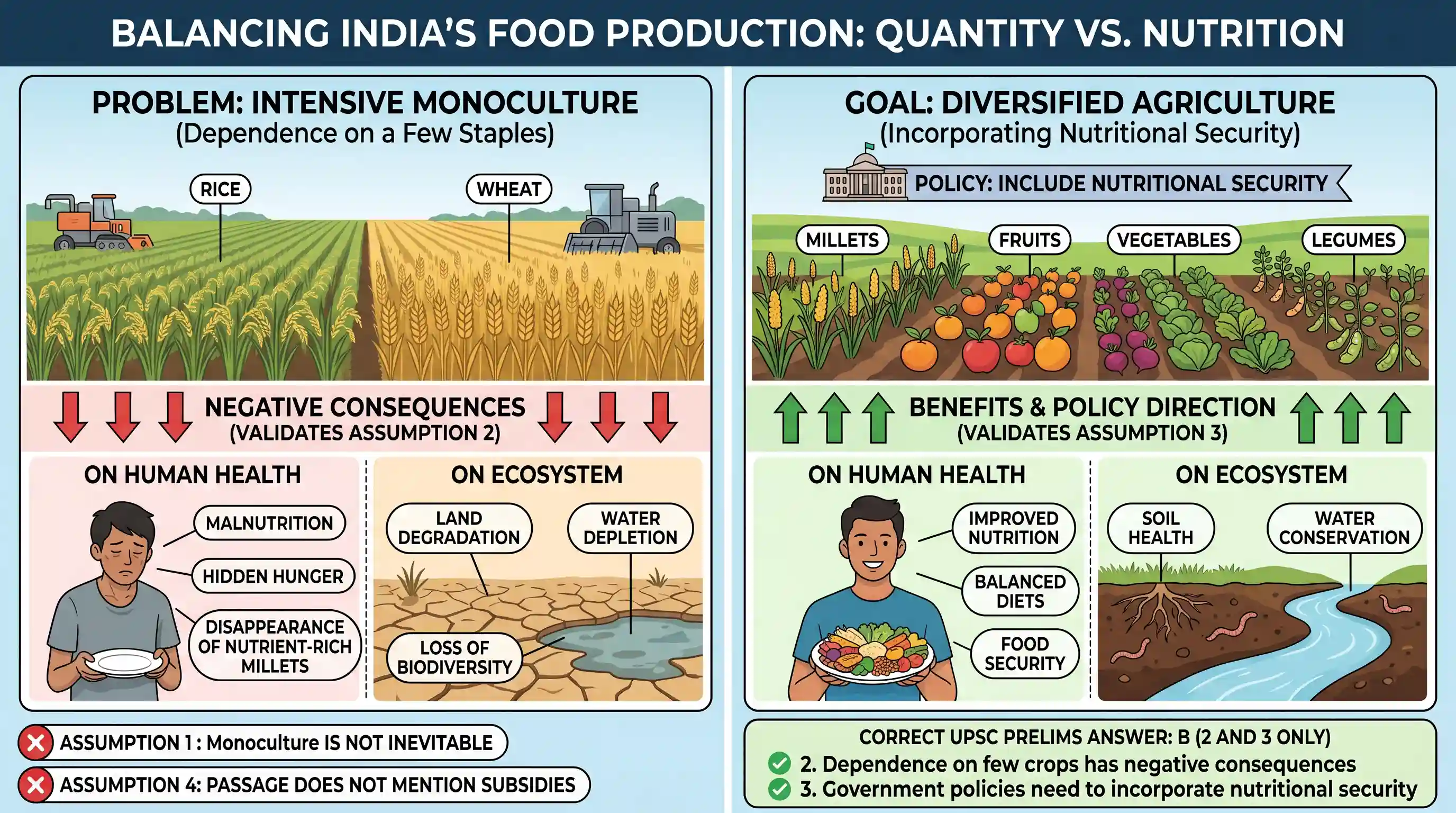
The correct answer is B because only assumptions 2 and 3 are valid based on the provided passage.
Analysis of each assumption:
-
To implement the Sustainable Development Goals and to achieve zero-hunger goal, monoculture agriculture practices are inevitable even if they do not address malnutrition. This assumption is NOT VALID. The passage states that monoculture agriculture "can perpetuate the food and nutrition security problem by degrading the quality of land, water and food." This implies monoculture is a hindrance, not an inevitable or desirable practice, for achieving zero-hunger or SDGs, especially if it doesn't address malnutrition.
-
Dependence on a few crops has negative consequences for human health and the ecosystem. This assumption IS VALID. The passage states that focus on staples "led to lower production and consumption of indigenous traditional crops/grains, fruits and other vegetables, impacting food and nutrition security in the process" (negative for human health). It also mentions "intensive, monoculture agriculture practices can perpetuate the food and nutrition security problem by degrading the quality of land, water" (negative for the ecosystem). Monoculture is a form of dependence on a few crops.
-
Government policies regarding food planning need to incorporate nutritional security. This assumption IS VALID. The passage highlights that "food grain production has increased over five times since independence, it has not sufficiently addressed the issue of malnutrition." It also states that focus on staples "impacted food and nutrition security." This strongly implies that current food planning policies are inadequate regarding nutrition and need to be revised to incorporate nutritional security.
-
For the present monoculture agriculture practices, farmers receive subsidies in various ways and government offers remunerative prices for grains and therefore they do not tend to consider crop diversity. This assumption is NOT VALID. The passage mentions the agriculture sector's focus on staples but does not provide any information or context about government subsidies, remunerative prices, or farmers' motivations for not considering crop diversity. This information is outside the scope of the passage.
Related questions
More UPSC Prelims practice from the same subject and topic.
- Prelims 2023CSATReading Comprehension
We often hear about conflicts among different States in India over river waters. Of the 20 major river systems, 14 are already water- stressed; 75% of the population lives in water- stressed regions, …
- Prelims 2023CSATReading Comprehension
More than half of Indian women and almost a quarter of Indian men of working age suffer from anaemia. According to studies, they are anywhere from 5 - 15% less productive than they could be, as a resu…
- Prelims 2023CSATReading Comprehension
In India, a majority of farmers are marginal and small, less educated and possess low adaptive capabilities to climate change, perhaps because of credit and other constraints. So, one cannot expect au…
- Prelims 2023CSATReading Comprehension
The emissions humans put into the atmosphere now will affect the climate in the middle of the century and onwards. Technological change, meanwhile, could make a future transition away from fossil fuel…
- Prelims 2023CSATReading Comprehension
Environmental problems cause health problems. Substantial changes in lifestyle can reduce environmental or health problems, but this idea appears almost impossible to adopt. With environmental problem…
- Prelims 2023CSATReading Comprehension
Many people are not eating the right food. For some, it is simply a decision to stick with food they enjoy but which is not too healthy. This is leading to an increase in non- communicable diseases. T…