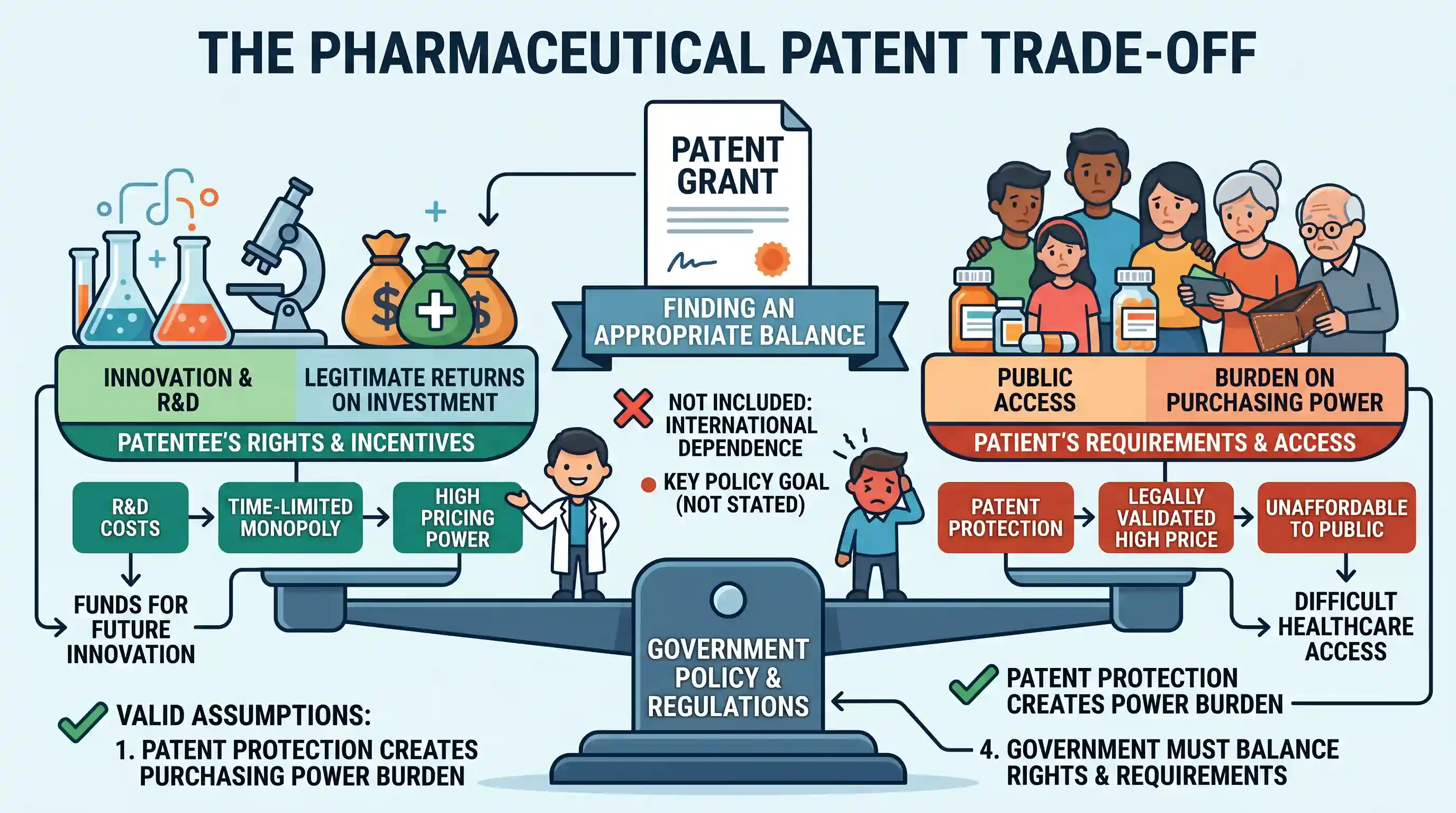
Pharmaceutical patents grant protection to the patentee for the duration of the patent term. The patentees enjoy the liberty to determine the prices of medicines, which is time- limited to the period of monopoly, but could be unaffordable to the public. Such patent protection offered to the patentees is believed to benefit the public over the longer term through innovations and research and development (R&D), although it comes at a cost, in the nature of higher prices for the patented medicine. The patent regime and price protection - through a legally validated high price for the medicine during the currency of the patent - provide the patentee with a legitimate mechanism to get returns on the costs incurred in innovation and research. Based on the above passage, the following assumptions have been made: 1. Patent protection given to patentees puts a huge burden on public's purchasing power in accessing patented medicines. 2. Dependence on other countries for pharmaceutical products is a huge burden for developing and poor countries. 3. Providing medicines to the public at affordable prices is a key goal during the public health policy design in many countries. 4. Governments need to find an appropriate balance between the rights of patentees and the requirements of the patients. Which of the above assumptions are valid?

- A1 and 2
- B1 and 4Correct
- C3 and 4
- D2 and 3
Explanation
The passage discusses the trade-off between patent protection (which allows patentees to charge high prices, potentially unaffordable to the public) and the long-term benefits of innovation and R&D.
Let's analyze each assumption:
-
Patent protection given to patentees puts a huge burden on public's purchasing power in accessing patented medicines.
- The passage states: "The patentees enjoy the liberty to determine the prices of medicines... but could be unaffordable to the public." This directly supports the idea that patent protection can lead to prices that are a burden on public purchasing power. Thus, this assumption is valid.
-
Dependence on other countries for pharmaceutical products is a huge burden for developing and poor countries.
- The passage focuses on the mechanism of patent protection, pricing, and innovation. It does not mention anything about international dependence for pharmaceutical products or specifically address developing/poor countries. This assumption goes beyond the scope of the given text. Thus, this assumption is invalid.
-
Providing medicines to the public at affordable prices is a key goal during the public health policy design in many countries.
- While the passage highlights that patented medicines "could be unaffordable to the public," it describes this as a consequence or cost of the patent system. It does not explicitly state that providing affordable medicines is a "key goal" of public health policy. It points to the problem, but not necessarily the policy objective in those terms. This is an inference not directly supported by the text. Thus, this assumption is invalid.
-
Governments need to find an appropriate balance between the rights of patentees and the requirements of the patients.
- The passage explicitly outlines the dilemma: patentees need "legitimate mechanism to get returns on the costs incurred in innovation and research" (rights of patentees), but this comes "at a cost, in the nature of higher prices for the patented medicine" which "could be unaffordable to the public" (requirements of patients). The entire passage frames this as a conflict that needs resolution, implying a balance must be struck, often by governments through policy. Thus, this assumption is valid.
Based on the analysis, assumptions 1 and 4 are valid.
The final answer is B
Related questions
More UPSC Prelims practice from the same subject and topic.
- Prelims 2023CSATReading Comprehension
We often hear about conflicts among different States in India over river waters. Of the 20 major river systems, 14 are already water- stressed; 75% of the population lives in water- stressed regions, …
- Prelims 2023CSATReading Comprehension
More than half of Indian women and almost a quarter of Indian men of working age suffer from anaemia. According to studies, they are anywhere from 5 - 15% less productive than they could be, as a resu…
- Prelims 2023CSATReading Comprehension
In India, a majority of farmers are marginal and small, less educated and possess low adaptive capabilities to climate change, perhaps because of credit and other constraints. So, one cannot expect au…
- Prelims 2023CSATReading Comprehension
The emissions humans put into the atmosphere now will affect the climate in the middle of the century and onwards. Technological change, meanwhile, could make a future transition away from fossil fuel…
- Prelims 2023CSATReading Comprehension
Environmental problems cause health problems. Substantial changes in lifestyle can reduce environmental or health problems, but this idea appears almost impossible to adopt. With environmental problem…
- Prelims 2023CSATReading Comprehension
Many people are not eating the right food. For some, it is simply a decision to stick with food they enjoy but which is not too healthy. This is leading to an increase in non- communicable diseases. T…