In essence, what does 'Due Process of Law' mean?

- AThe principle of natural justiceCorrect
- BThe procedure established by law
- CFair application of law
- DEquality before law
Explanation
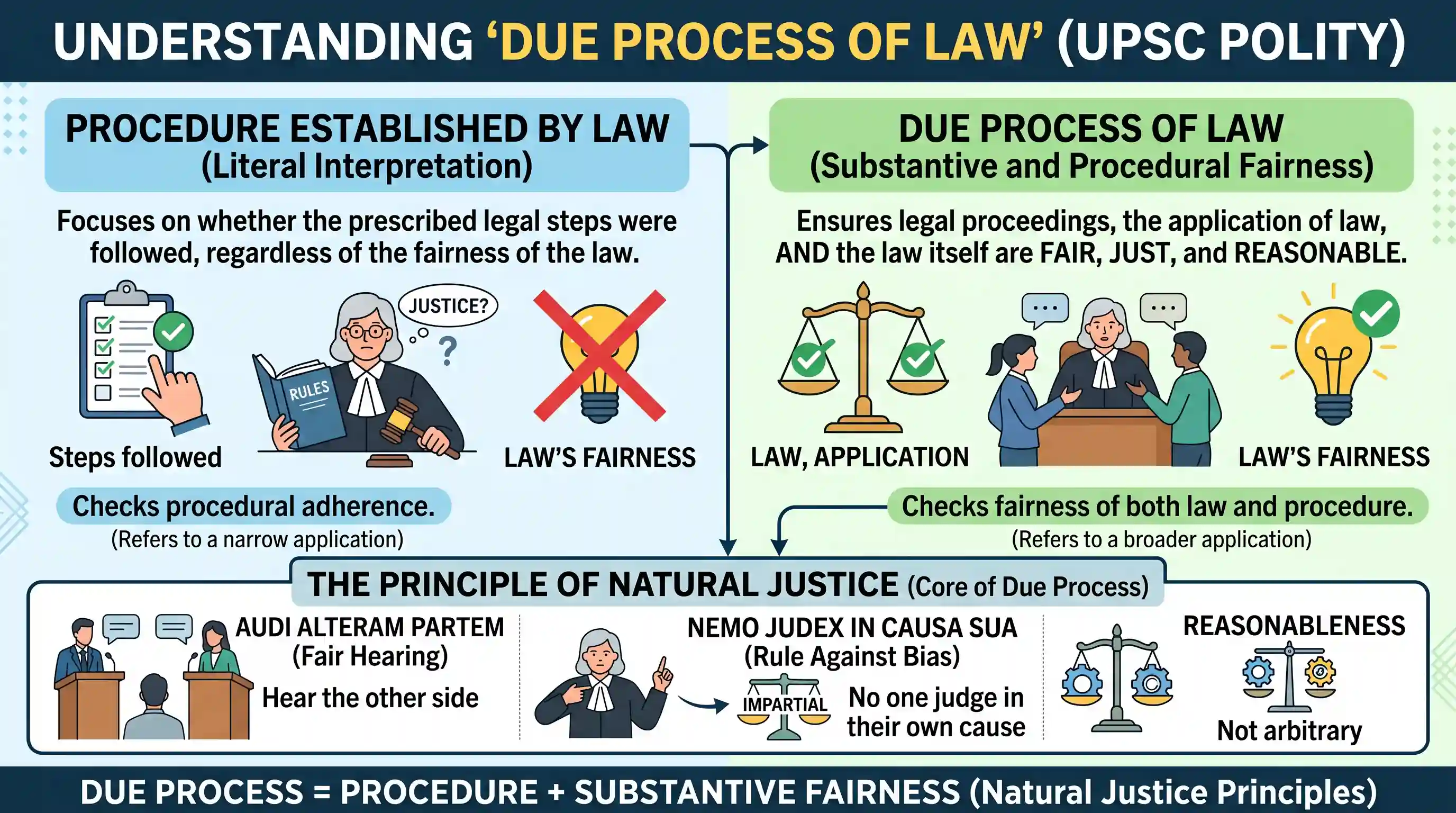
'Due Process of Law' is a concept that originated in the United States. In essence, it means that a person should not be deprived of life, liberty, or property without fair and just legal proceedings. It implies that not only should the procedure established by law be followed, but the law itself must also be fair, just, and reasonable. This is a broader concept than 'procedure established by law', which only checks if the prescribed procedure is followed, irrespective of the fairness of the law itself.
The principle of natural justice, which includes rules like 'Audi alteram partem' (hear the other side) and 'Nemo judex in causa sua' (no one should be a judge in their own cause), aligns very closely with 'due process of law' because both emphasize fairness, reasonableness, and impartiality in legal and administrative actions. Therefore, 'Due Process of Law' encompasses the spirit and application of natural justice to ensure that the law is not arbitrary and its application is equitable.
Related questions
More UPSC Prelims practice from the same subject and topic.
- Prelims 2023GS1polity-and-governance
Which one of the following statements best reflects the Chief purpose of the 'Constitution' of a country?
- Prelims 2023GS1polity-and-governance
In India, which one of the following Constitutional Amendments was widely believed to be enacted to overcome the judicial interpretations of the Fundamental Rights?
- Prelims 2023GS1polity-and-governance
Consider the following statements: 1. If the election of the President of India is declared void by the Supreme Court of India, all acts done by him/her in the performance of duties of his/her office …
- Prelims 2023GS1polity-and-governance
With reference to Finance Bill and Money Bill in the Indian Parliament, consider the following statements: 1. When the Lok Sabha transmits Finance Bill to the Rajya Sabha, it can amend or reject the B…
- Prelims 2023GS1polity-and-governance
Consider the following statements: 1. According to the Constitution of India, the Central Government has a duty to protect States from internal disturbances. 2. The Constitution of India exempts the S…
- Prelims 2023GS1polity-and-governance
Consider the following statements in respect of election to the President of India: 1. The members nominated to either House of the Parliament or the Legislative Assemblies of States are also eligible…