In India, which one of the following Constitutional Amendments was widely believed to be enacted to overcome the judicial interpretations of the Fundamental Rights?

- A1st AmendmentCorrect
- B42nd Amendment
- C44th Amendment
- D86th Amendment
Explanation
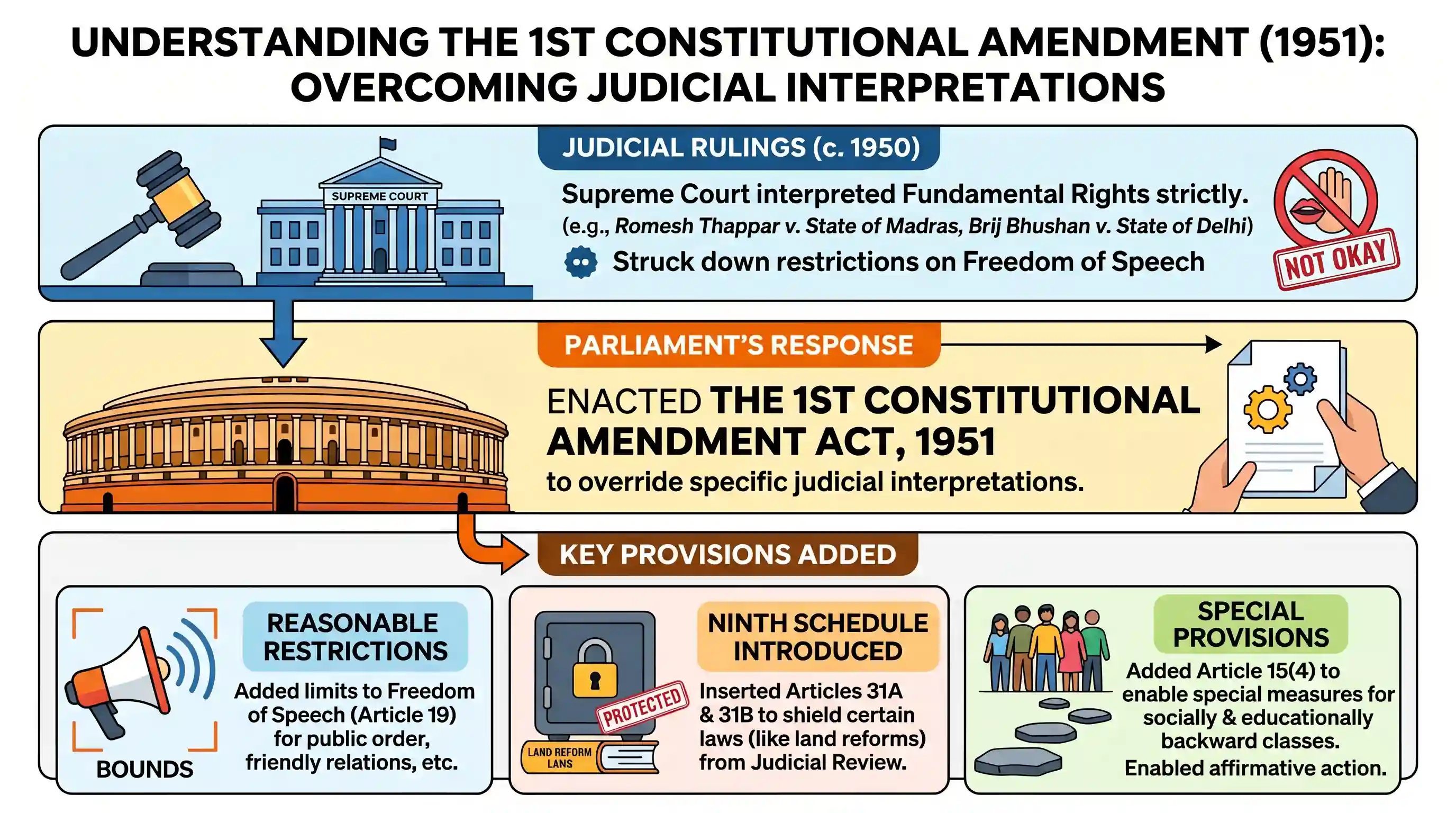
The 1st Constitutional Amendment (1951) was enacted primarily to overcome judicial interpretations of Fundamental Rights. The Supreme Court in cases like Romesh Thappar v. State of Madras (1950) and Brij Bhushan v. State of Delhi (1950) had struck down restrictions on freedom of speech. The 1st Amendment added reasonable restrictions to Article 19, inserted Articles 31A and 31B with the Ninth Schedule to protect land reform laws from judicial review, and added Article 15(4) to enable special provisions for socially and educationally backward classes. Note: This question was dropped by UPSC from the 2023 Prelims exam.
Related questions
More UPSC Prelims practice from the same subject and topic.
- Prelims 2023GS1polity-and-governance
In essence, what does 'Due Process of Law' mean?
- Prelims 2023GS1polity-and-governance
Which one of the following statements best reflects the Chief purpose of the 'Constitution' of a country?
- Prelims 2023GS1polity-and-governance
Consider the following statements: 1. If the election of the President of India is declared void by the Supreme Court of India, all acts done by him/her in the performance of duties of his/her office …
- Prelims 2023GS1polity-and-governance
With reference to Finance Bill and Money Bill in the Indian Parliament, consider the following statements: 1. When the Lok Sabha transmits Finance Bill to the Rajya Sabha, it can amend or reject the B…
- Prelims 2023GS1polity-and-governance
Consider the following statements: 1. According to the Constitution of India, the Central Government has a duty to protect States from internal disturbances. 2. The Constitution of India exempts the S…
- Prelims 2023GS1polity-and-governance
Consider the following statements in respect of election to the President of India: 1. The members nominated to either House of the Parliament or the Legislative Assemblies of States are also eligible…