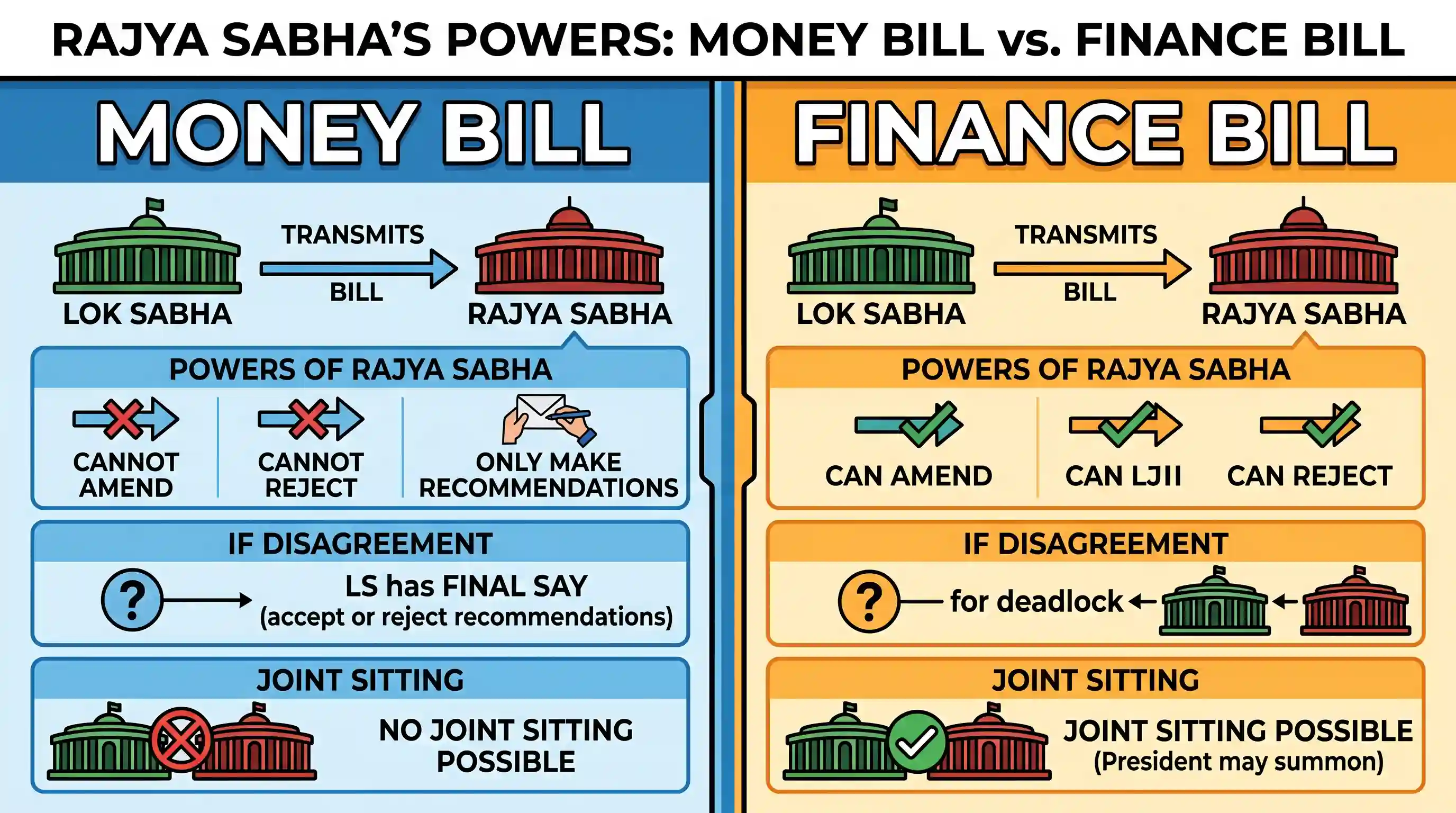
With reference to Finance Bill and Money Bill in the Indian Parliament, consider the following statements: 1. When the Lok Sabha transmits Finance Bill to the Rajya Sabha, it can amend or reject the Bill. 2. When the Lok Sabha transmits Money Bill to the Rajya Sabha, it cannot amend or reject the Bill, it can only make recommendations. 3. In the case of disagreement between the Lok Sabha and the Rajya Sabha, there is no joint sitting for Money Bill, but a joint sitting becomes necessary for Finance Bill. How many of the above statements are correct?

- AOnly one
- BOnly twoCorrect
- CAll three
- DNone
Explanation
Let's analyze each statement regarding Finance Bill and Money Bill:
-
When the Lok Sabha transmits Finance Bill to the Rajya Sabha, it can amend or reject the Bill. This statement is correct. A Finance Bill, which deals with revenue and expenditure, is usually introduced in the Lok Sabha. While some Finance Bills (specifically Finance Bill I under Article 110(1) (a) to (f)) are similar to Money Bills, other Finance Bills (Finance Bill II) are treated as ordinary bills regarding the powers of the Rajya Sabha. For such Finance Bills that are not exclusively Money Bills, the Rajya Sabha has the power to amend or reject them, similar to any ordinary bill.
-
When the Lok Sabha transmits Money Bill to the Rajya Sabha, it cannot amend or reject the Bill, it can only make recommendations. This statement is correct. This is a fundamental difference between Money Bills and other bills. Rajya Sabha has very limited powers over Money Bills; it can only make recommendations which the Lok Sabha may or may not accept. Rajya Sabha cannot reject or amend a Money Bill.
-
In the case of disagreement between the Lok Sabha and the Rajya Sabha, there is no joint sitting for Money Bill, but a joint sitting becomes necessary for Finance Bill. This statement is incorrect. The first part, 'there is no joint sitting for Money Bill', is correct because of the limited powers of the Rajya Sabha over Money Bills. However, the second part, 'a joint sitting becomes necessary for Finance Bill', is incorrect. A joint sitting (under Article 108) is possible for Finance Bills (which are considered ordinary bills in this context if they face a deadlock), but it is not 'necessary' or an automatic outcome in every case of disagreement. The President 'may' summon a joint sitting, it's not a mandatory step for every disagreement.
Therefore, only statements 1 and 2 are correct.
Related questions
More UPSC Prelims practice from the same subject and topic.
- Prelims 2023GS1polity-and-governance
In essence, what does 'Due Process of Law' mean?
- Prelims 2023GS1polity-and-governance
Which one of the following statements best reflects the Chief purpose of the 'Constitution' of a country?
- Prelims 2023GS1polity-and-governance
In India, which one of the following Constitutional Amendments was widely believed to be enacted to overcome the judicial interpretations of the Fundamental Rights?
- Prelims 2023GS1polity-and-governance
Consider the following statements: 1. If the election of the President of India is declared void by the Supreme Court of India, all acts done by him/her in the performance of duties of his/her office …
- Prelims 2023GS1polity-and-governance
Consider the following statements: 1. According to the Constitution of India, the Central Government has a duty to protect States from internal disturbances. 2. The Constitution of India exempts the S…
- Prelims 2023GS1polity-and-governance
Consider the following statements in respect of election to the President of India: 1. The members nominated to either House of the Parliament or the Legislative Assemblies of States are also eligible…