Consider the following statements: 1. If the election of the President of India is declared void by the Supreme Court of India, all acts done by him/her in the performance of duties of his/her office of President before the date of decision become invalid. 2. Election for the post of the President of India can be postponed on the ground that some Legislative Assemblies have been dissolved and elections are yet to take place. 3. When a Bill is presented to the President of India, the Constitution prescribes time limits within which he/she has to declare his/her assent. How many of the above statements are correct?

- AOnly one
- BOnly two
- CAll three
- DNoneCorrect
Explanation
Let's analyze each statement regarding the President of India:
-
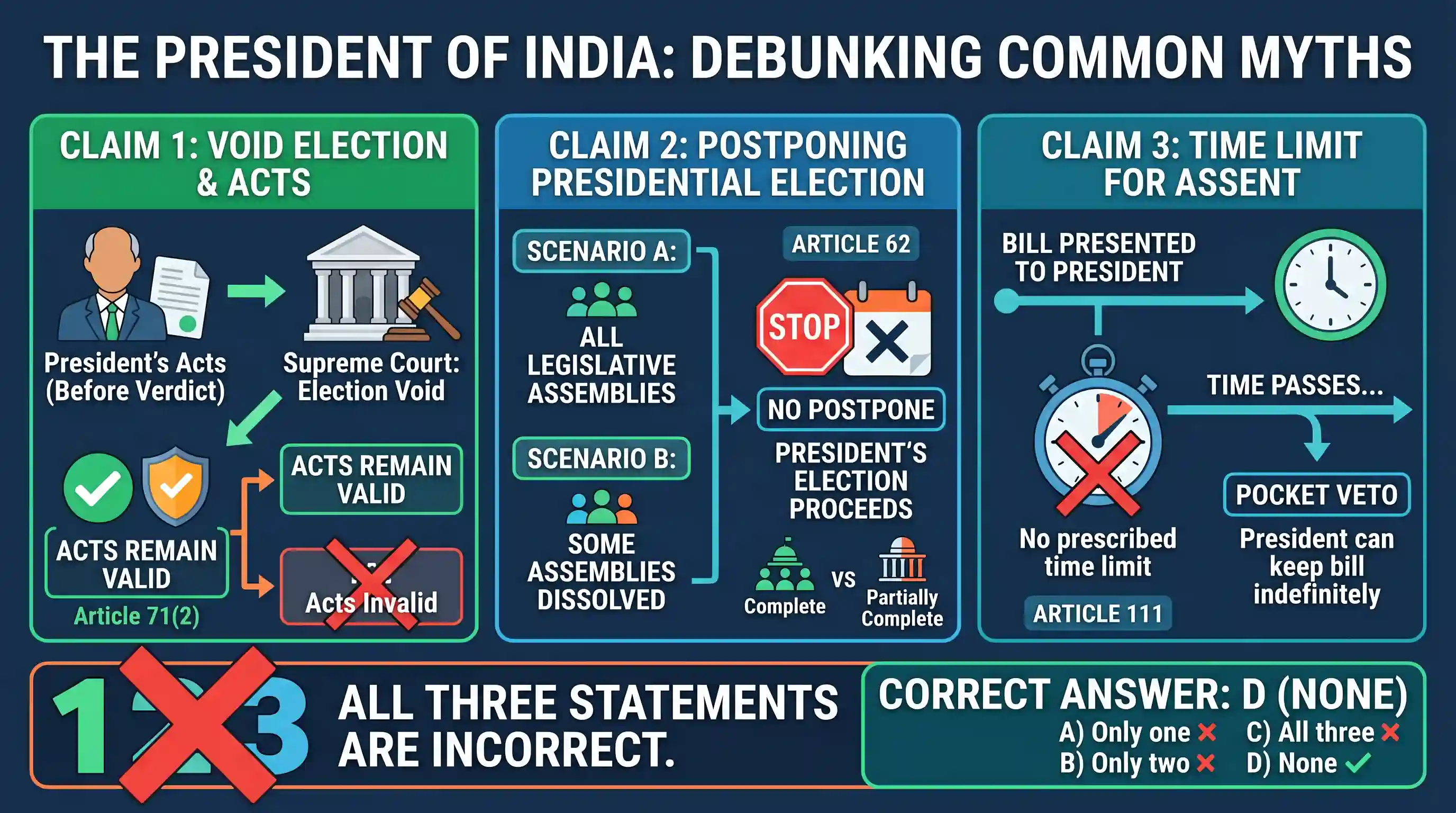
If the election of the President of India is declared void by the Supreme Court of India, all acts done by him/her in the performance of duties of his/her office of President before the date of decision become invalid. This statement is incorrect. Article 71(2) of the Constitution explicitly states that acts done by the President or Vice-President in the exercise of their powers and duties of office, before the date of the decision of the Supreme Court declaring their election to be void, shall not be invalidated by reason of that declaration.
-
Election for the post of the President of India can be postponed on the ground that some Legislative Assemblies have been dissolved and elections are yet to take place. This statement is incorrect. The election of the President cannot be postponed or challenged on the ground that some legislative assemblies are dissolved. The electoral college is deemed complete for the purpose of the election, and the election must be held within the prescribed time frame (Article 62).
-
When a Bill is presented to the President of India, the Constitution prescribes time limits within which he/she has to declare his/her assent. This statement is incorrect. Unlike some other constitutions (e.g., USA), the Indian Constitution does not prescribe any time limit within which the President must give assent to a bill. This allows the President to exercise a 'pocket veto' by simply keeping a bill pending indefinitely.
Since all three statements are incorrect, the correct answer is 'None'.
Related questions
More UPSC Prelims practice from the same subject and topic.
- Prelims 2023GS1polity-and-governance
In essence, what does 'Due Process of Law' mean?
- Prelims 2023GS1polity-and-governance
Which one of the following statements best reflects the Chief purpose of the 'Constitution' of a country?
- Prelims 2023GS1polity-and-governance
In India, which one of the following Constitutional Amendments was widely believed to be enacted to overcome the judicial interpretations of the Fundamental Rights?
- Prelims 2023GS1polity-and-governance
With reference to Finance Bill and Money Bill in the Indian Parliament, consider the following statements: 1. When the Lok Sabha transmits Finance Bill to the Rajya Sabha, it can amend or reject the B…
- Prelims 2023GS1polity-and-governance
Consider the following statements: 1. According to the Constitution of India, the Central Government has a duty to protect States from internal disturbances. 2. The Constitution of India exempts the S…
- Prelims 2023GS1polity-and-governance
Consider the following statements in respect of election to the President of India: 1. The members nominated to either House of the Parliament or the Legislative Assemblies of States are also eligible…