Consider the following statements: 1. According to the Constitution of India, the Central Government has a duty to protect States from internal disturbances. 2. The Constitution of India exempts the States from providing legal counsel to a person being held for preventive detention. 3. According to the Prevention of Terrorism Act, 2002, confession of the accused before the police cannot be used as evidence. How many of the above statements are correct?

- AOnly one
- BOnly twoCorrect
- CAll three
- DNone
Explanation
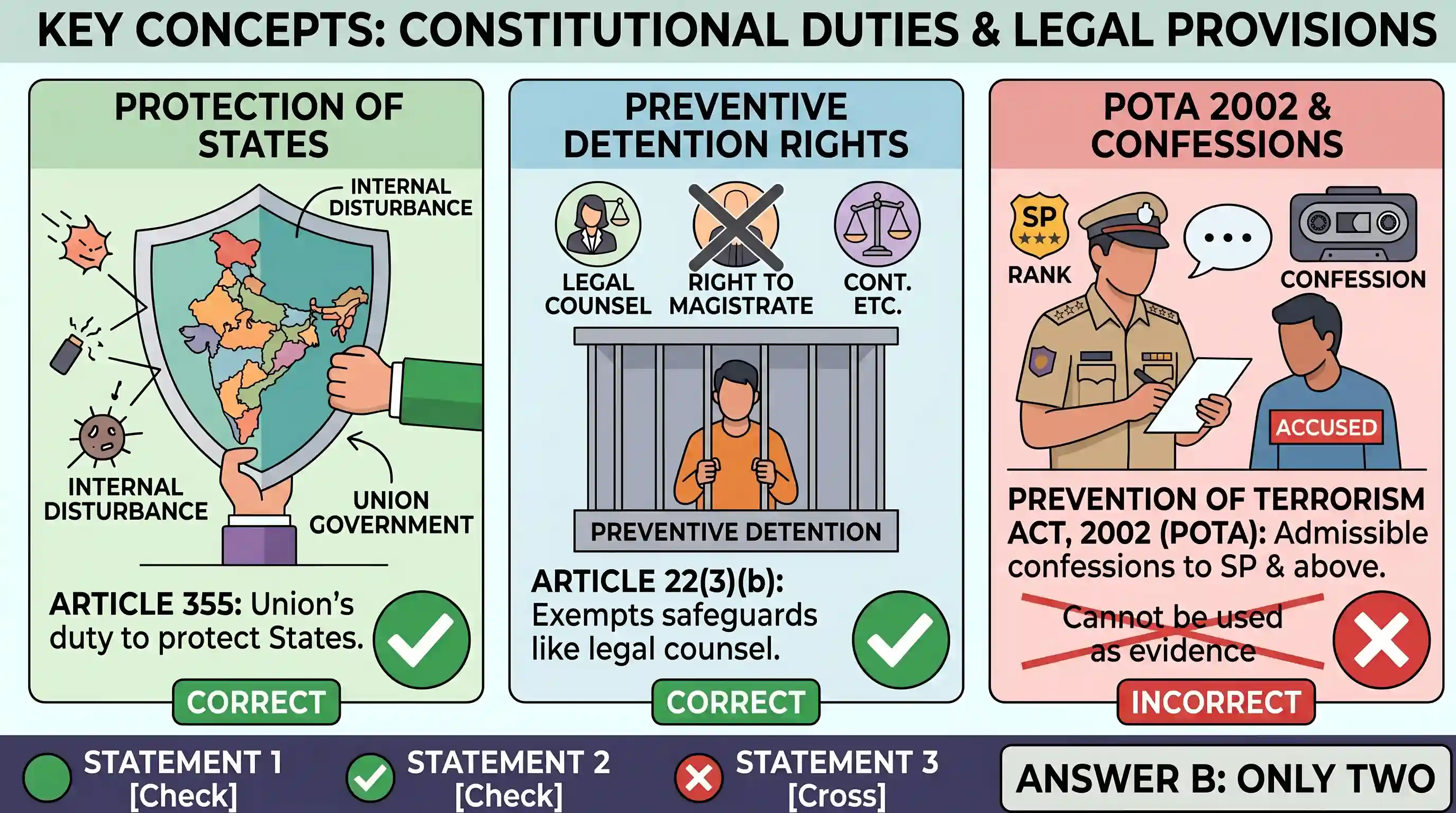
Statement 1 is correct. Article 355 of the Constitution of India states that it shall be the duty of the Union to protect every State against external aggression and internal disturbance.
Statement 2 is correct. Article 22(3)(b) of the Constitution exempts persons arrested under preventive detention laws from certain protections, including the right to consult and be defended by a legal practitioner. States are not required to provide legal counsel for preventive detention cases.
Statement 3 is incorrect. While POTA 2002 (Prevention of Terrorism Act) did contain provisions regarding confessions, it allowed confessions made before police officers of Superintendent of Police (SP) rank and above to be admissible as evidence — which was itself a controversial departure from normal evidence law. The statement as framed in the question contains inaccuracies.
Therefore, two statements (1 and 2) are correct.
Related questions
More UPSC Prelims practice from the same subject and topic.
- Prelims 2023GS1polity-and-governance
In essence, what does 'Due Process of Law' mean?
- Prelims 2023GS1polity-and-governance
Which one of the following statements best reflects the Chief purpose of the 'Constitution' of a country?
- Prelims 2023GS1polity-and-governance
In India, which one of the following Constitutional Amendments was widely believed to be enacted to overcome the judicial interpretations of the Fundamental Rights?
- Prelims 2023GS1polity-and-governance
Consider the following statements: 1. If the election of the President of India is declared void by the Supreme Court of India, all acts done by him/her in the performance of duties of his/her office …
- Prelims 2023GS1polity-and-governance
With reference to Finance Bill and Money Bill in the Indian Parliament, consider the following statements: 1. When the Lok Sabha transmits Finance Bill to the Rajya Sabha, it can amend or reject the B…
- Prelims 2023GS1polity-and-governance
Consider the following statements in respect of election to the President of India: 1. The members nominated to either House of the Parliament or the Legislative Assemblies of States are also eligible…